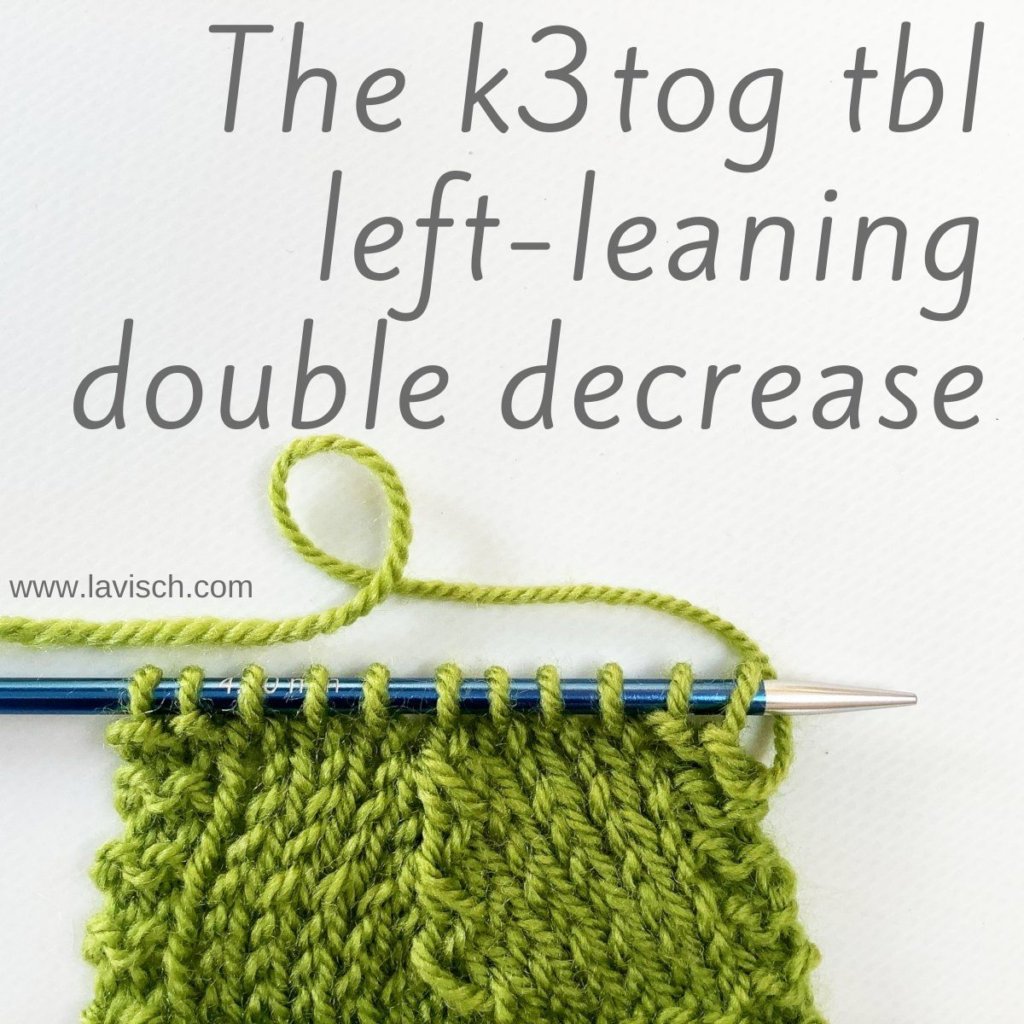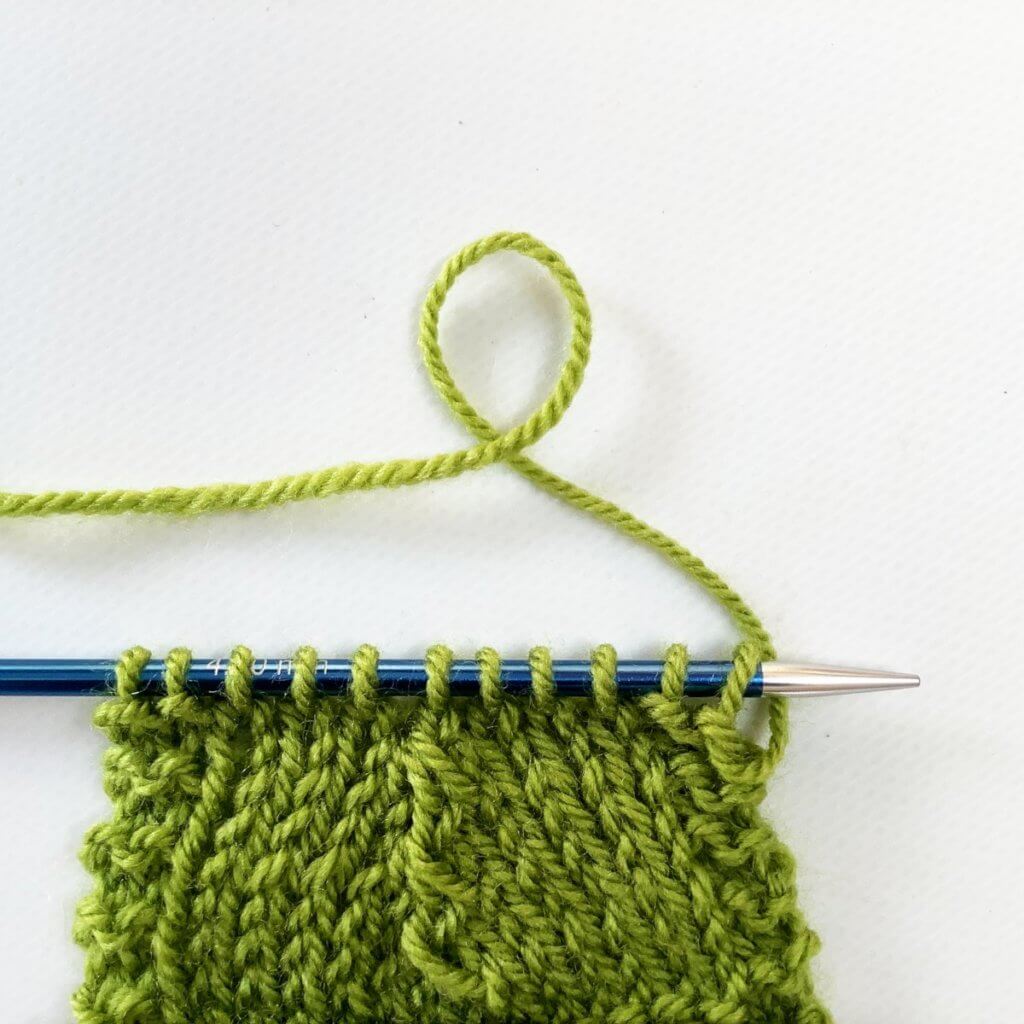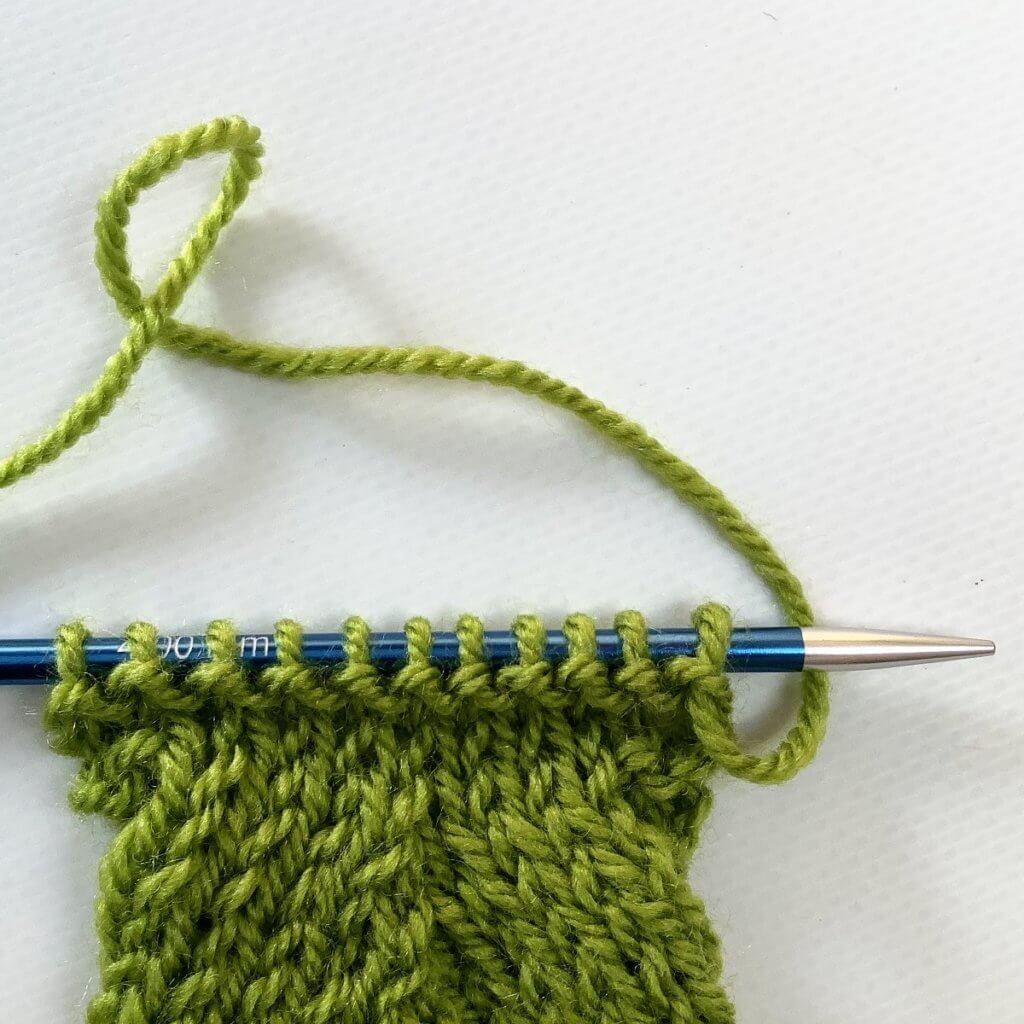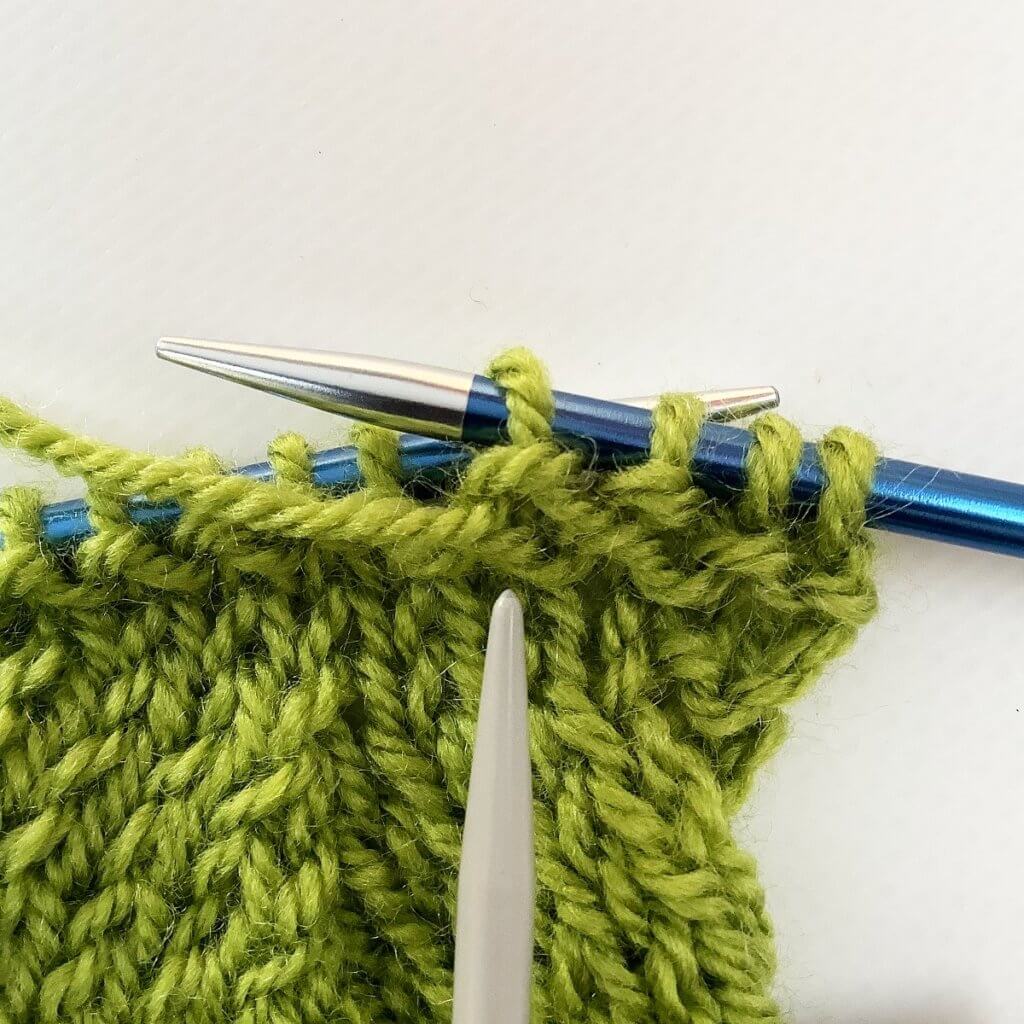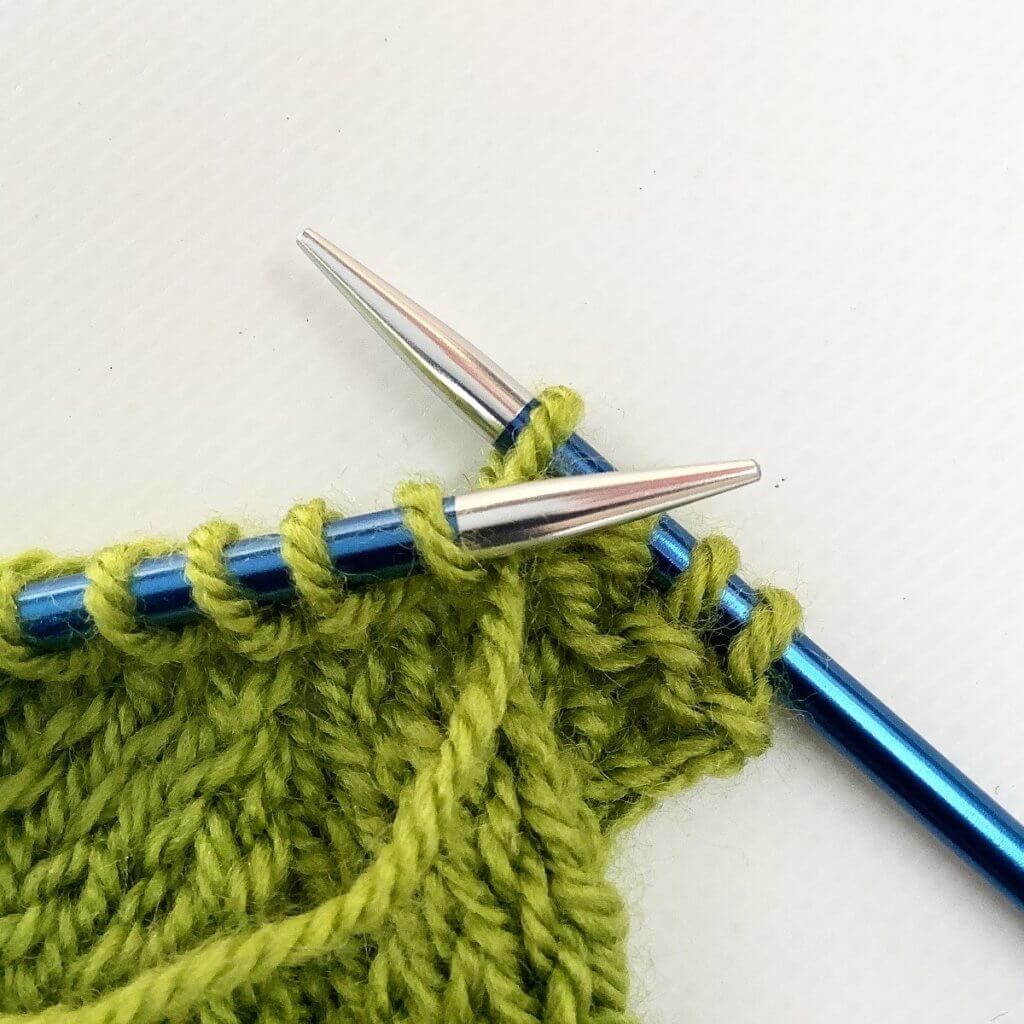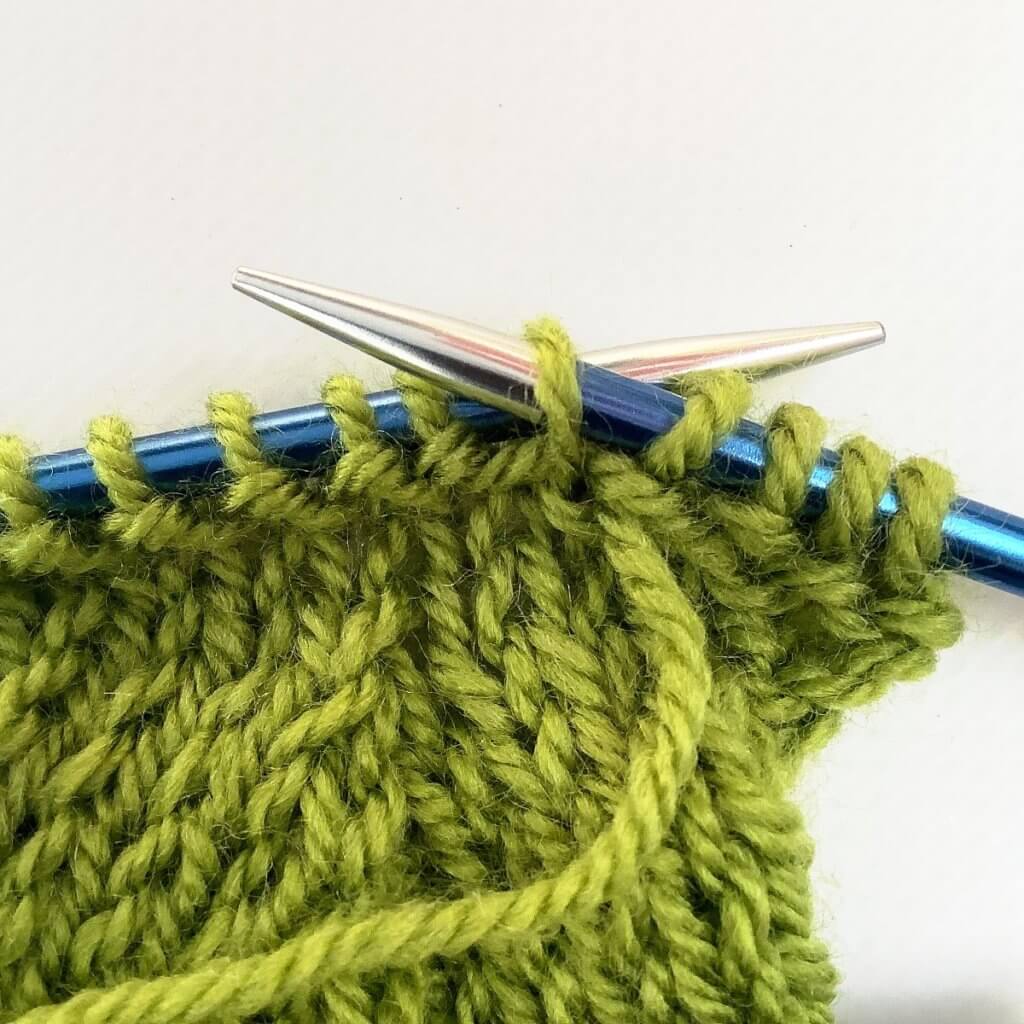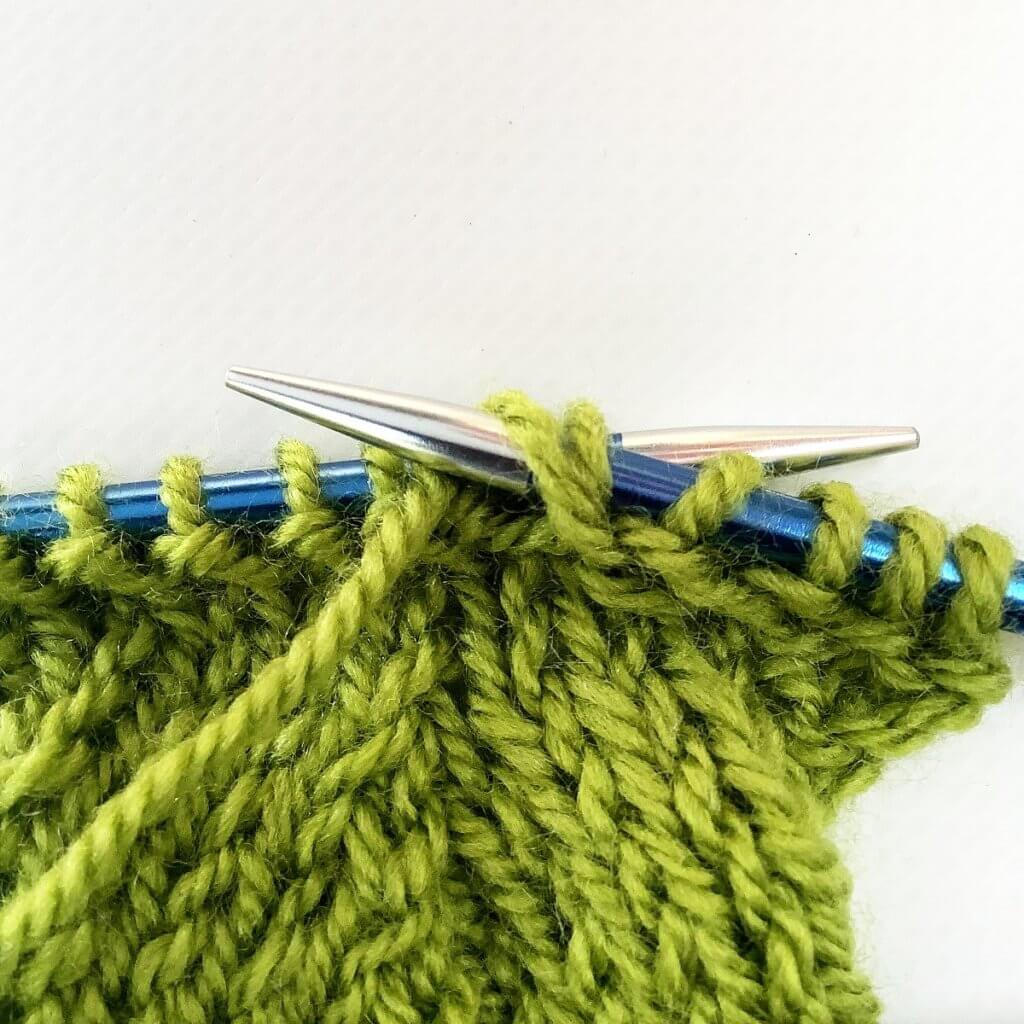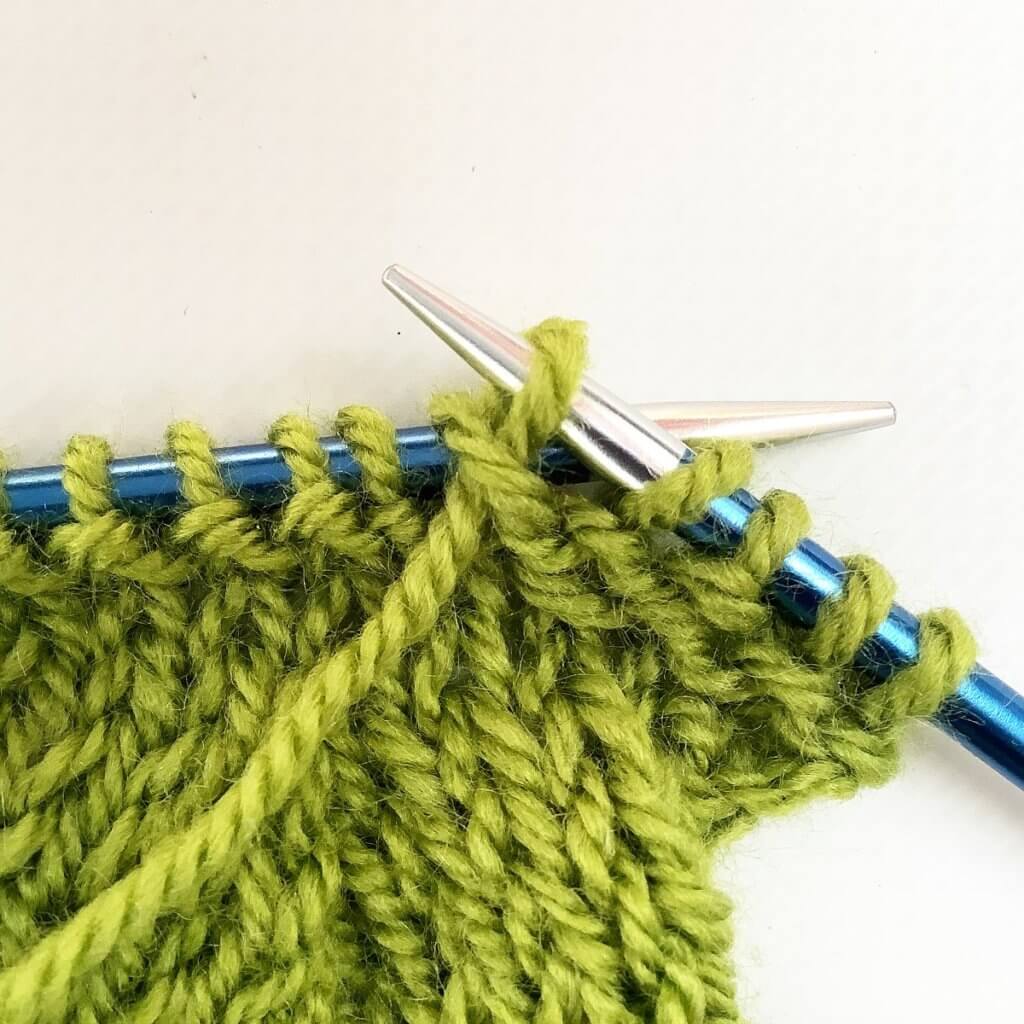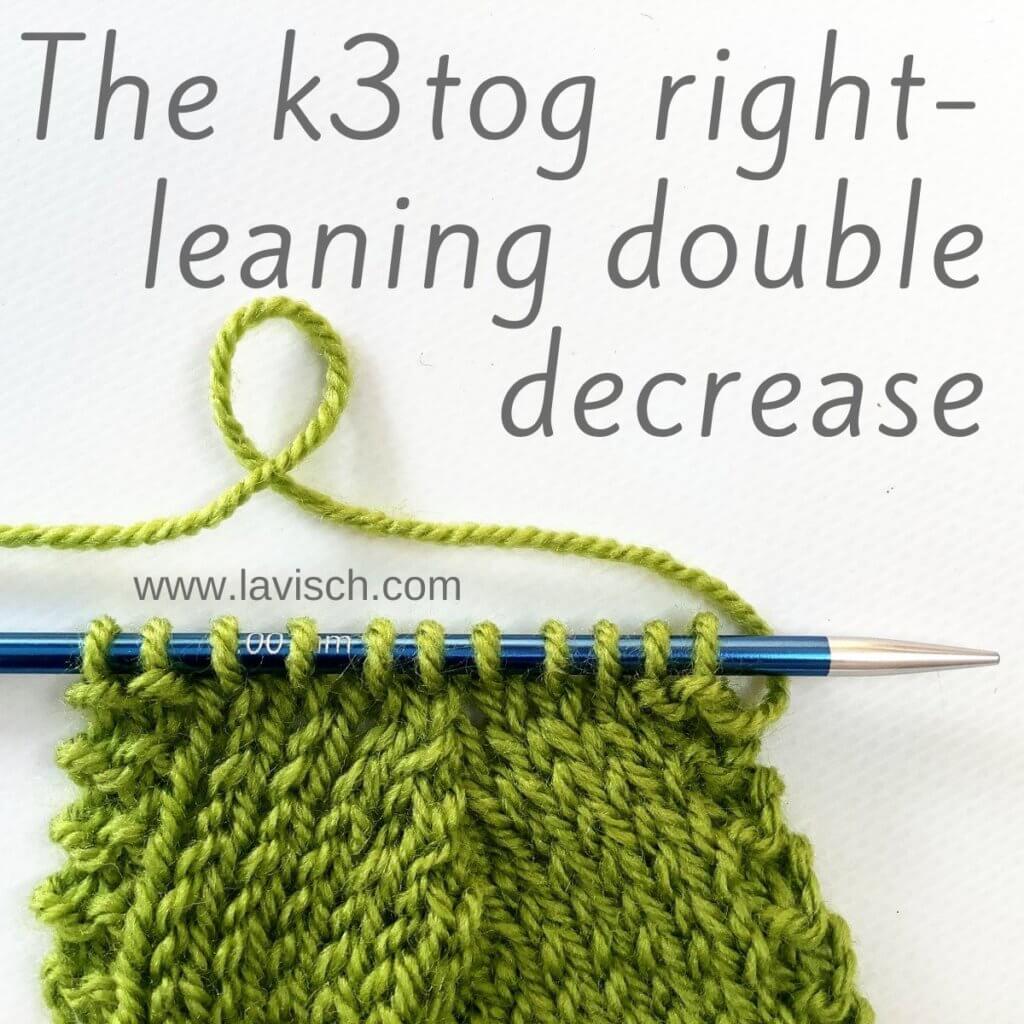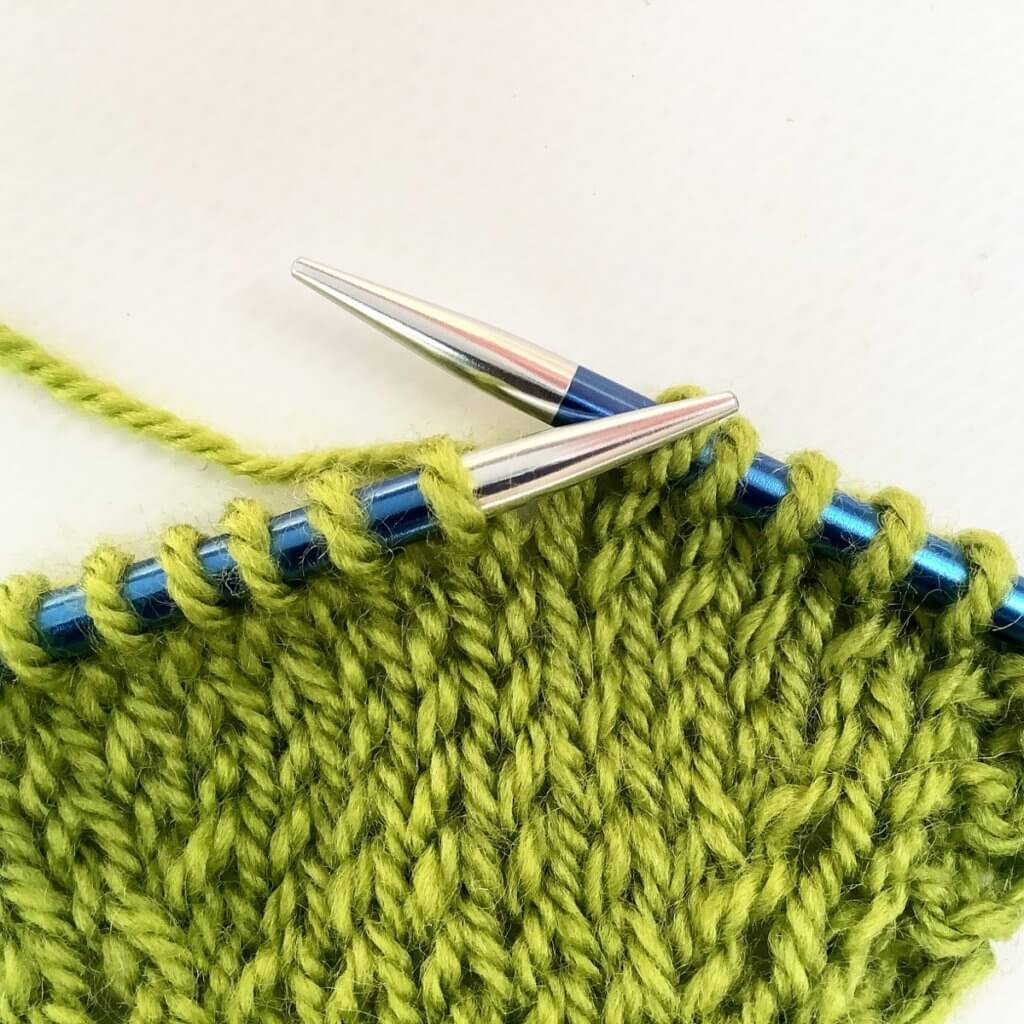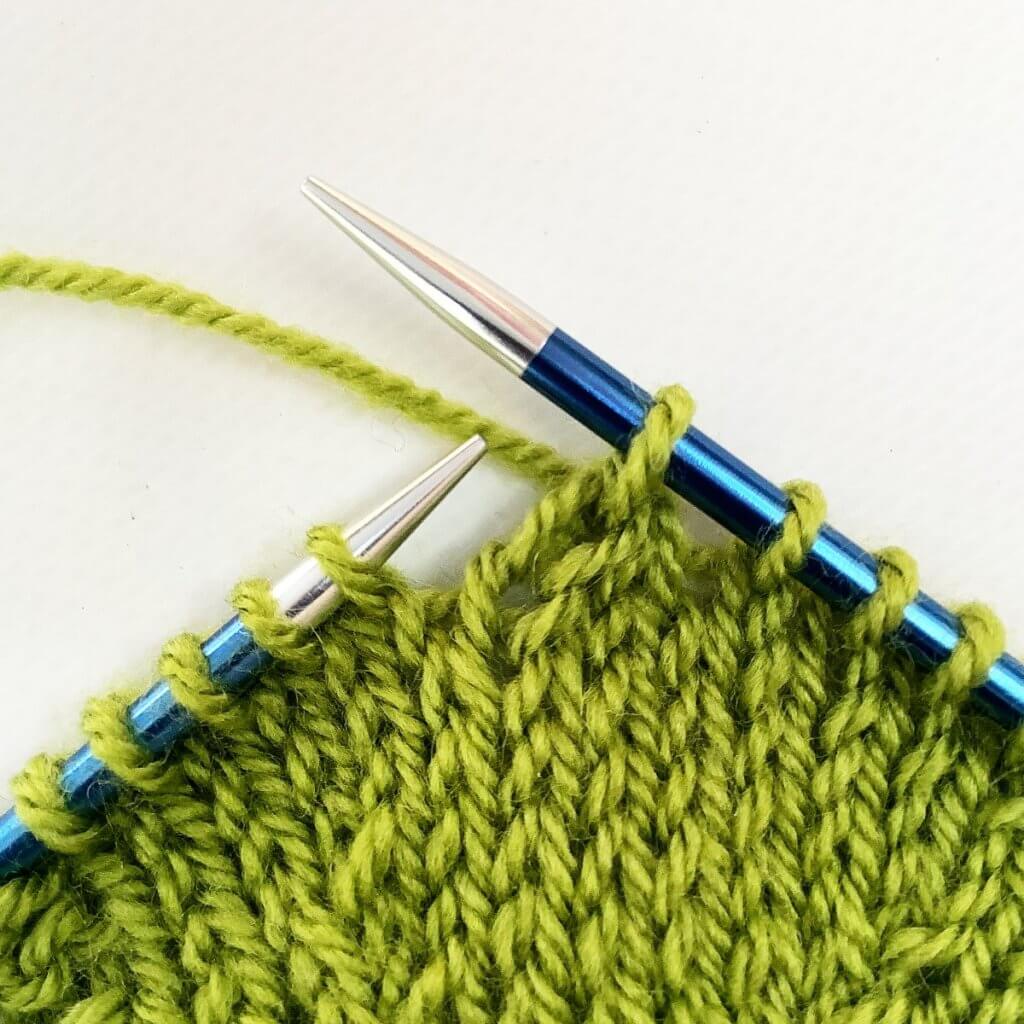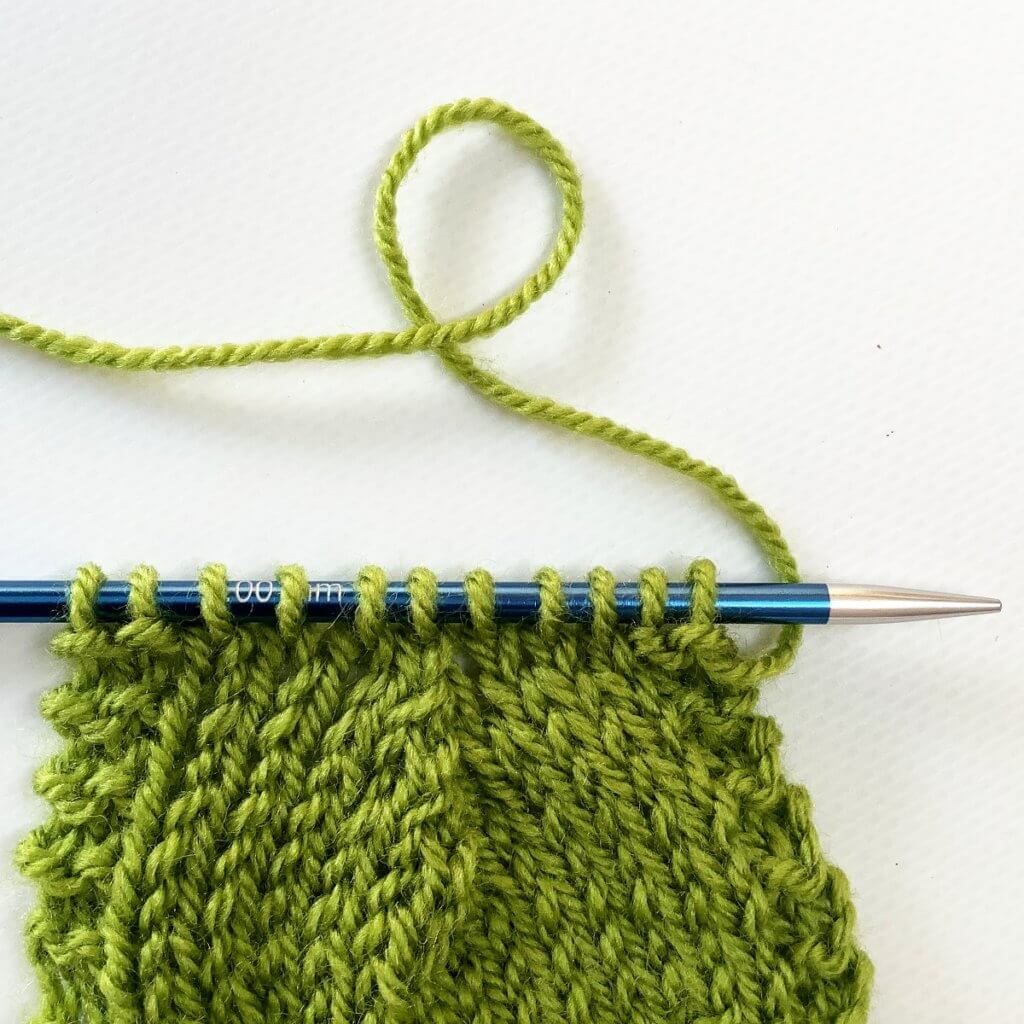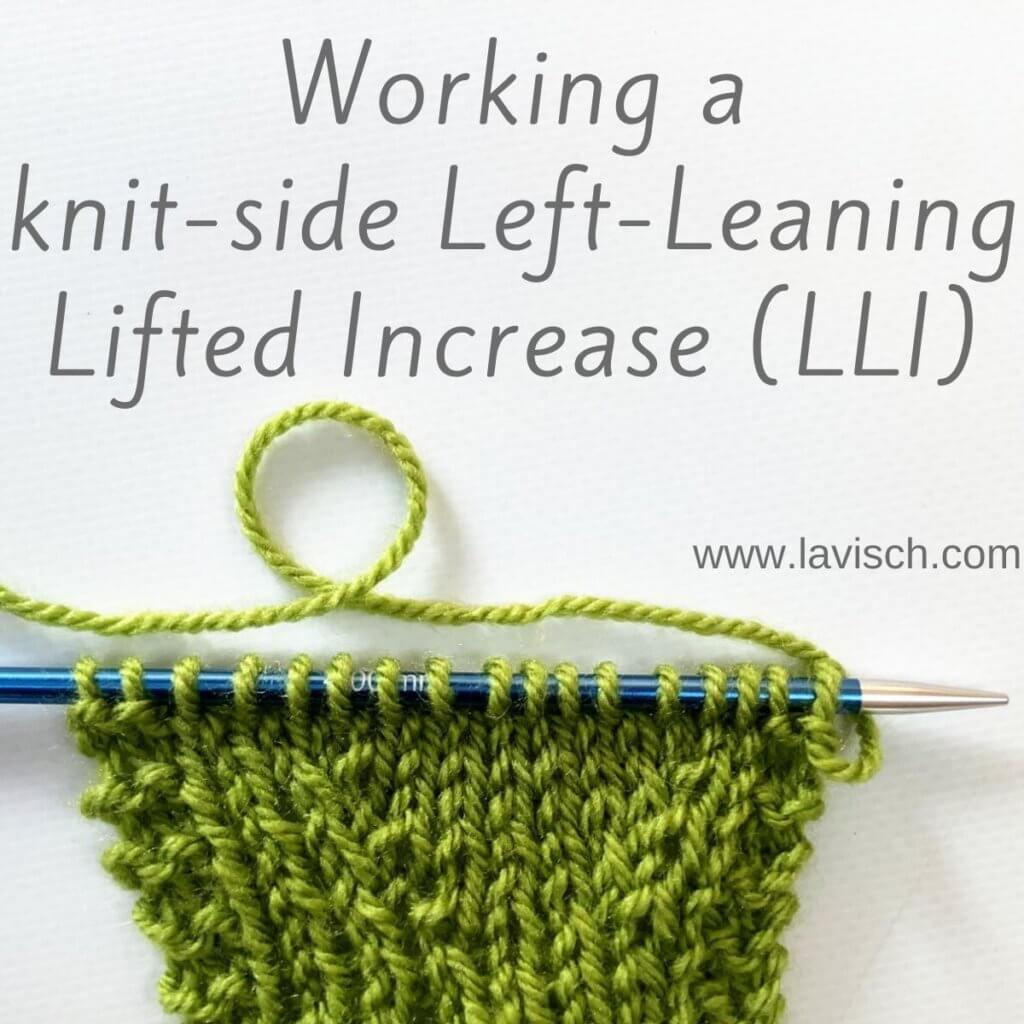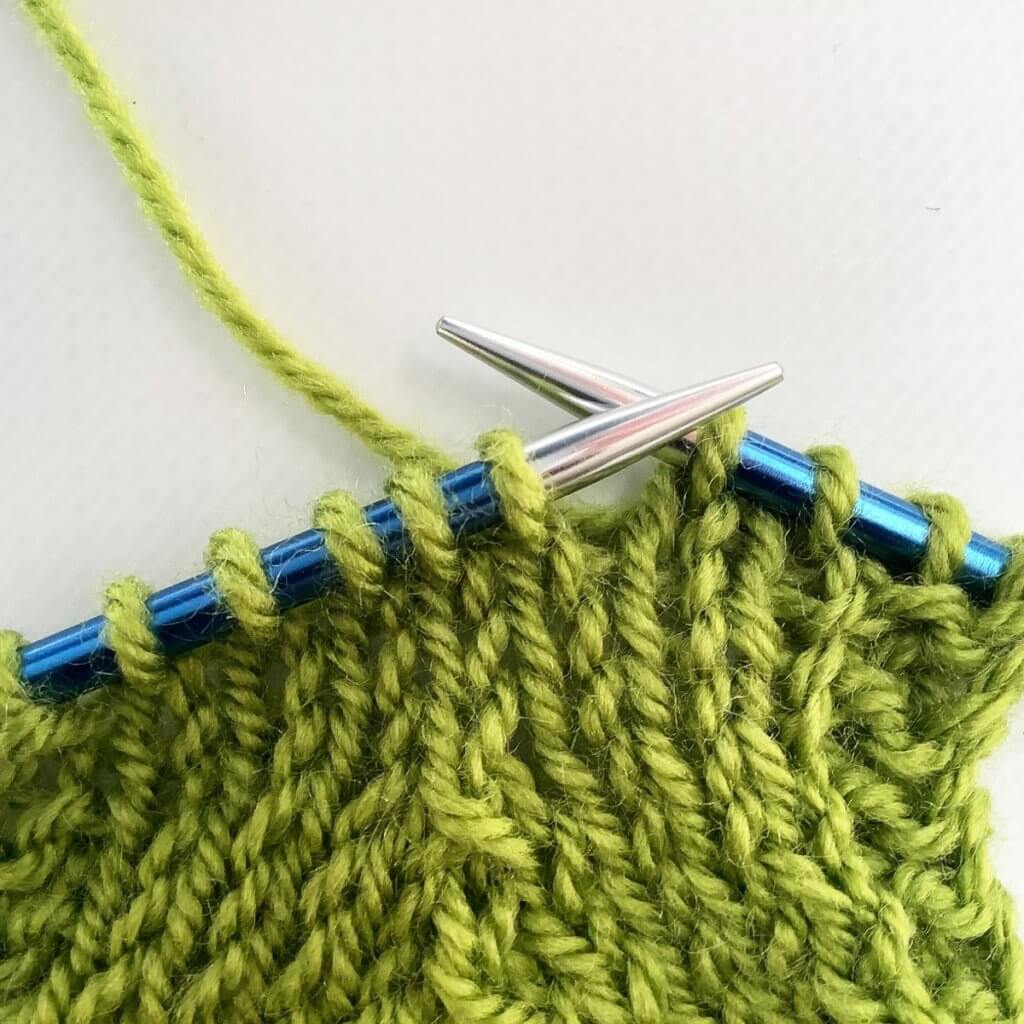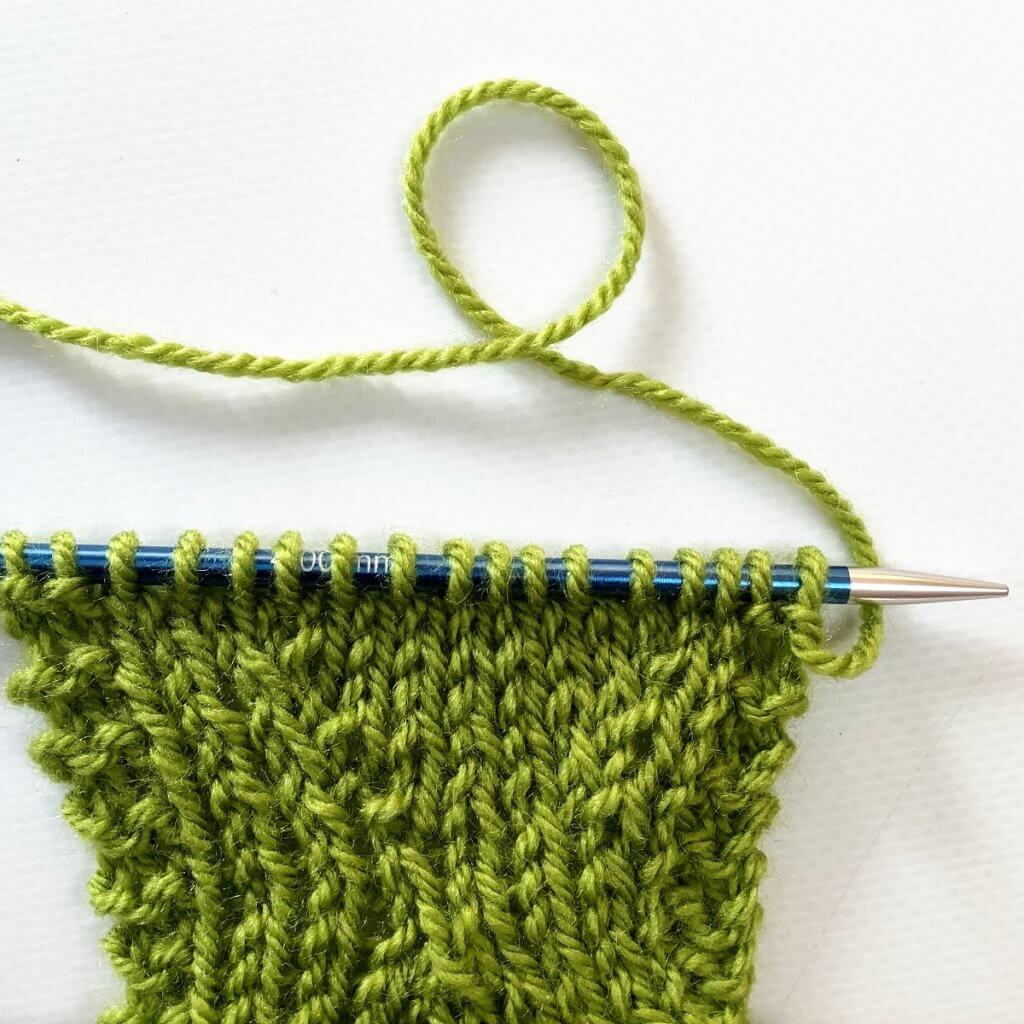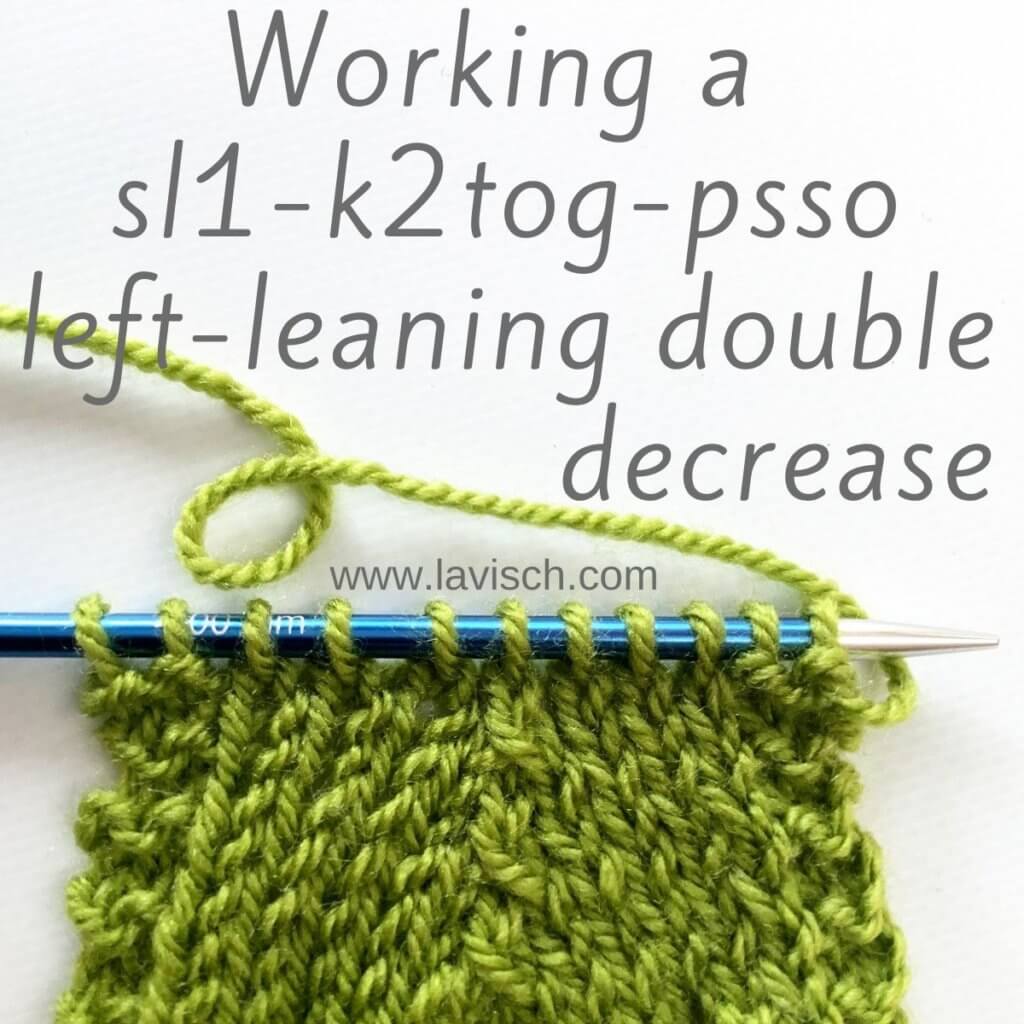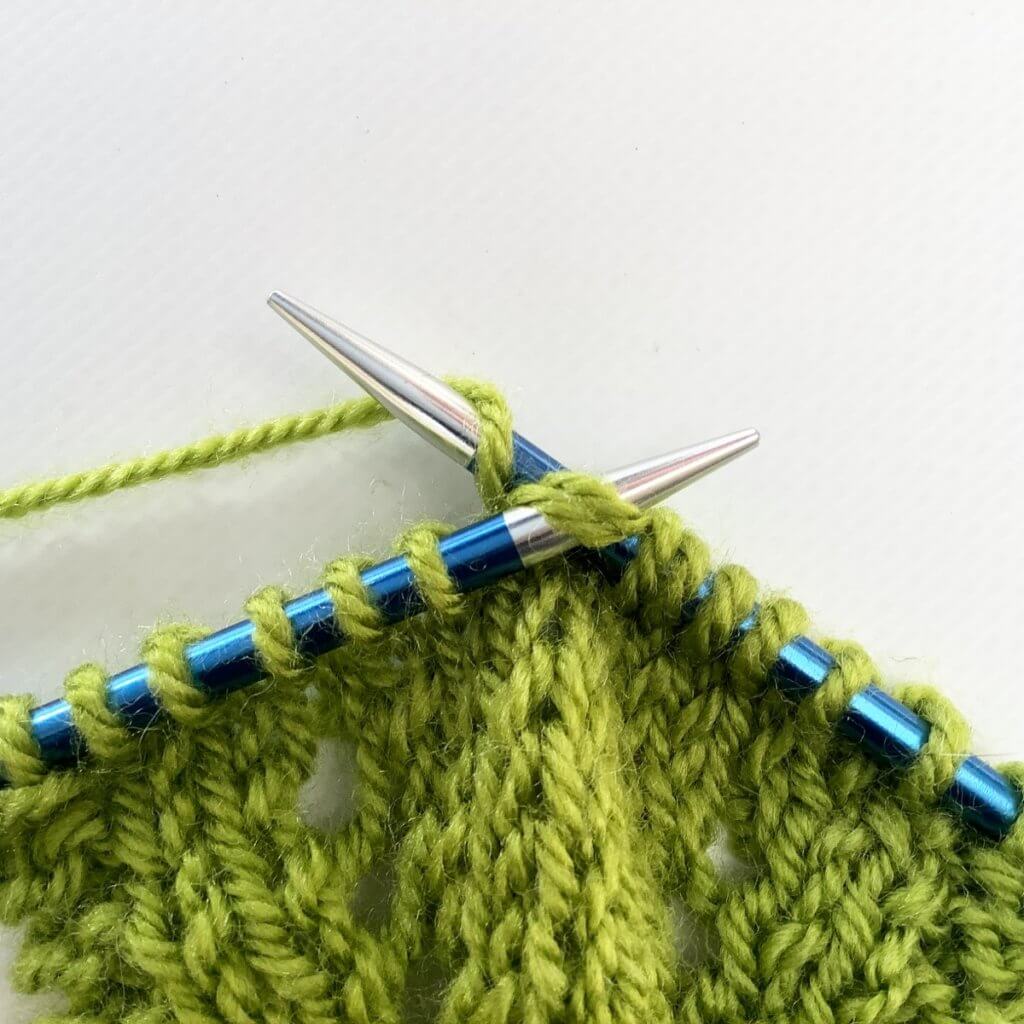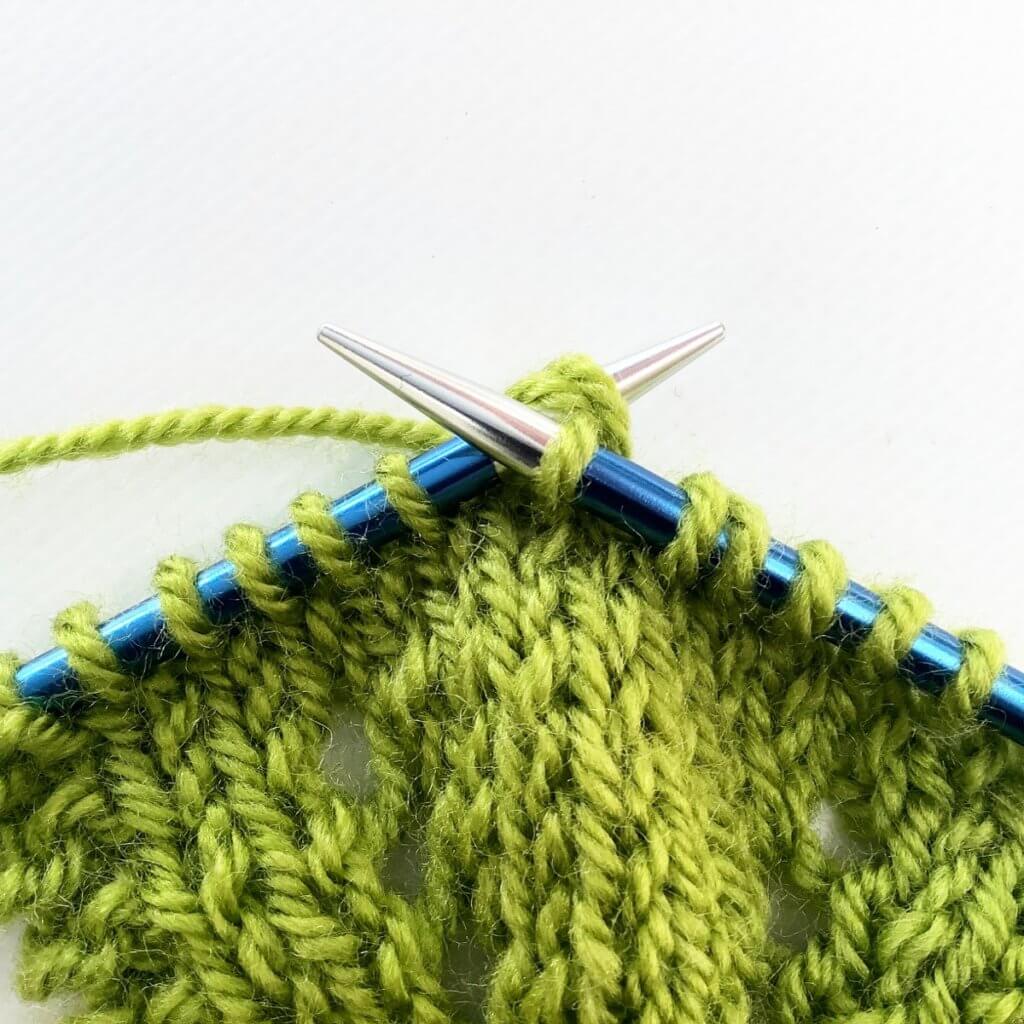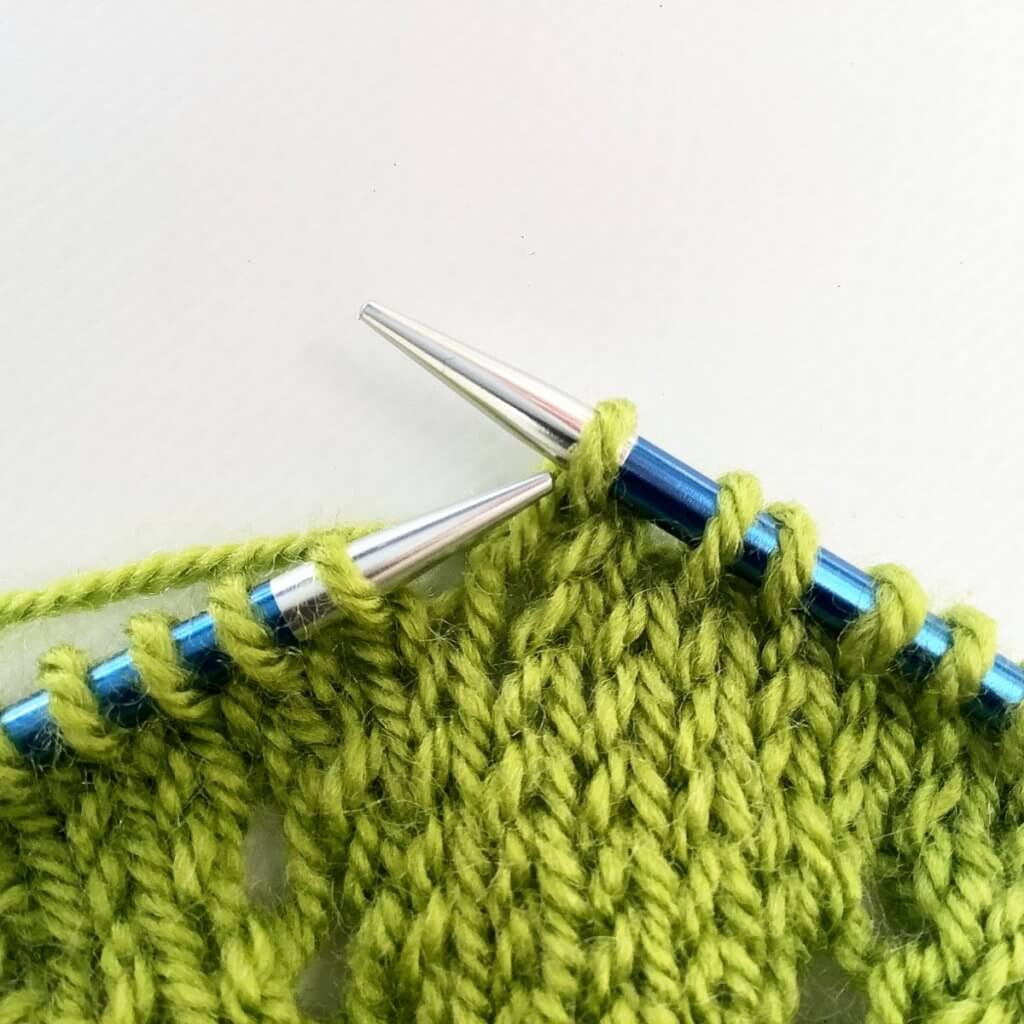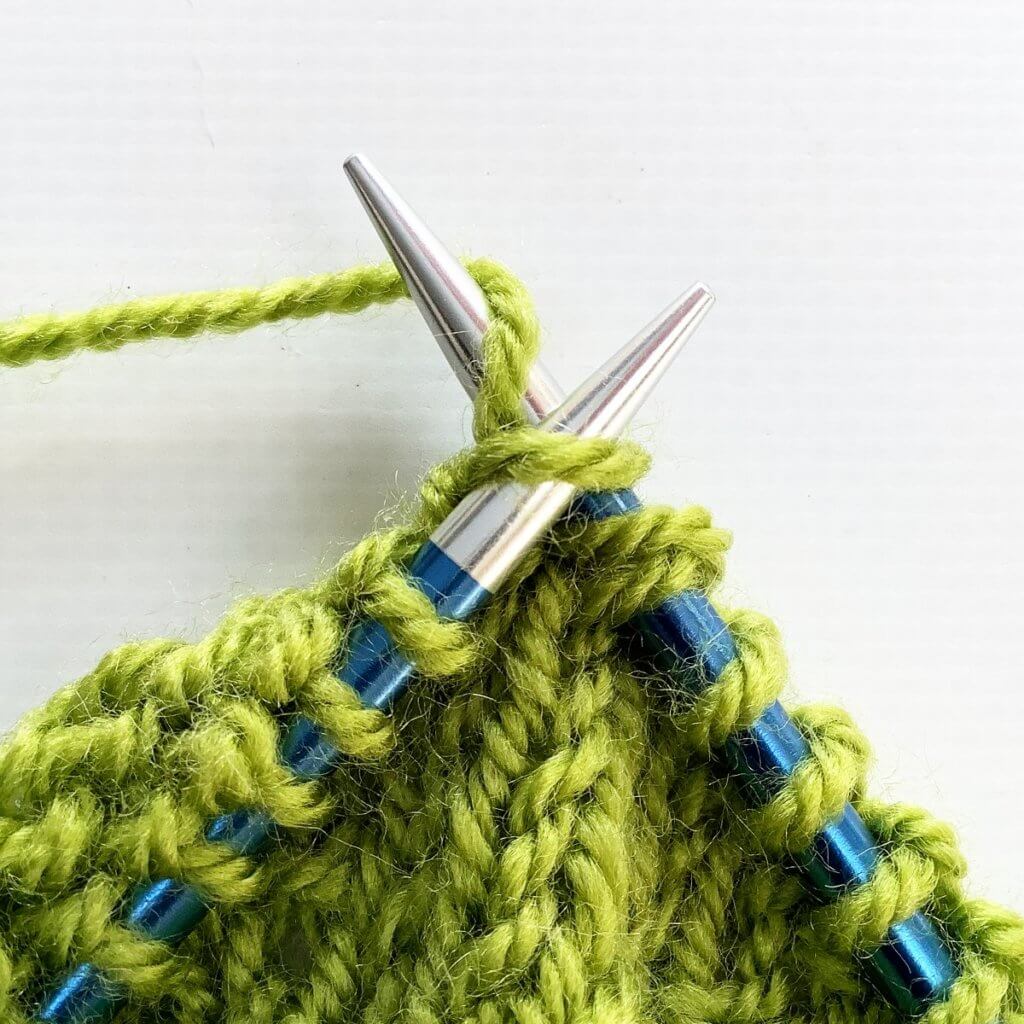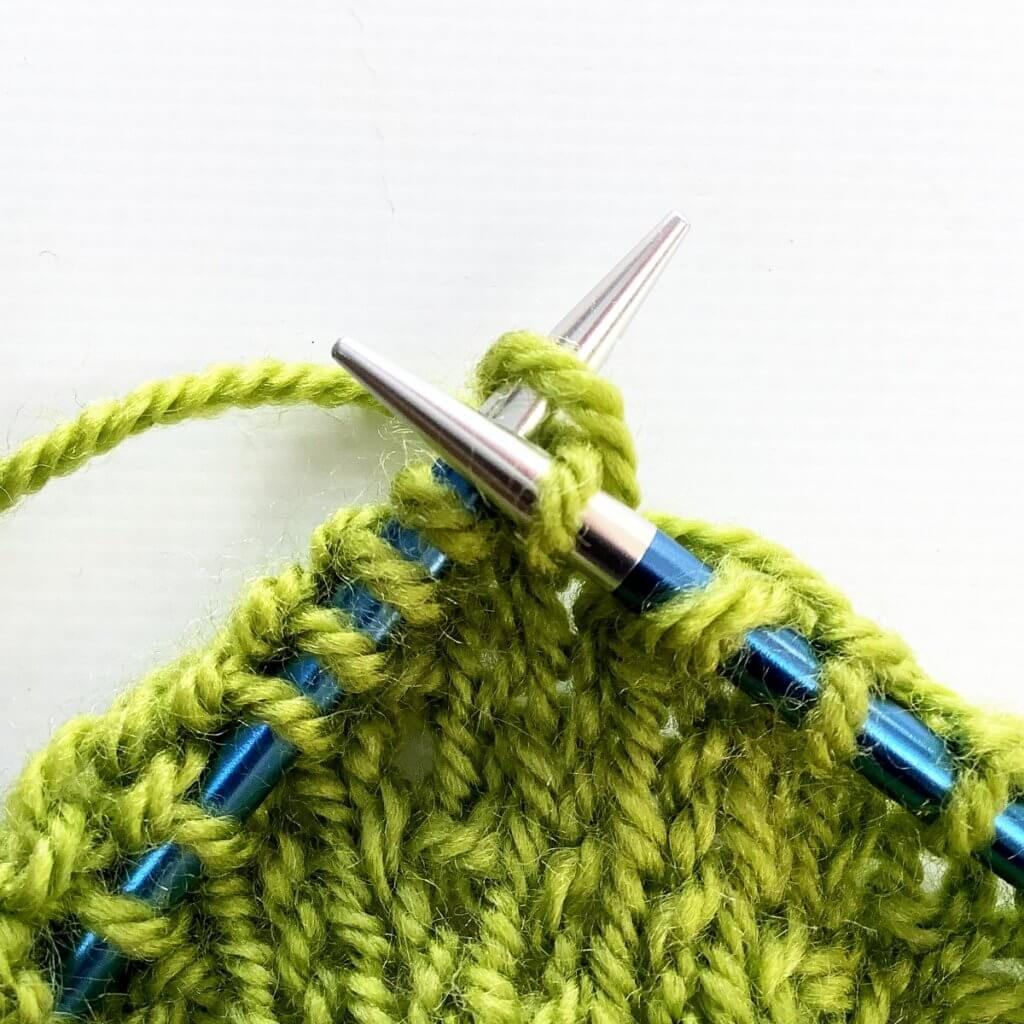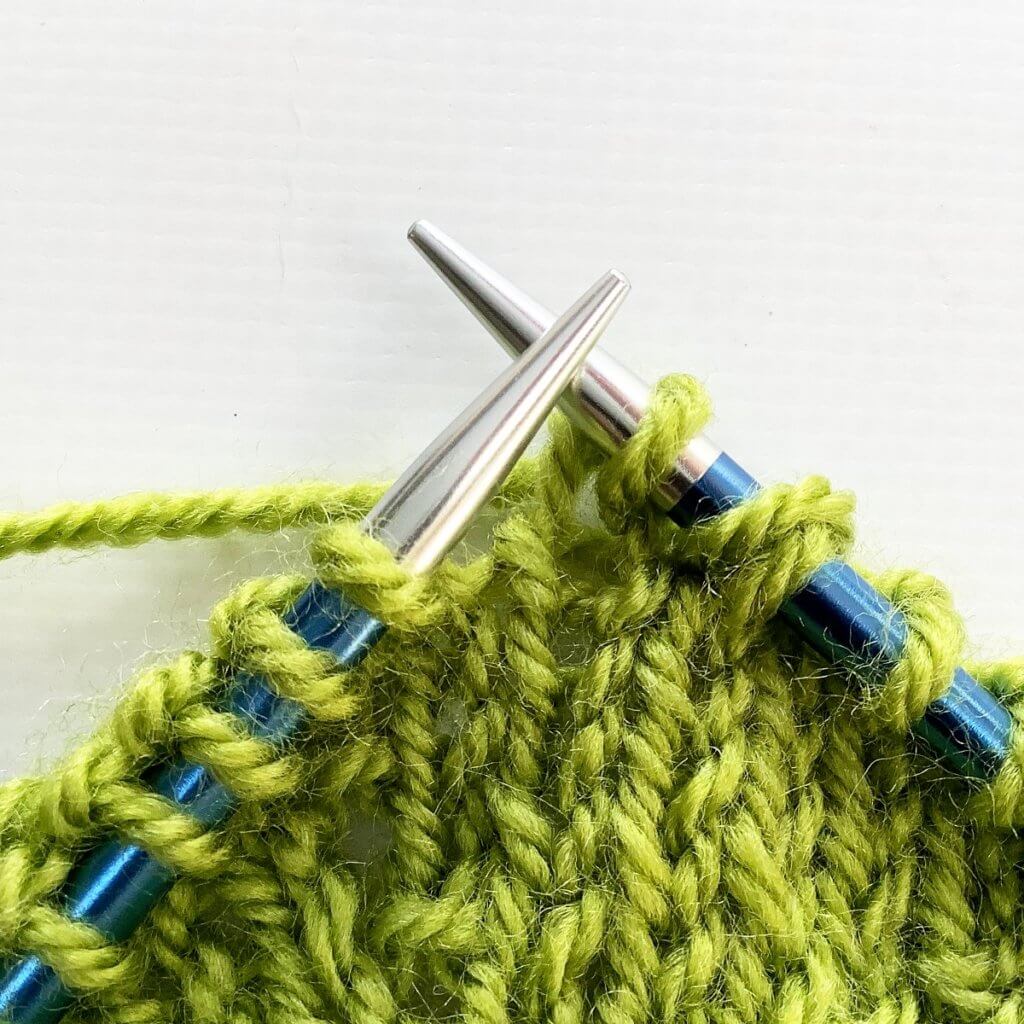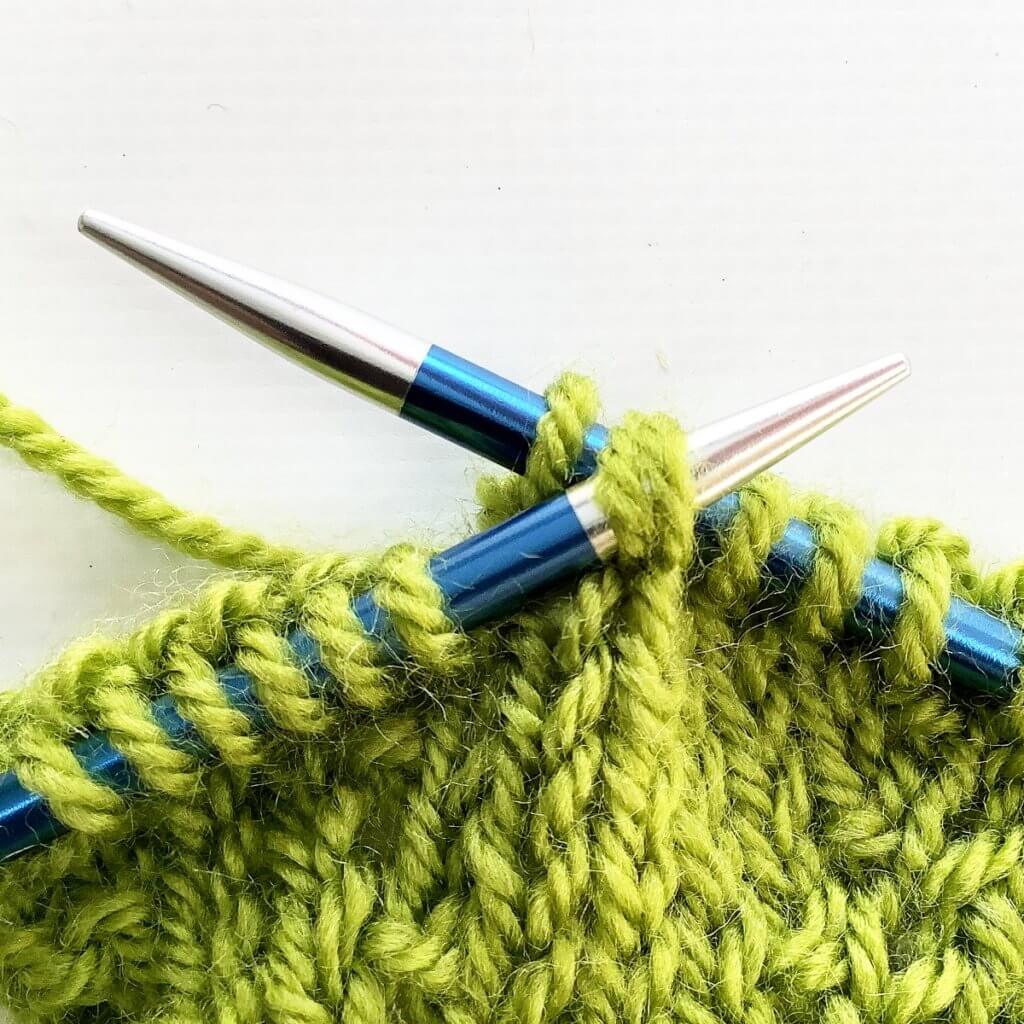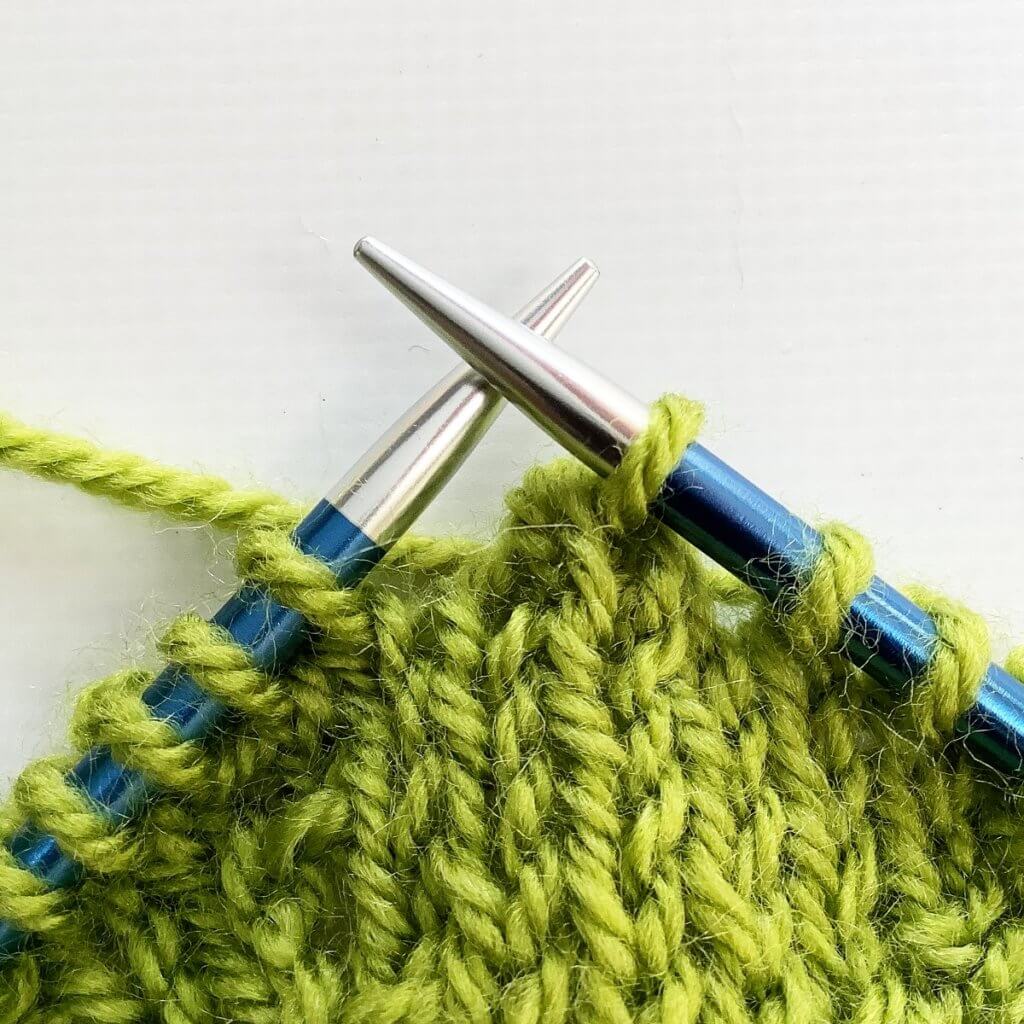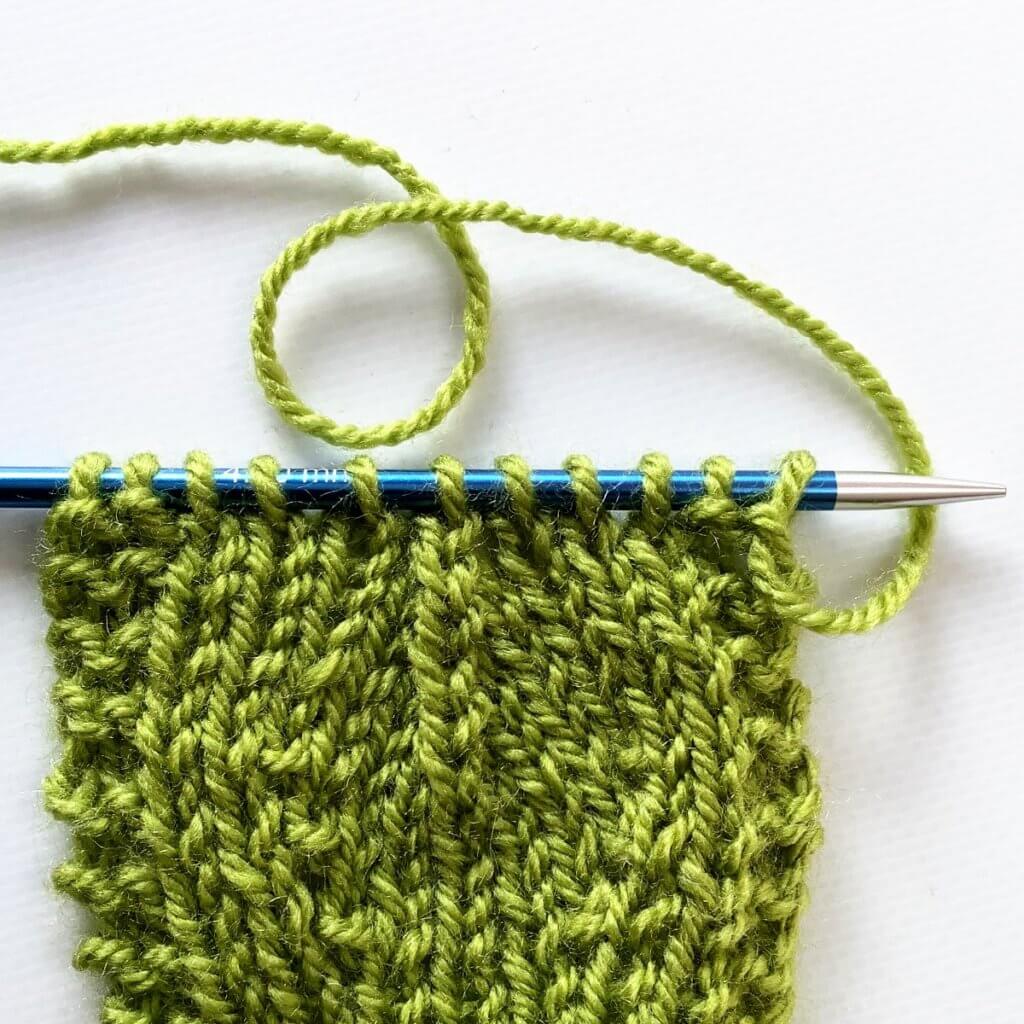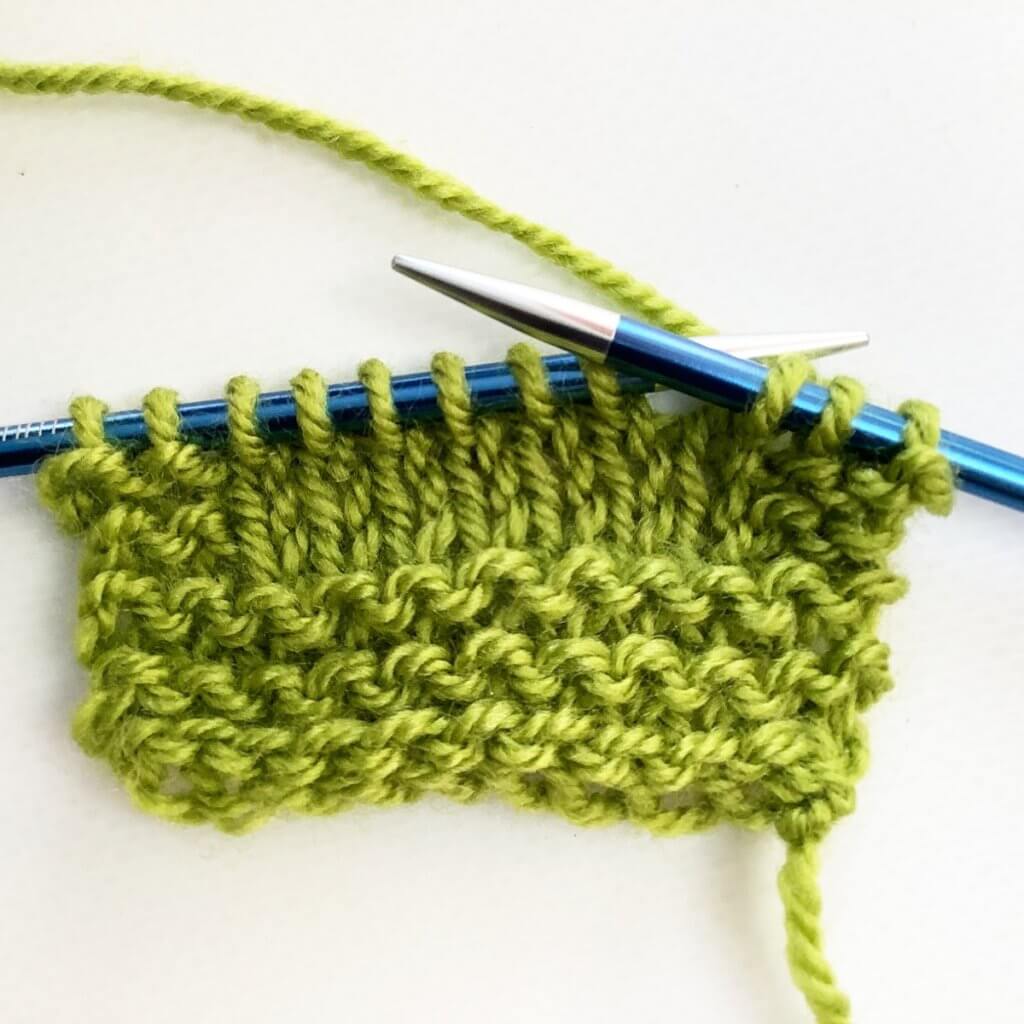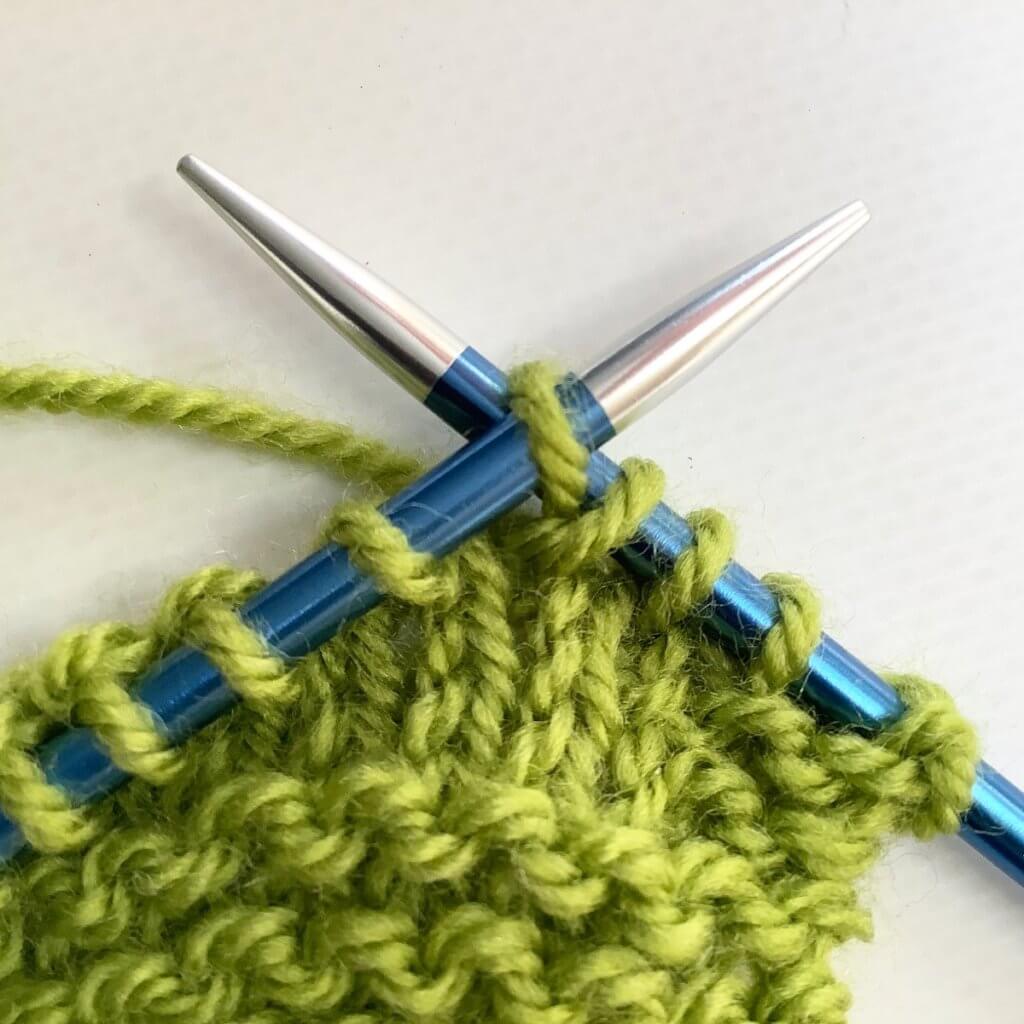
The double decrease as shown in this tutorial reduces 3 stitches down to 1 stitch in a left-leaning way. The sl1-k2tog-psso abbreviation is short for “slip 1 st, knit 2 stitches together, pass the slipped stitch over the knit-together stitches”. You may however also encounter SK2P as an abbreviation for this decrease.
As you may already expect, there are 3 main steps in working this double decrease: sl1, k2tog, and psso. Read on to see how it’s worked.
Materials
Yarn: * Paintbox Yarns Simply DK, a good value, good quality 100% acrylic yarn, here in the color 128 Lime Green.
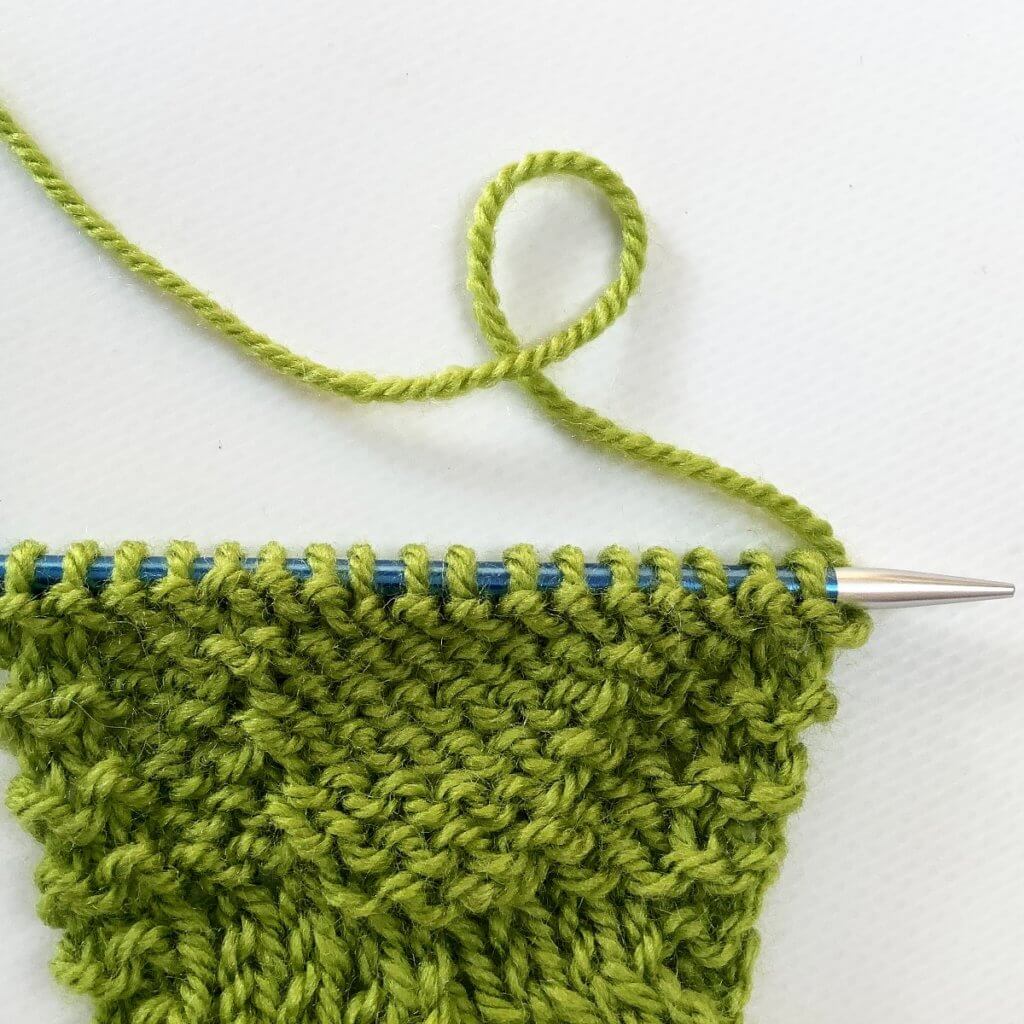
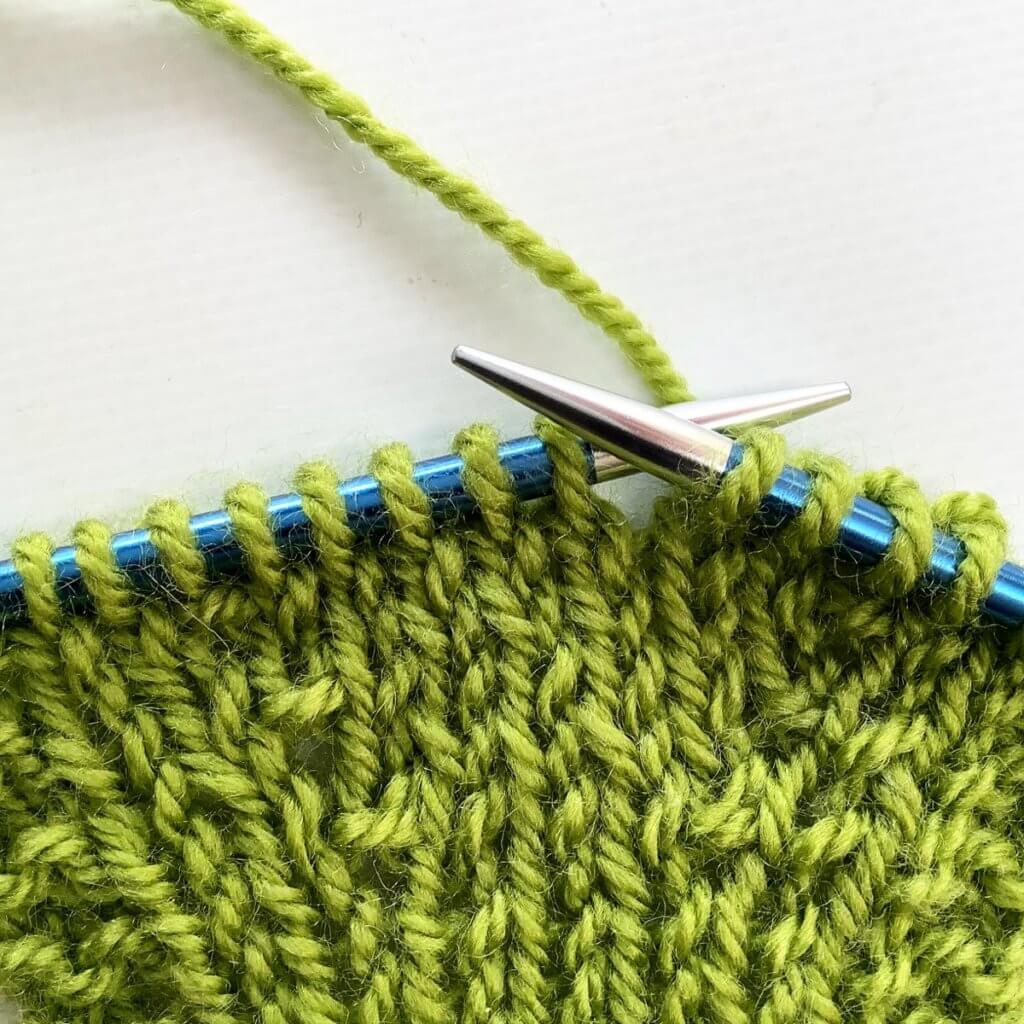
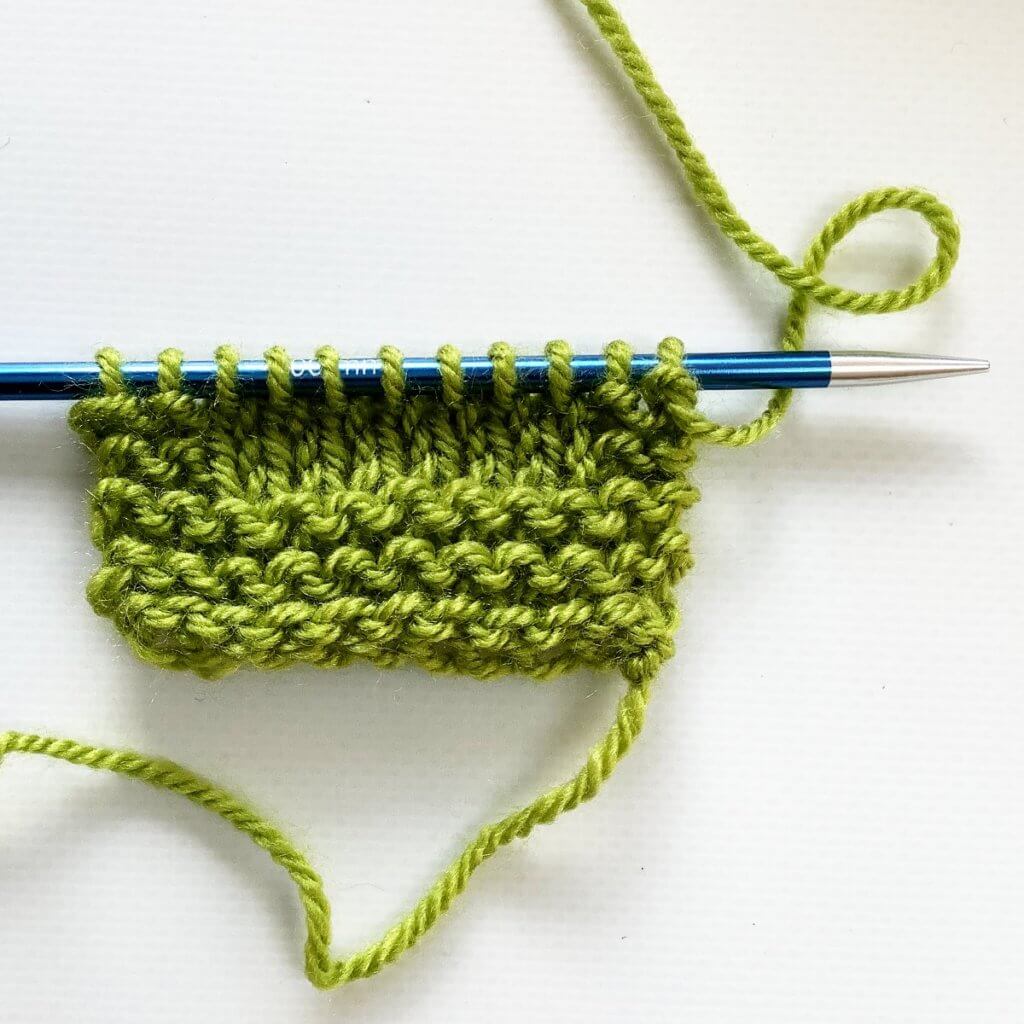
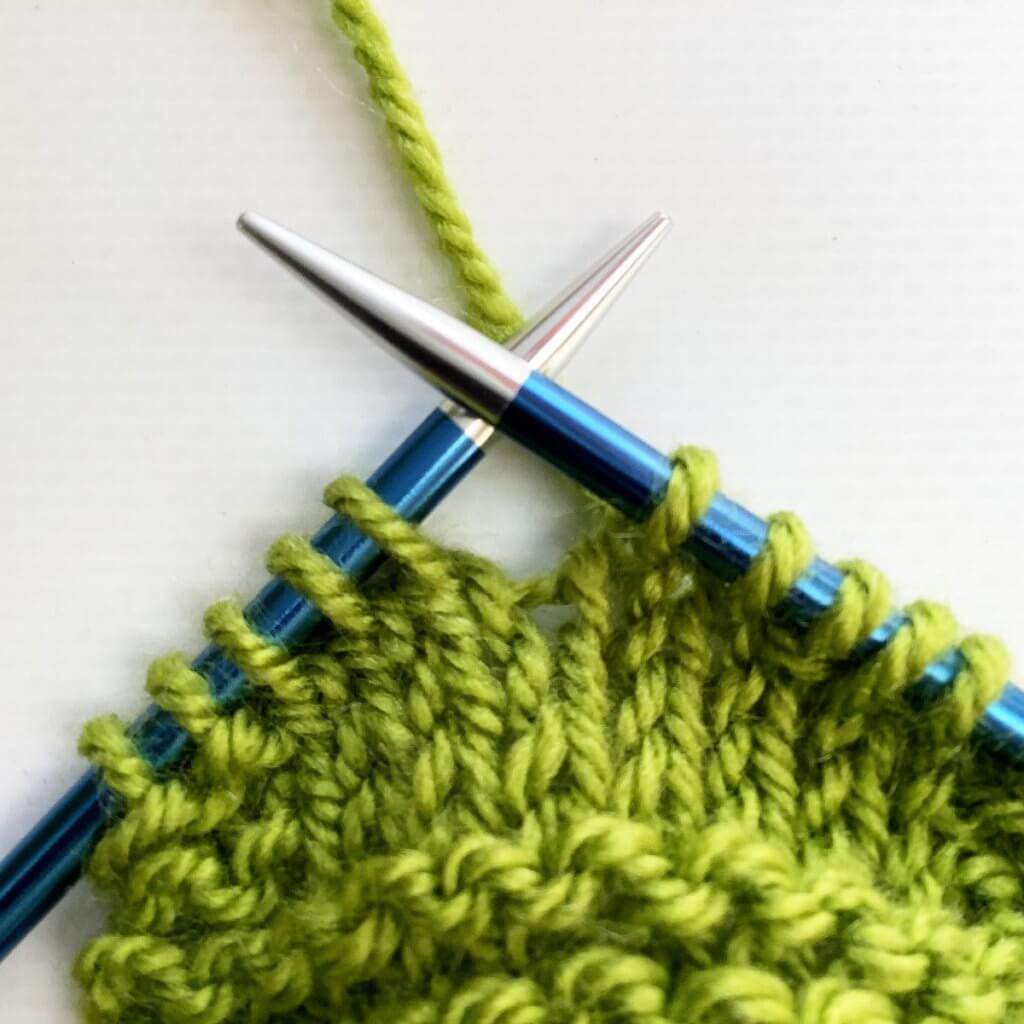
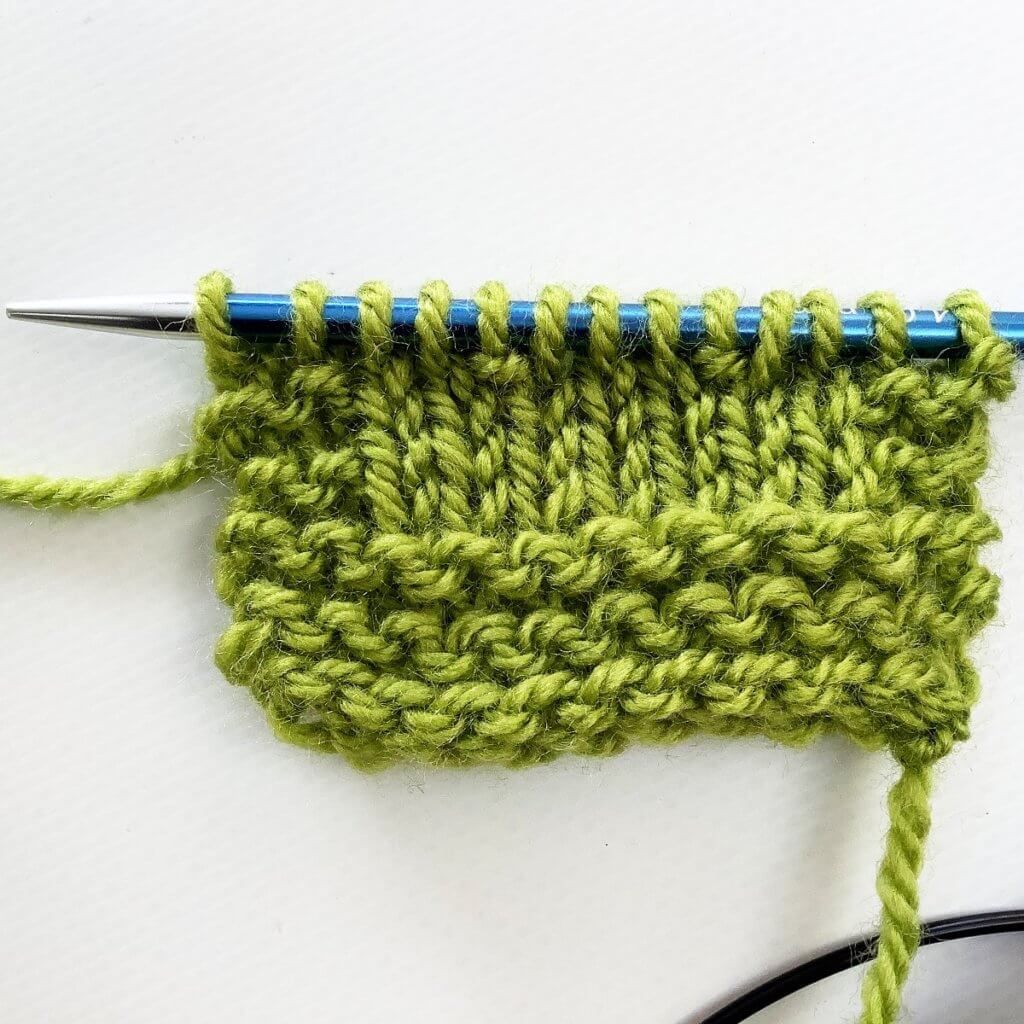
1. First, work your way across the row until you’ve reached the point where you want to make the decrease. In this case, I want to work the double decrease over the 3 stitches in the middle of the swatch. (I worked further in the same swatch I used for my yarn over tutorial).
2. To start, slip the next stitch knitwise from the left knitting needle to the right knitting needle. Unfortunately no picture for this step, I noticed too late that it was totally out of focus…
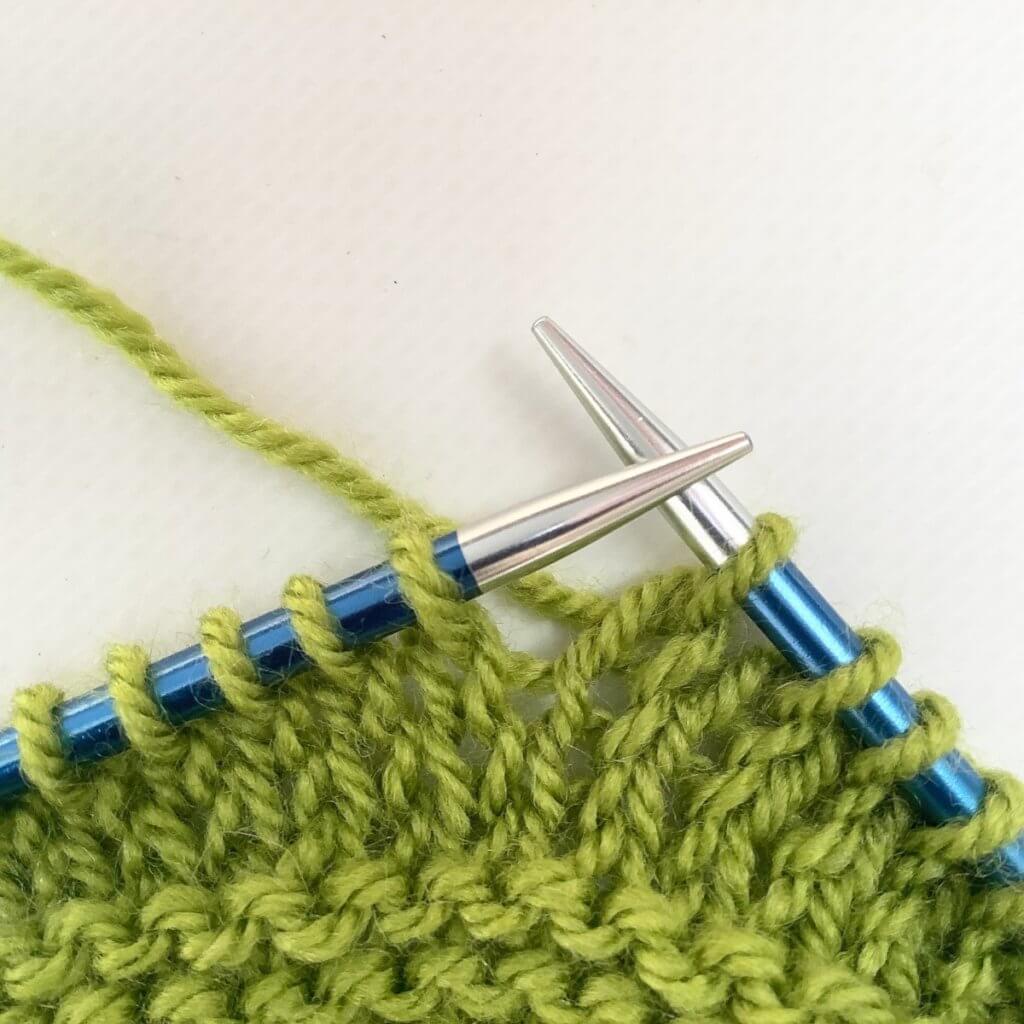
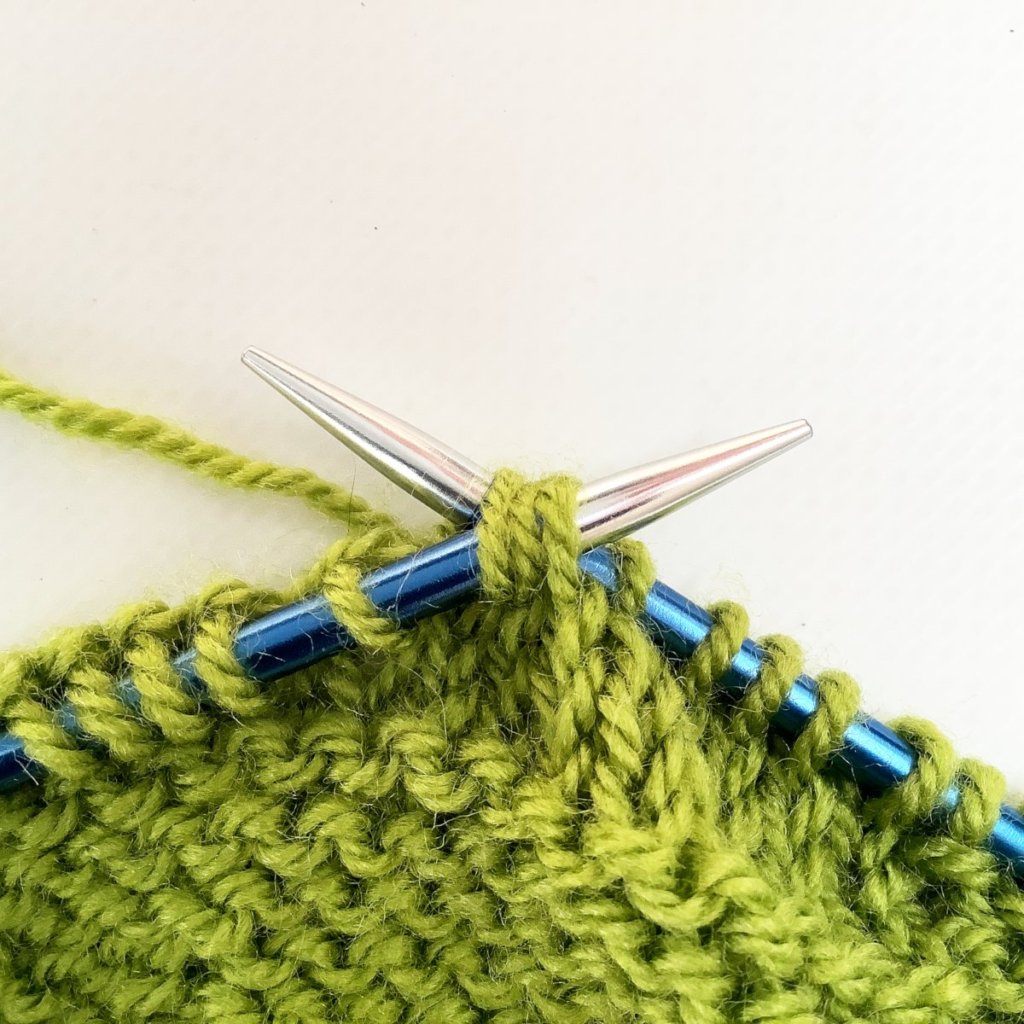
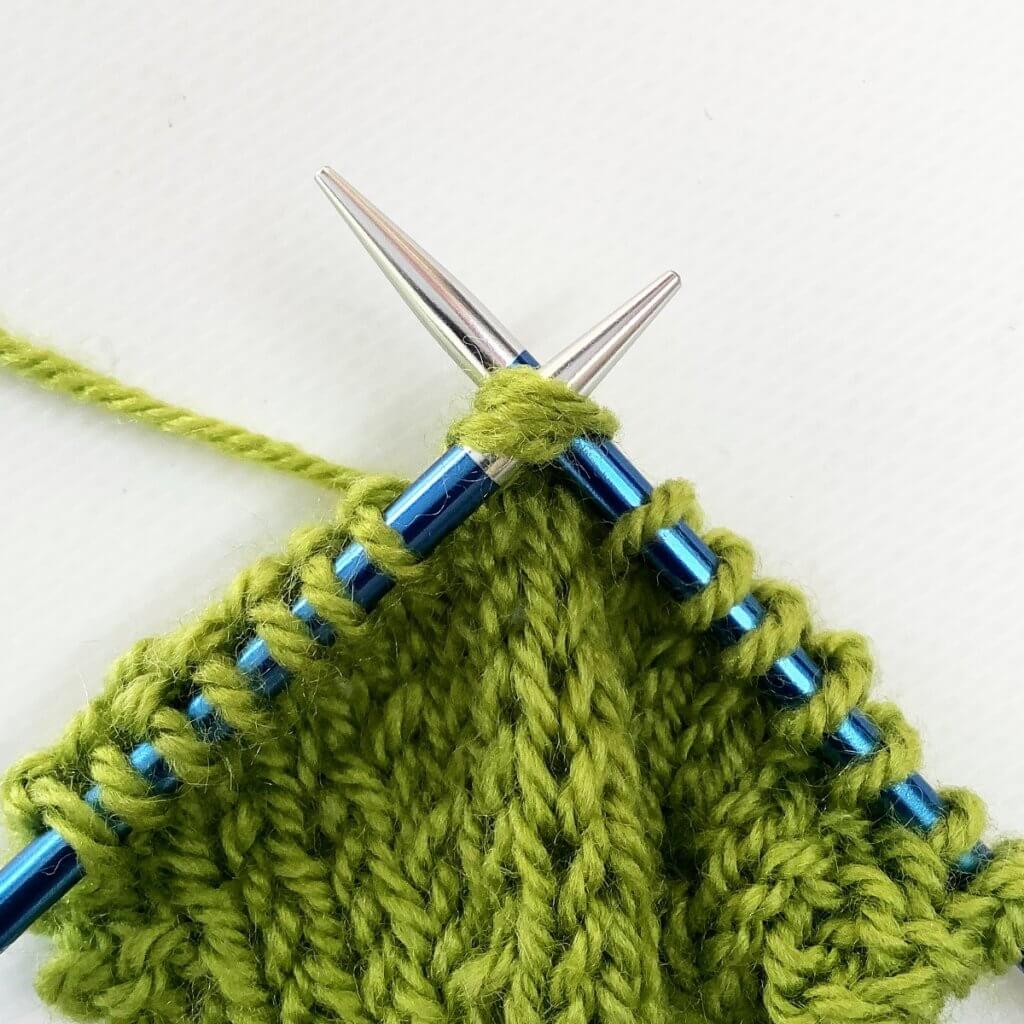
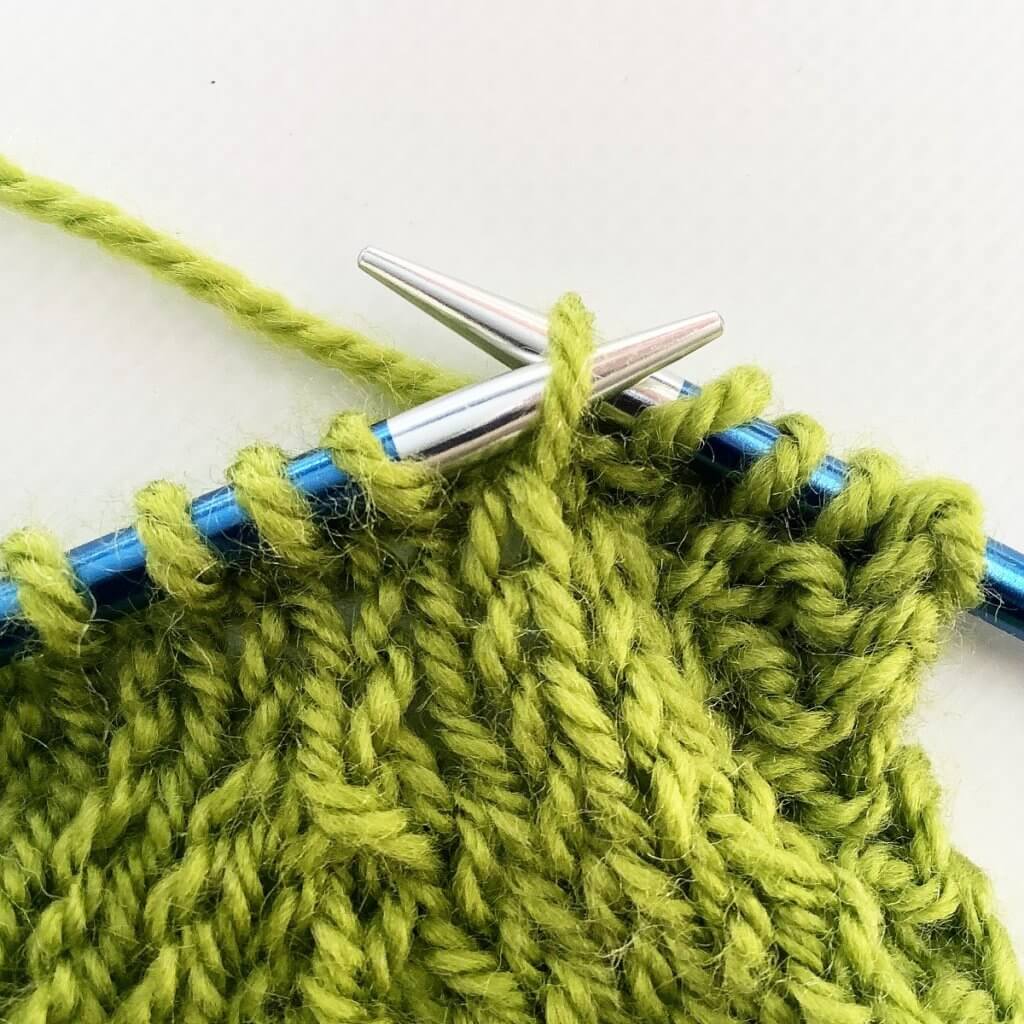
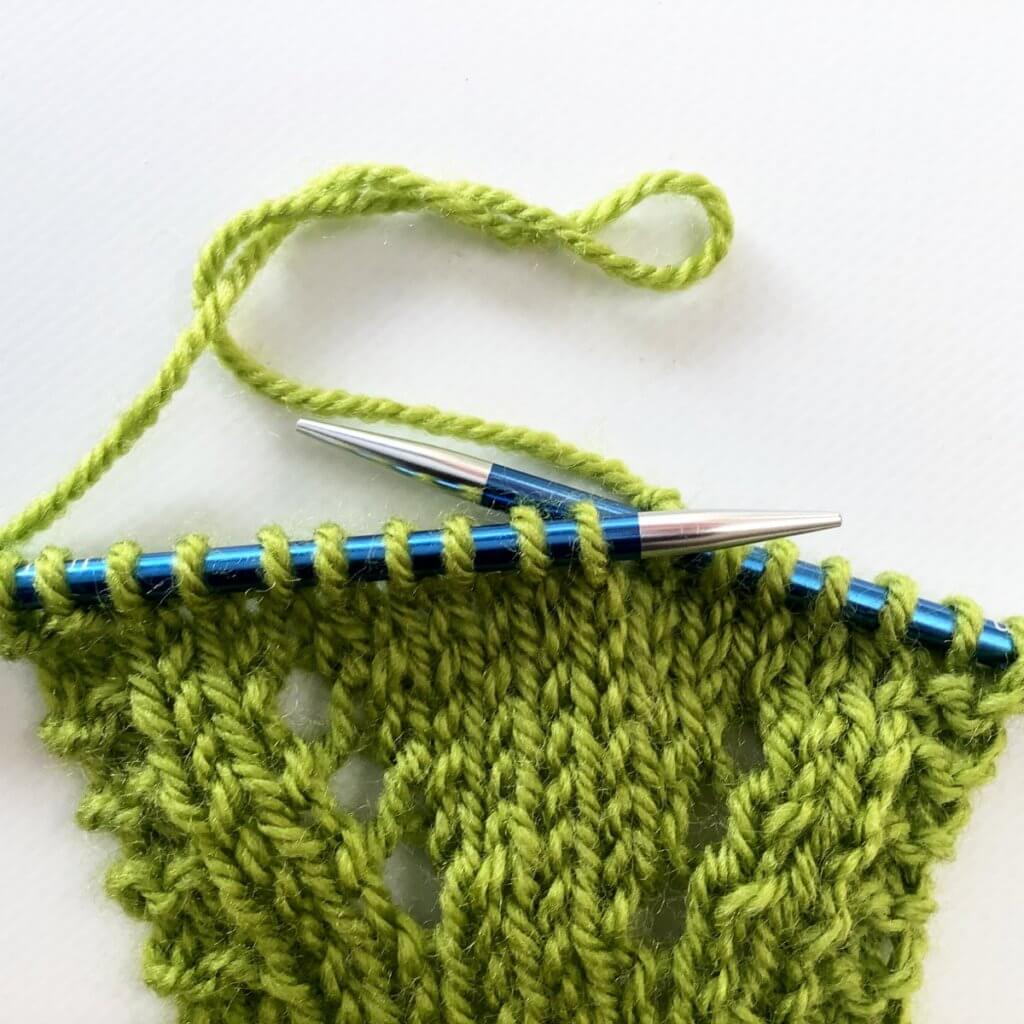
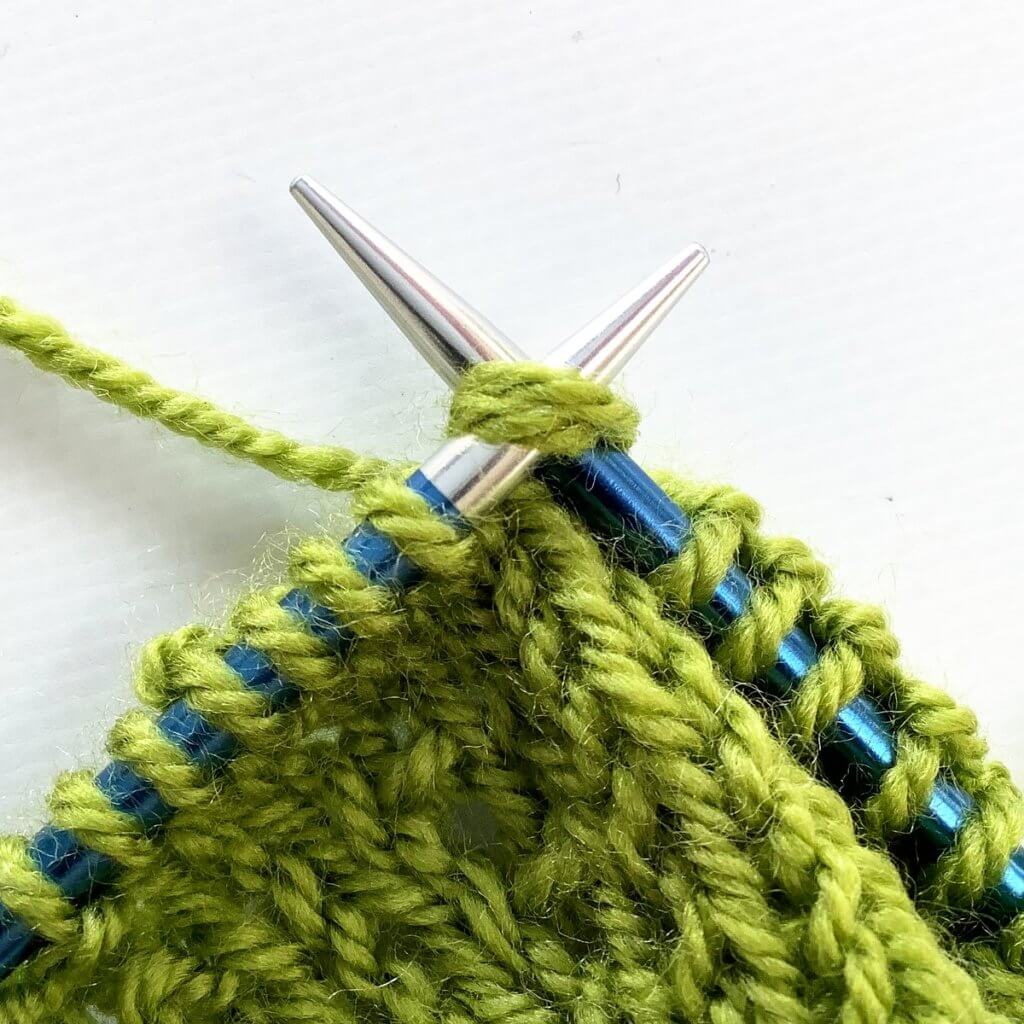
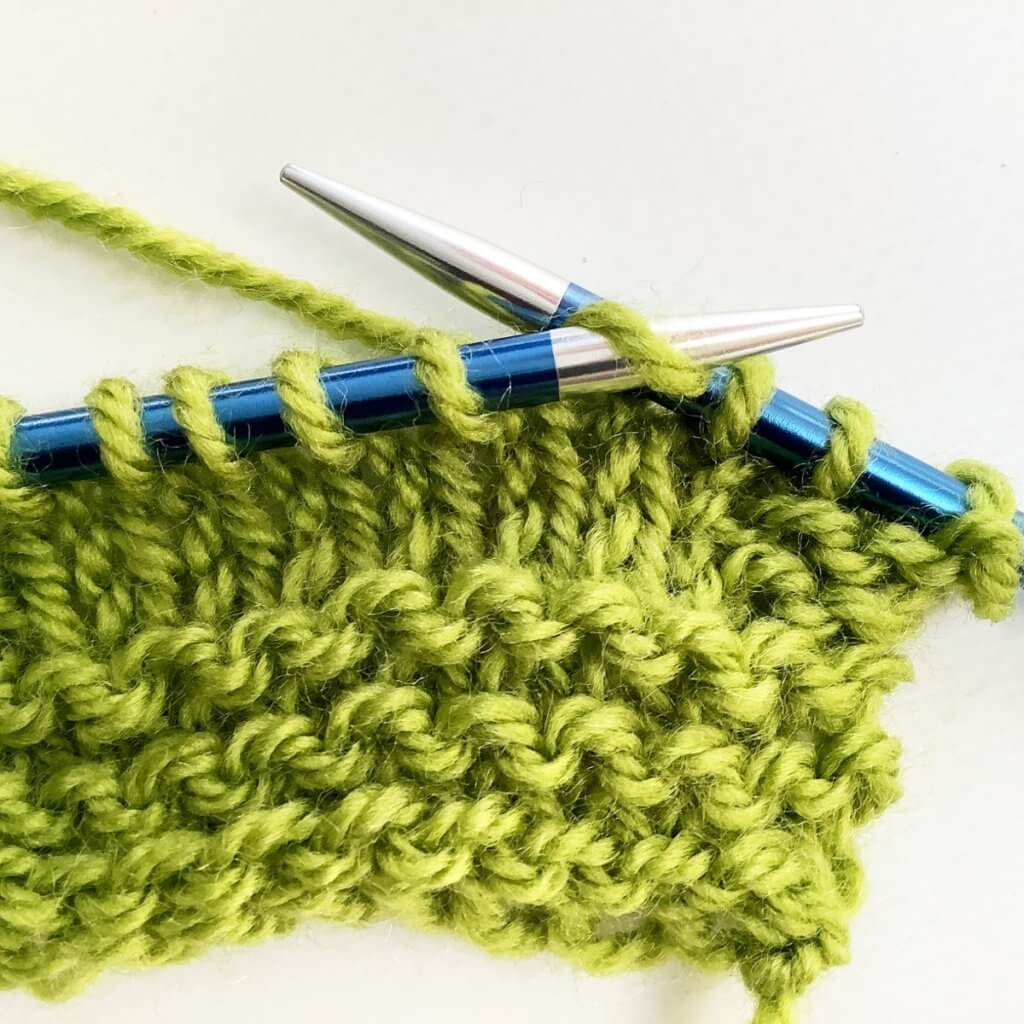
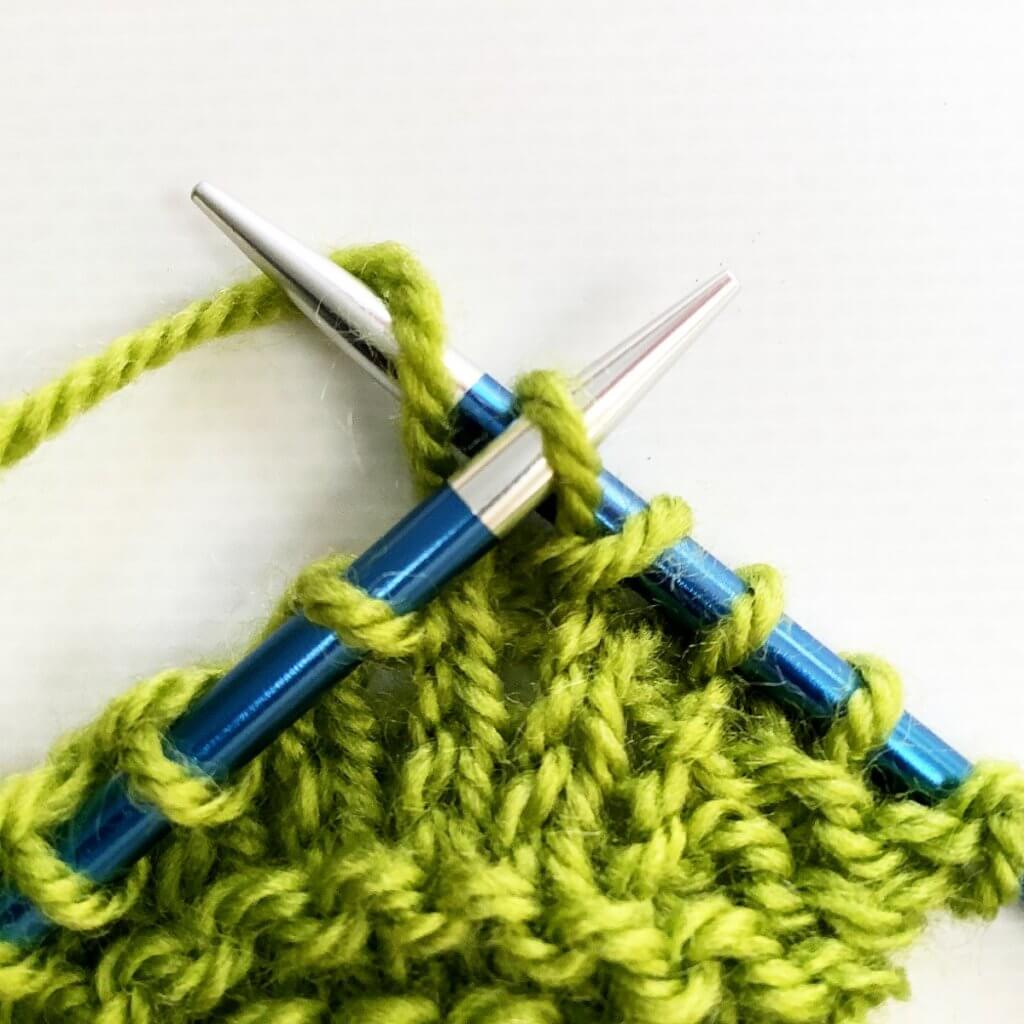
3. To work the next step, insert the right-hand needle knitwise into the front loop of the next 2 stitches on the left-hand needle.
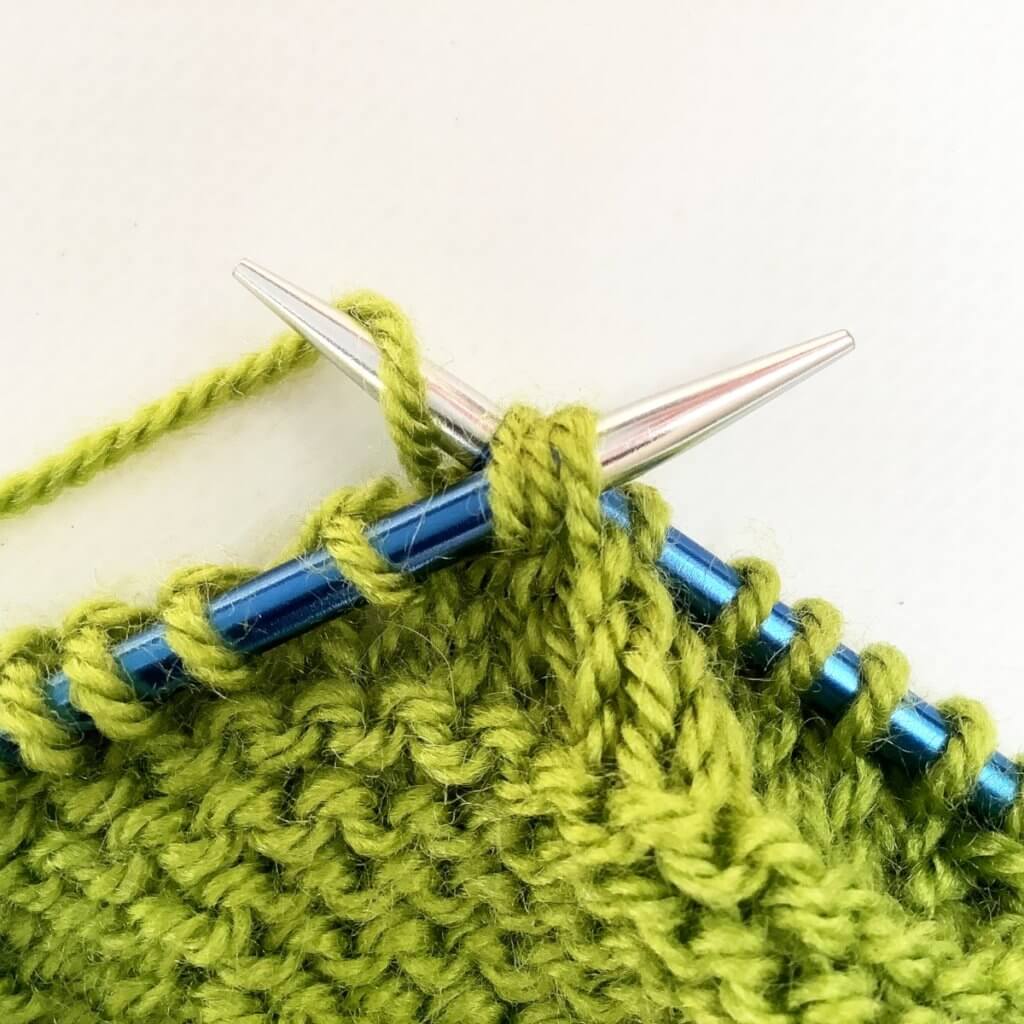
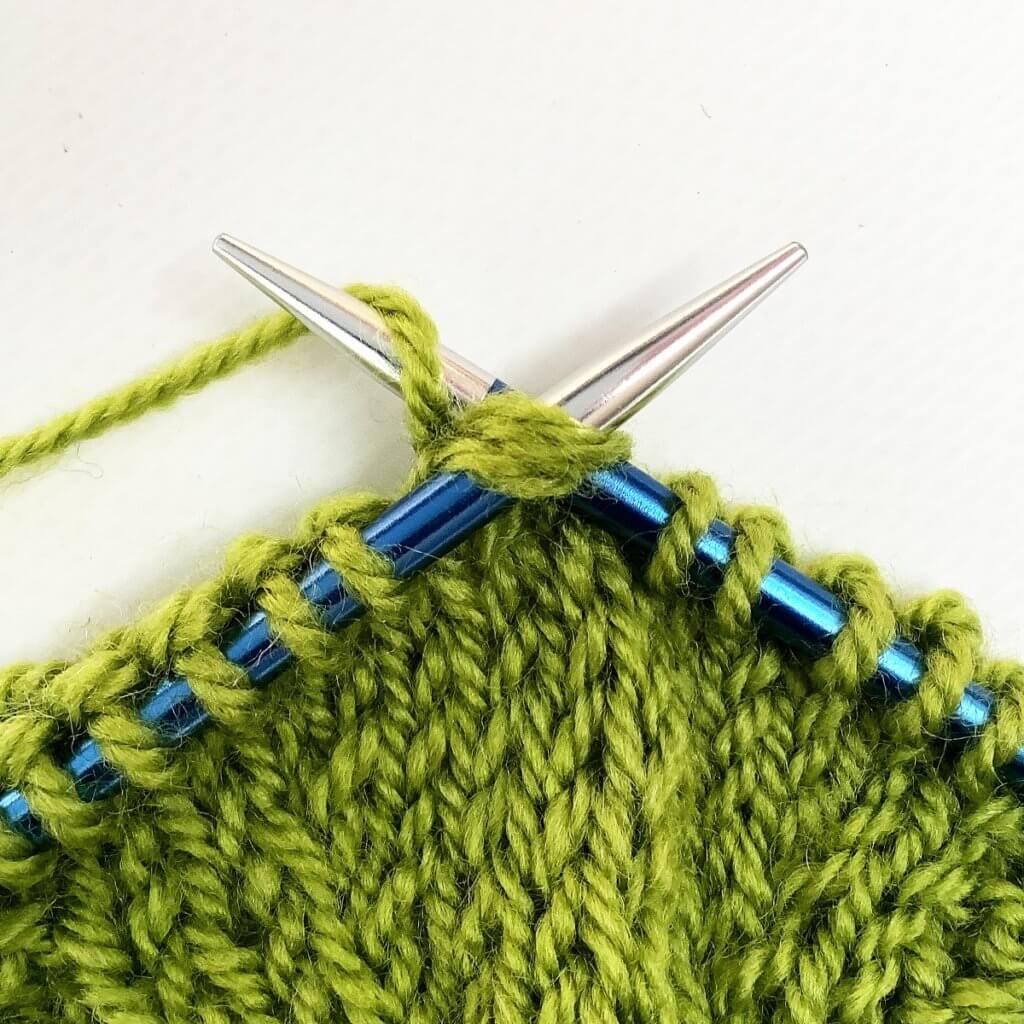
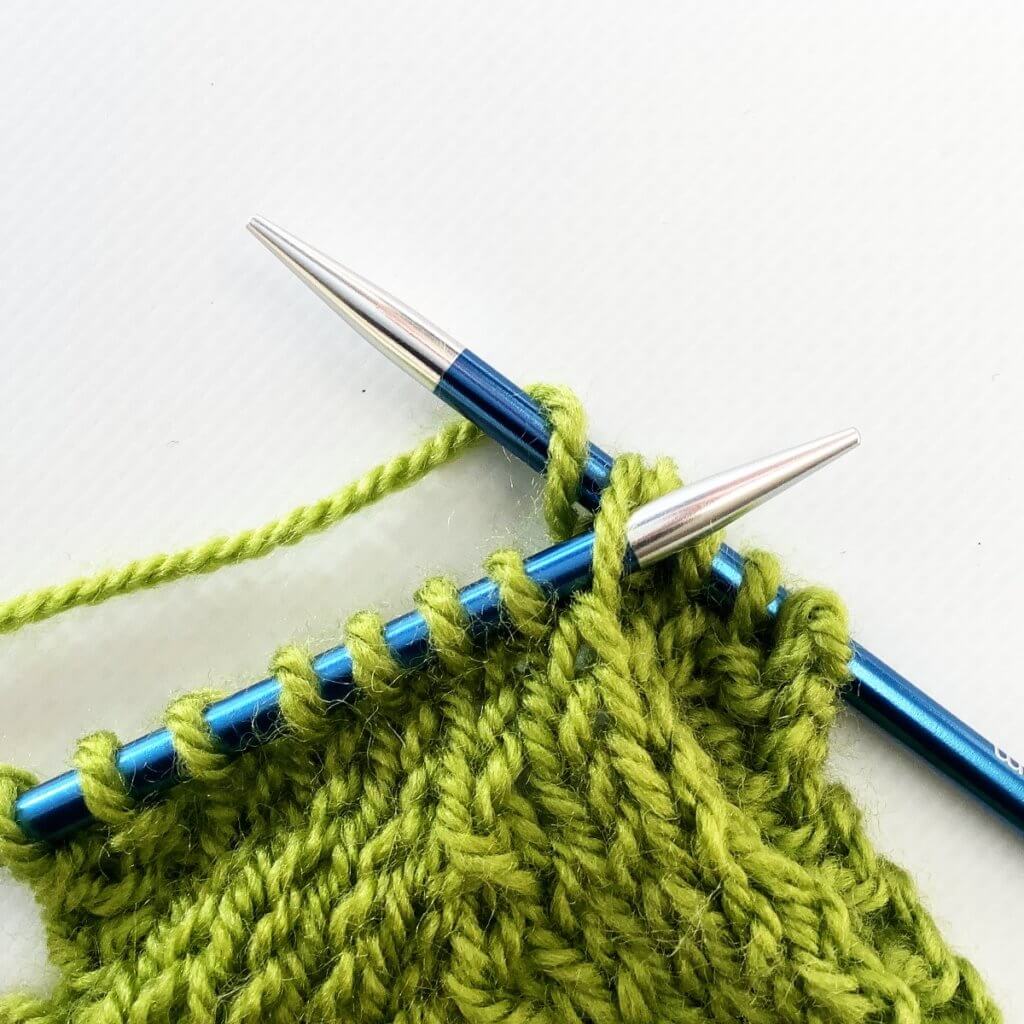
4. Wrap the yarn around the needle…
5. … and pull it through the 2 stitches.
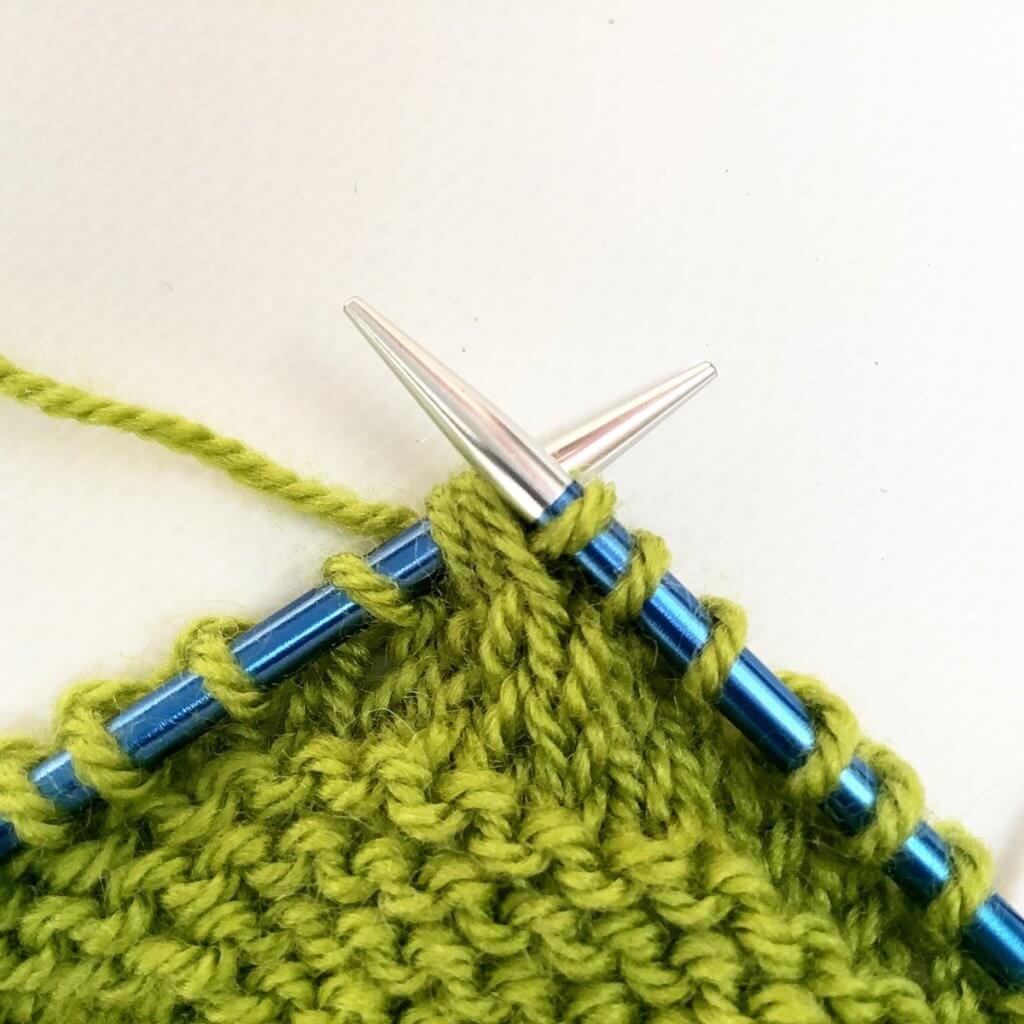
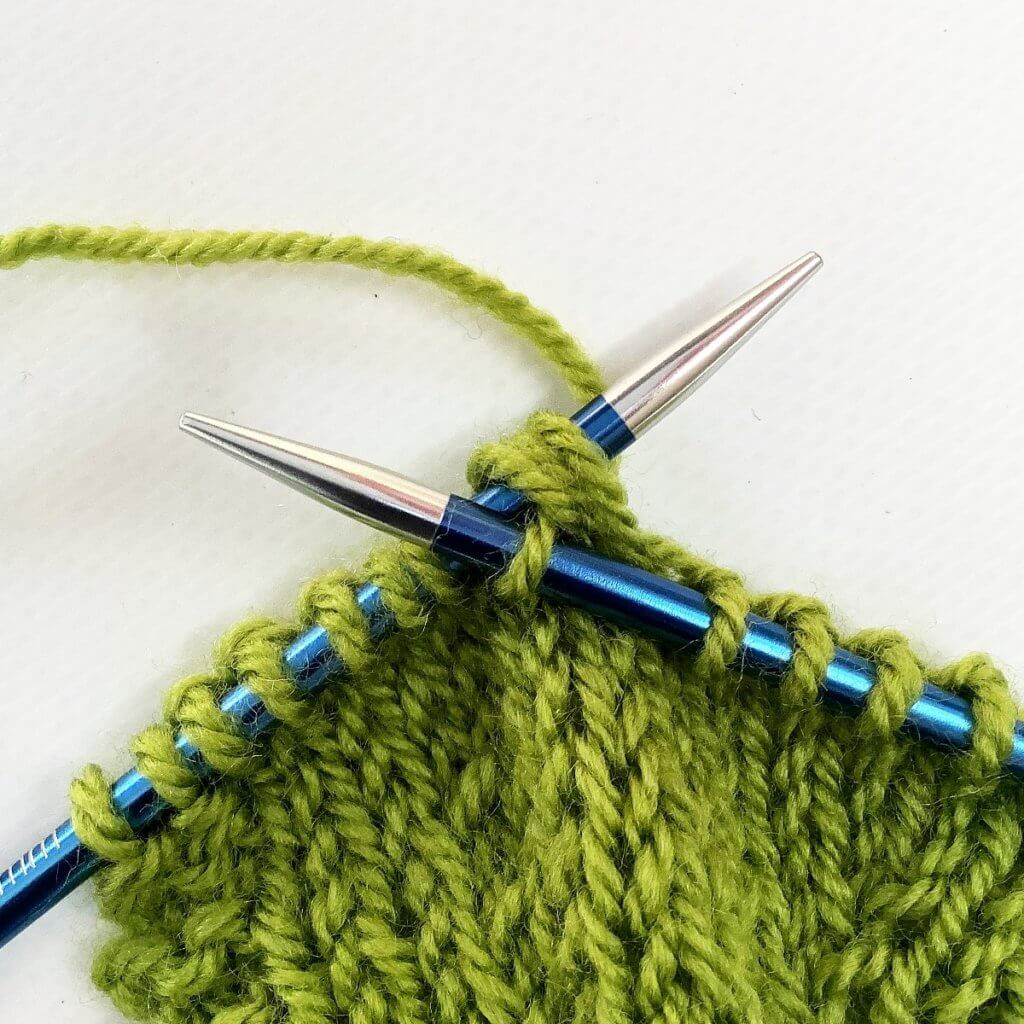
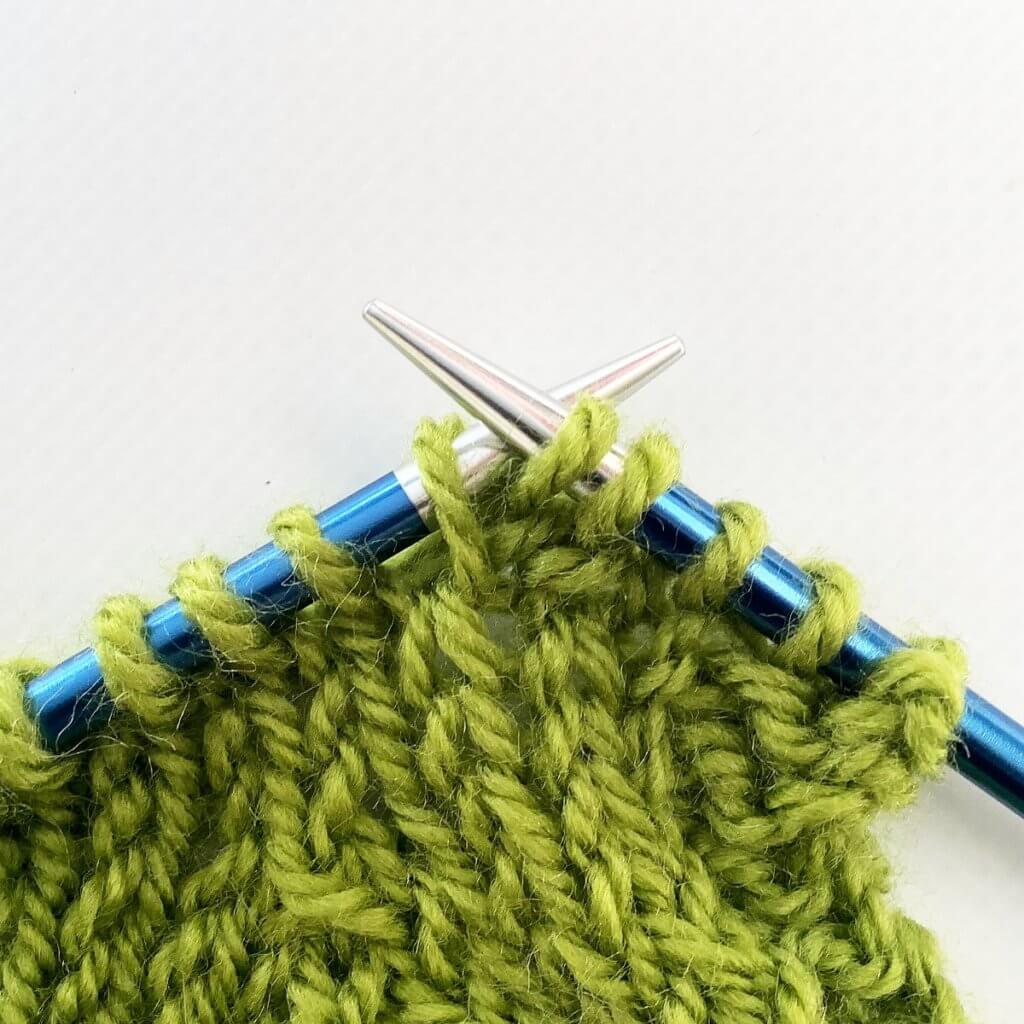
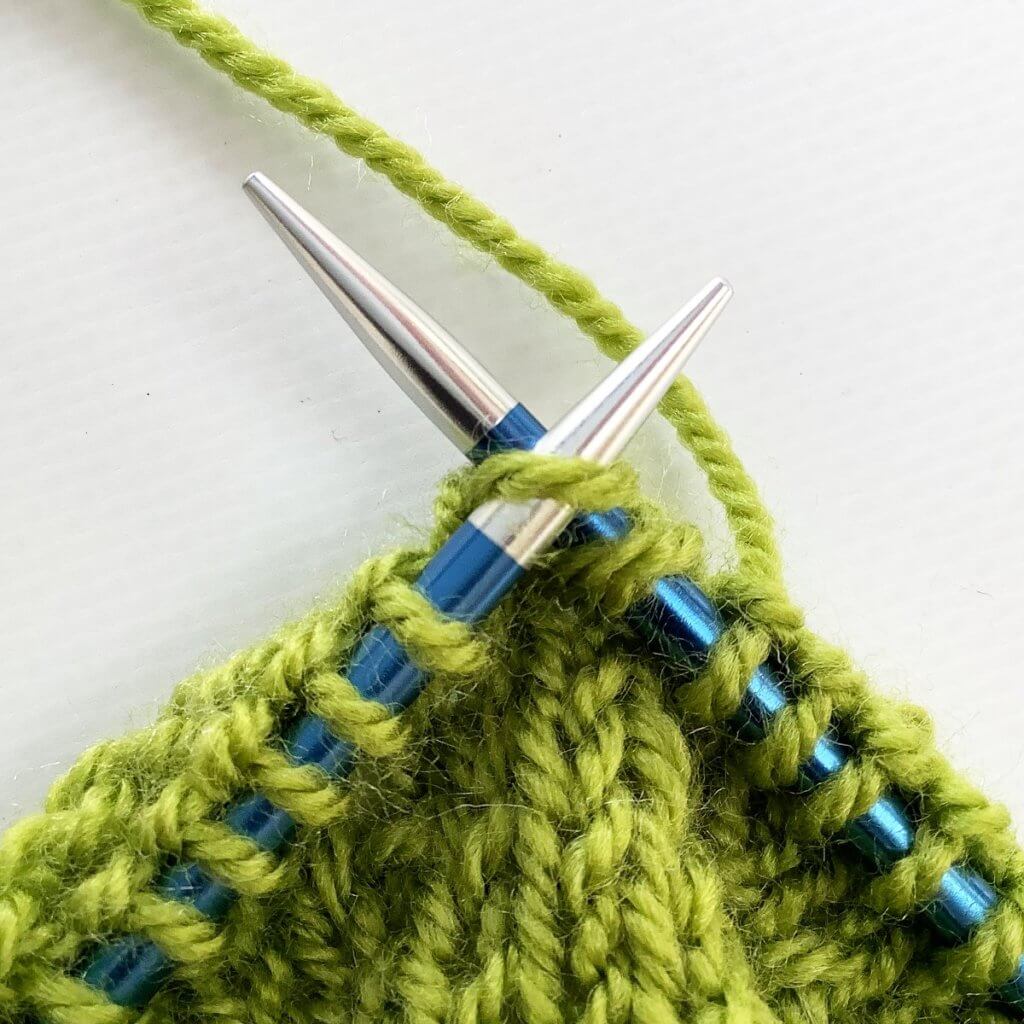
6. To finish the k2tog part of this decrease, slide the original 2 stitches off the left-hand needle.
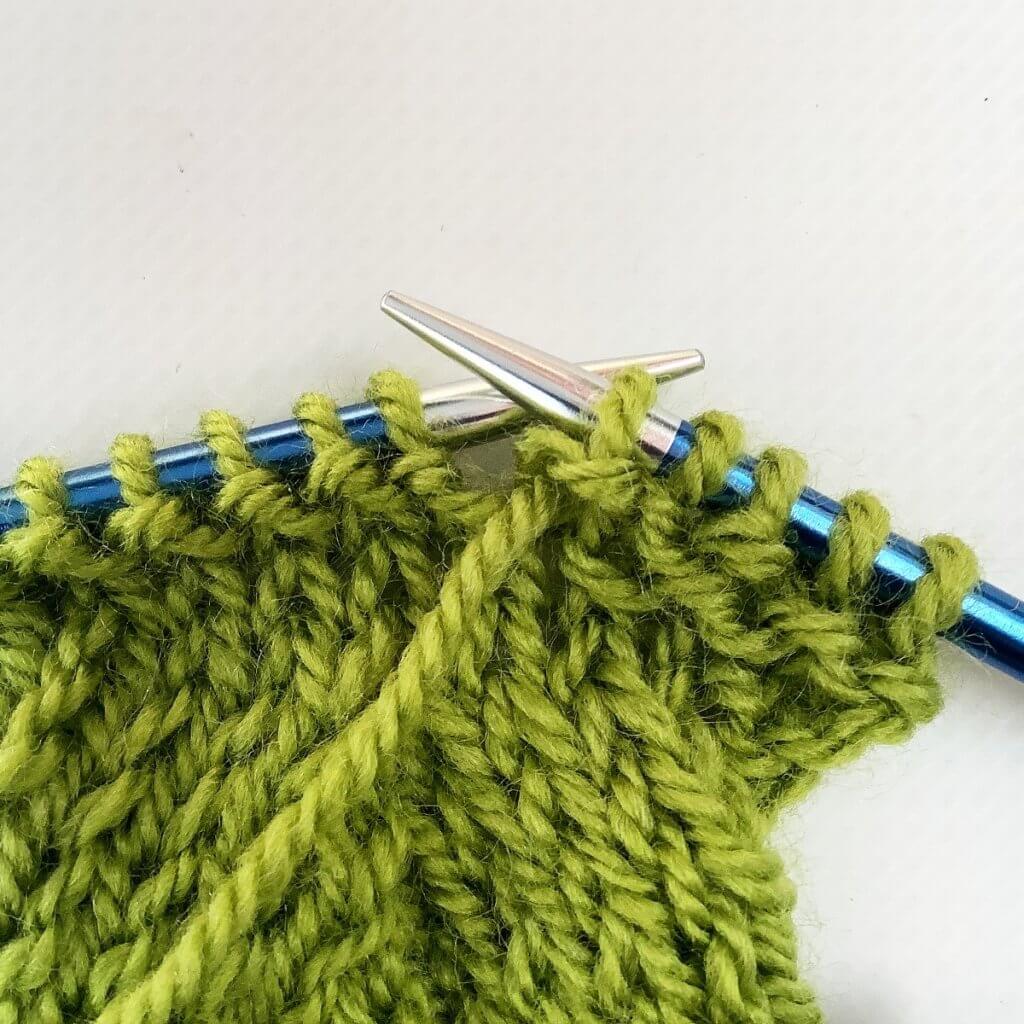
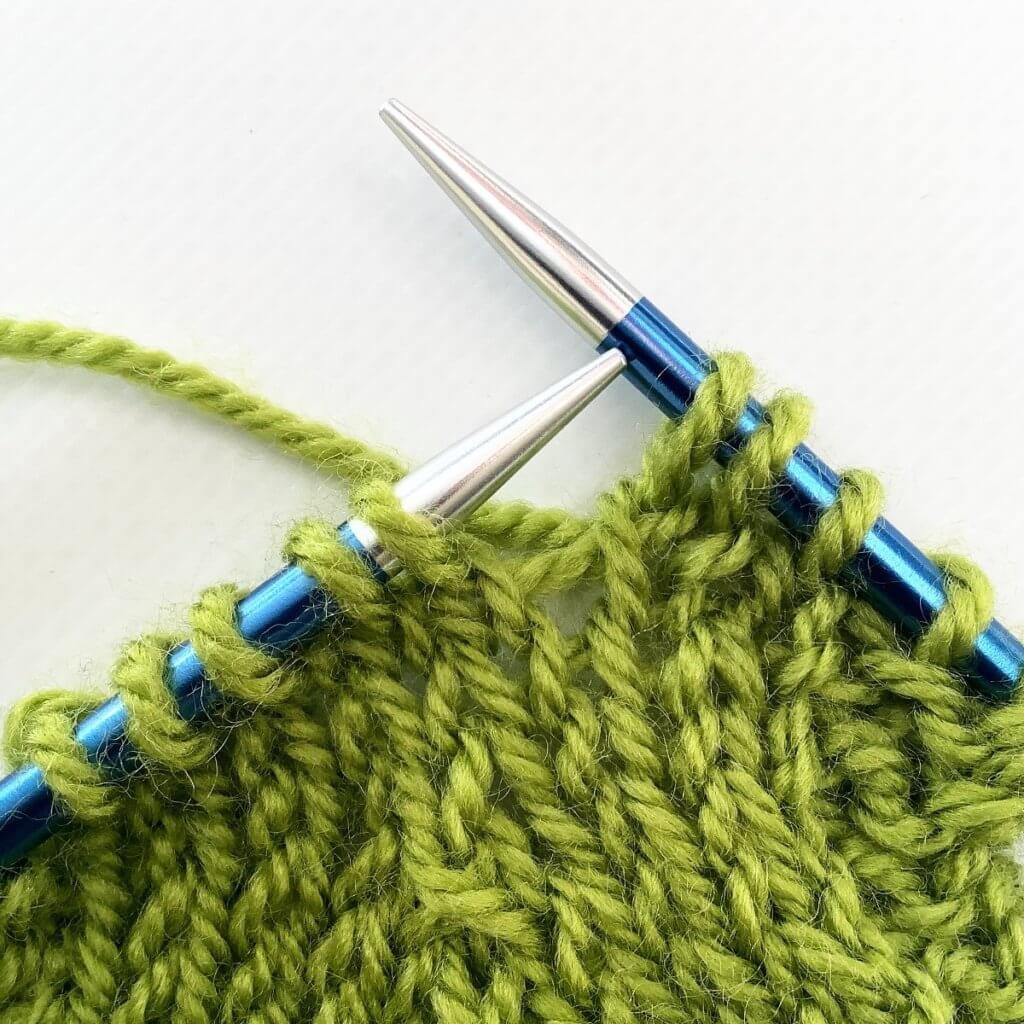
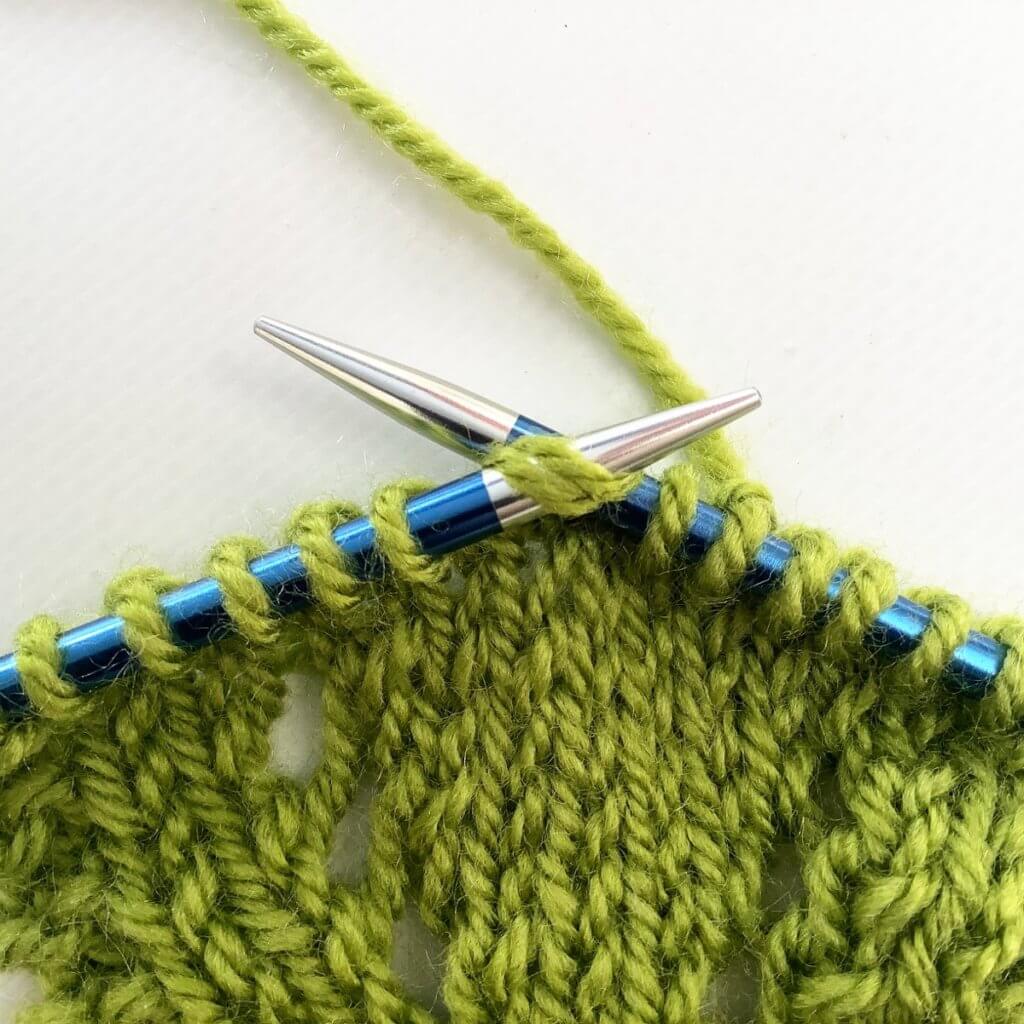
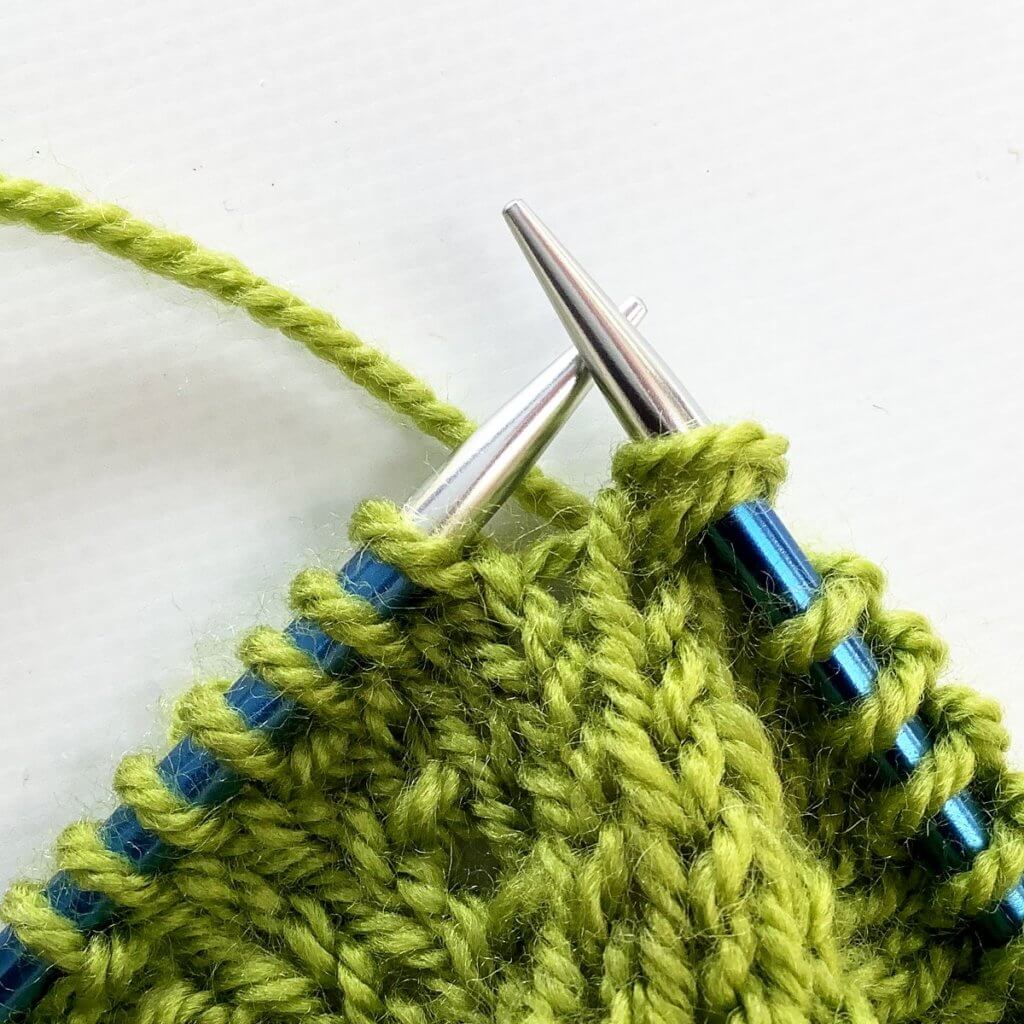
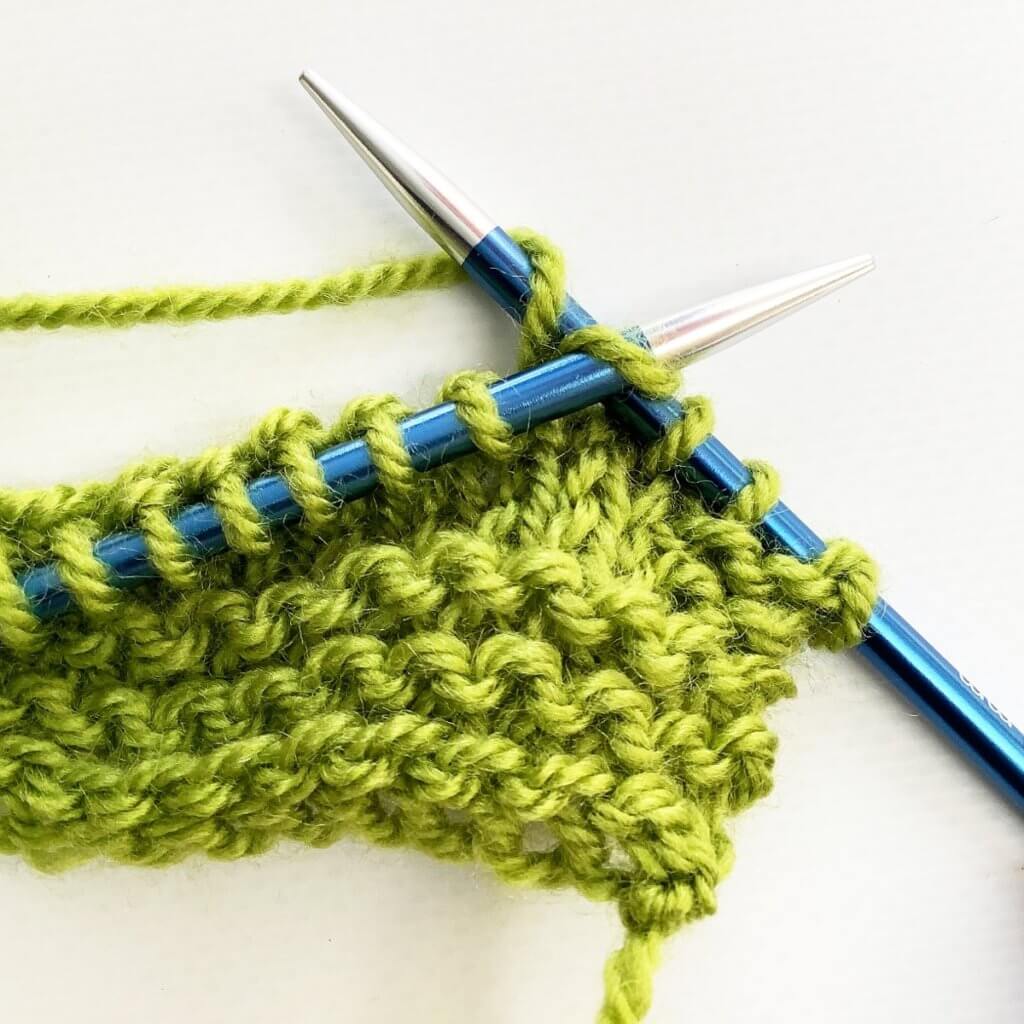
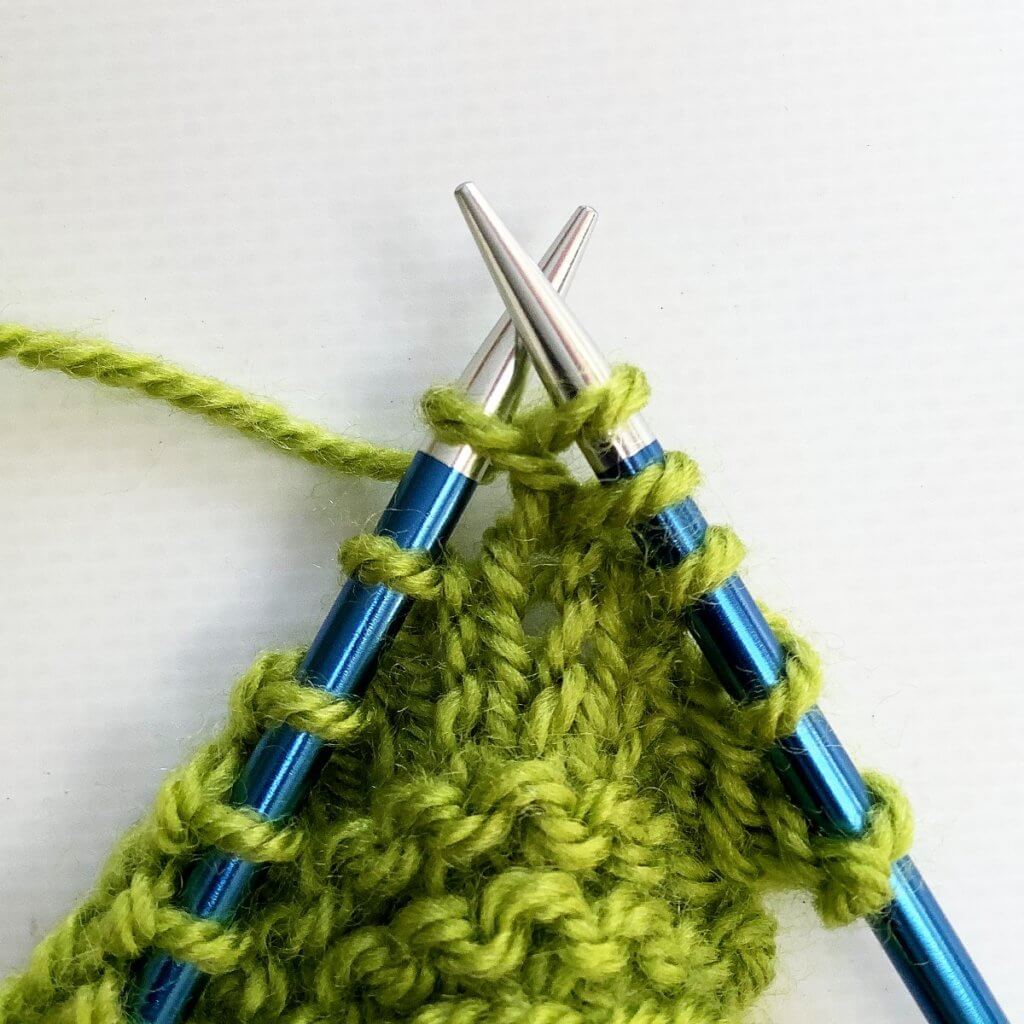
7. Now for the third and last part of this decrease, insert the left-hand needle into the slipped stitch …
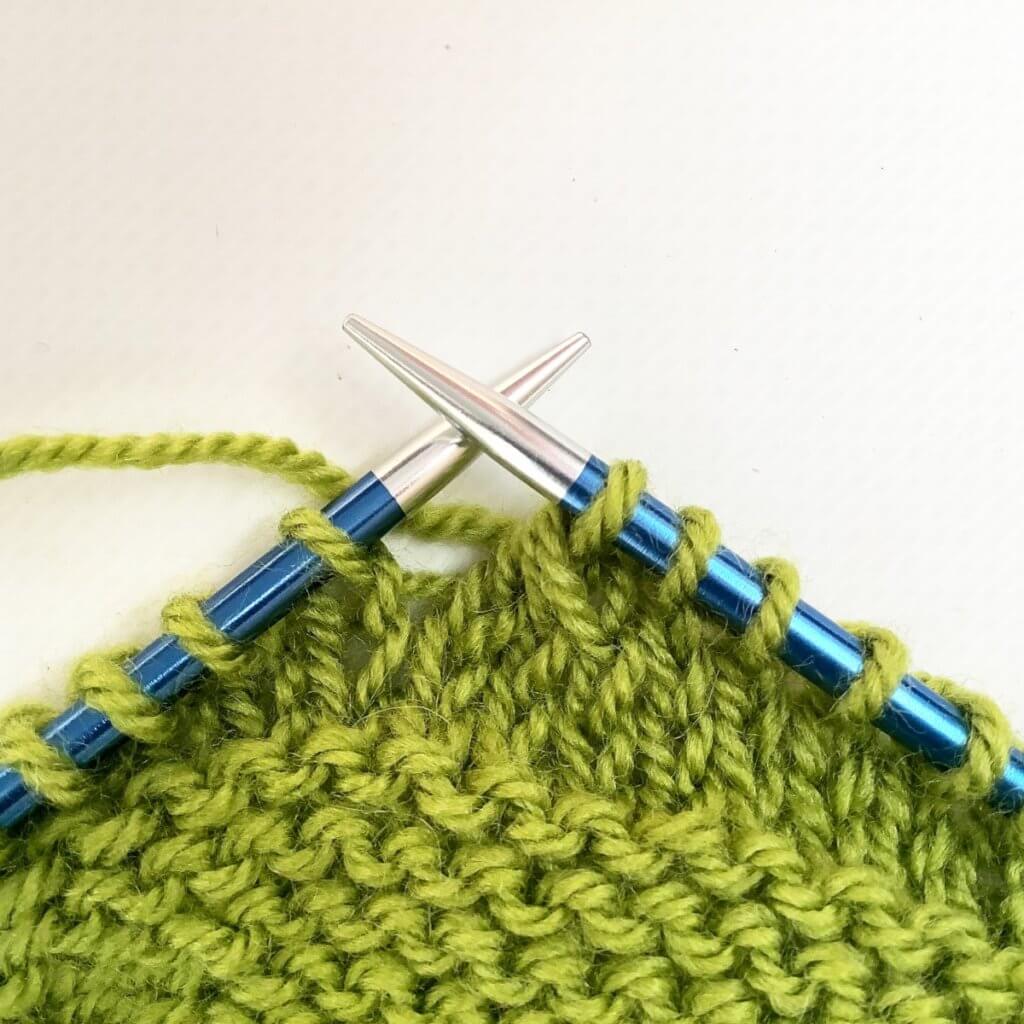
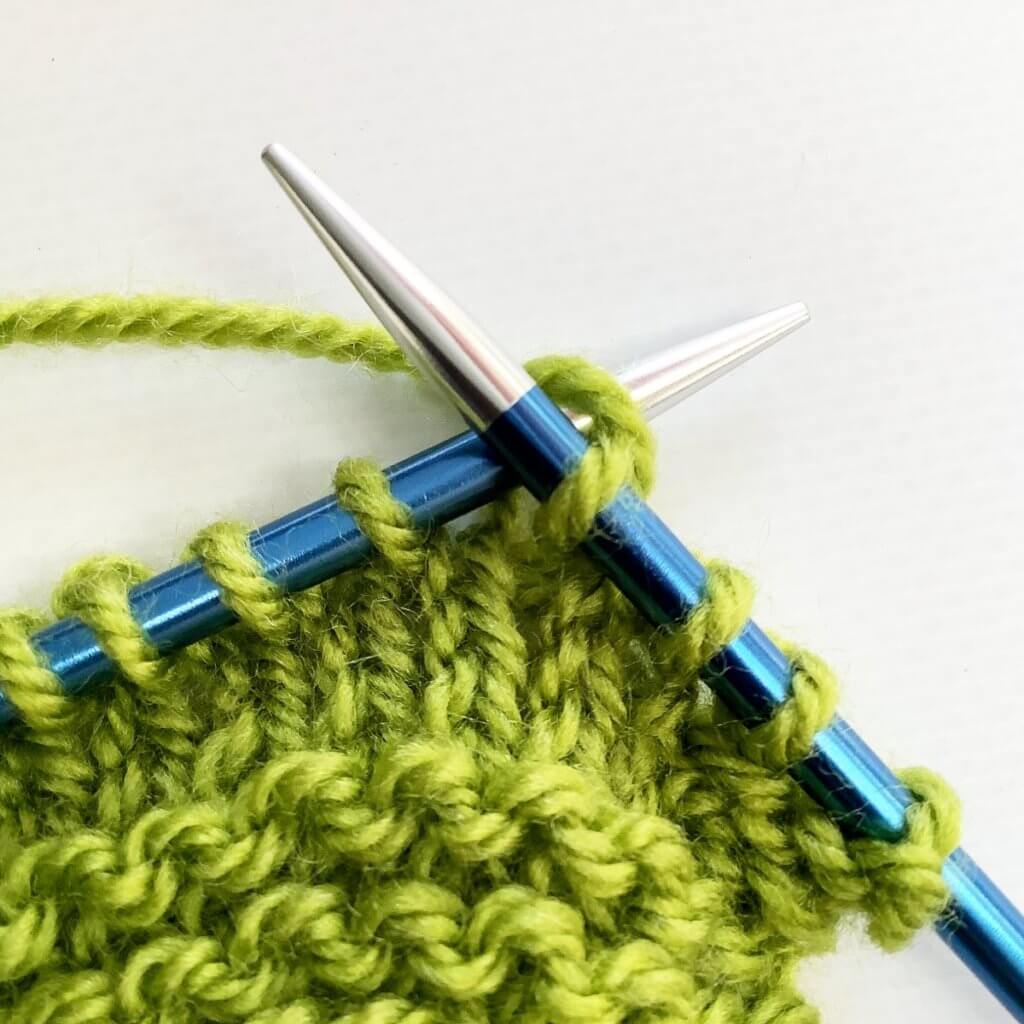
8. … and pull it over the k2tog and off the right-hand needle to complete the decrease.
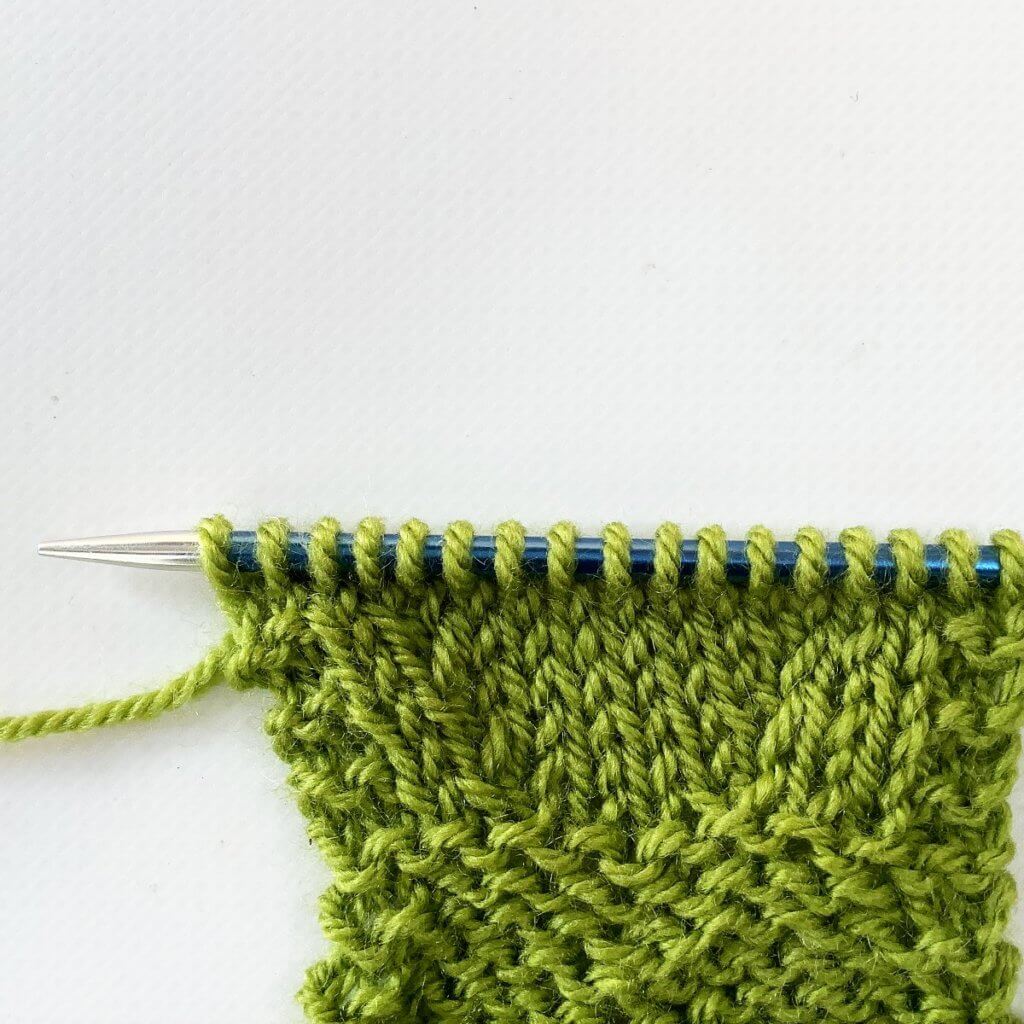
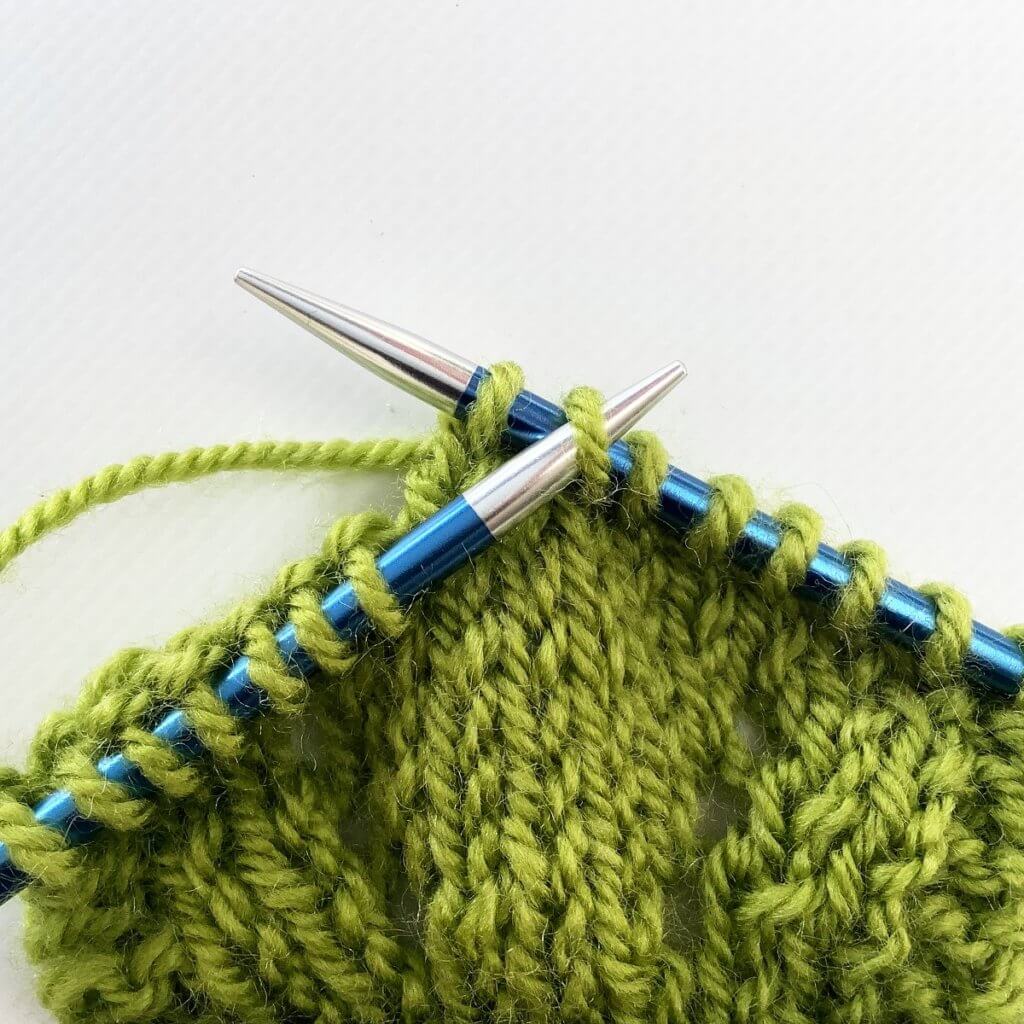
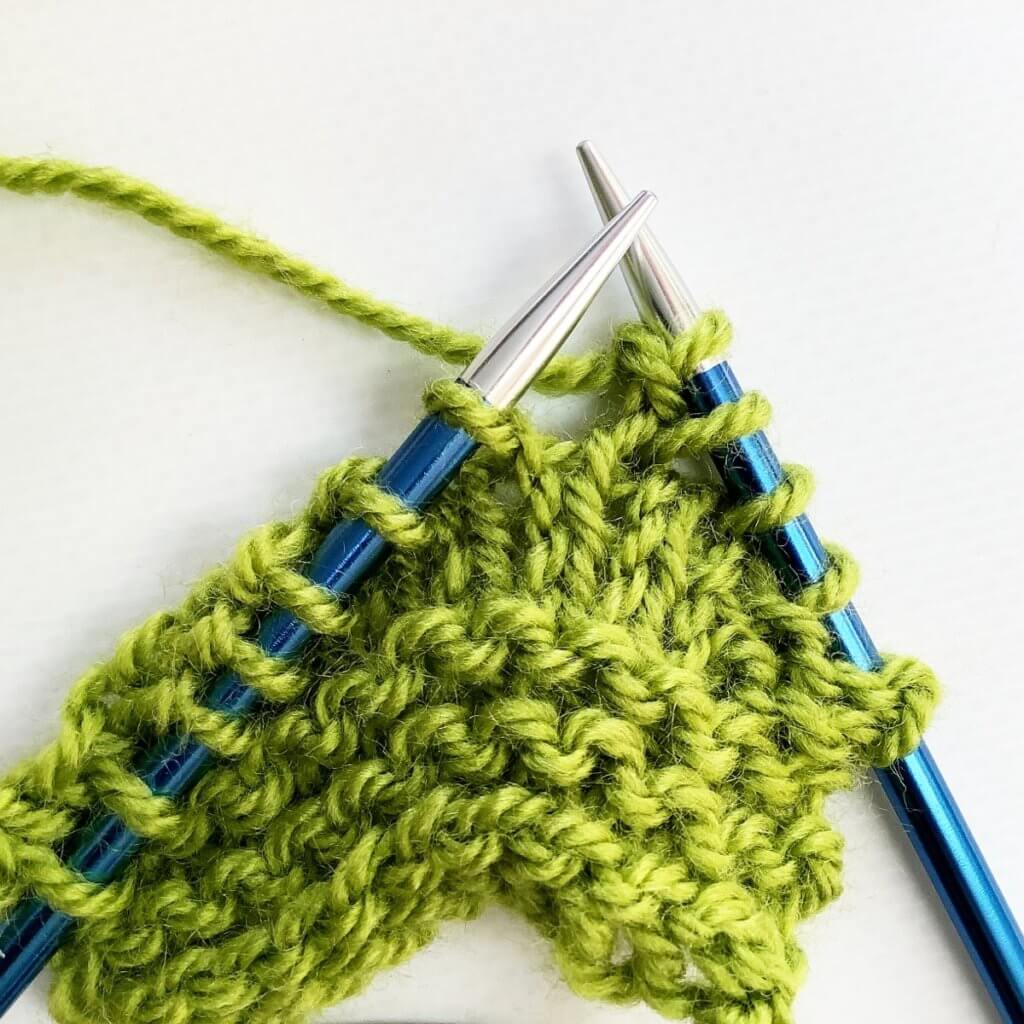
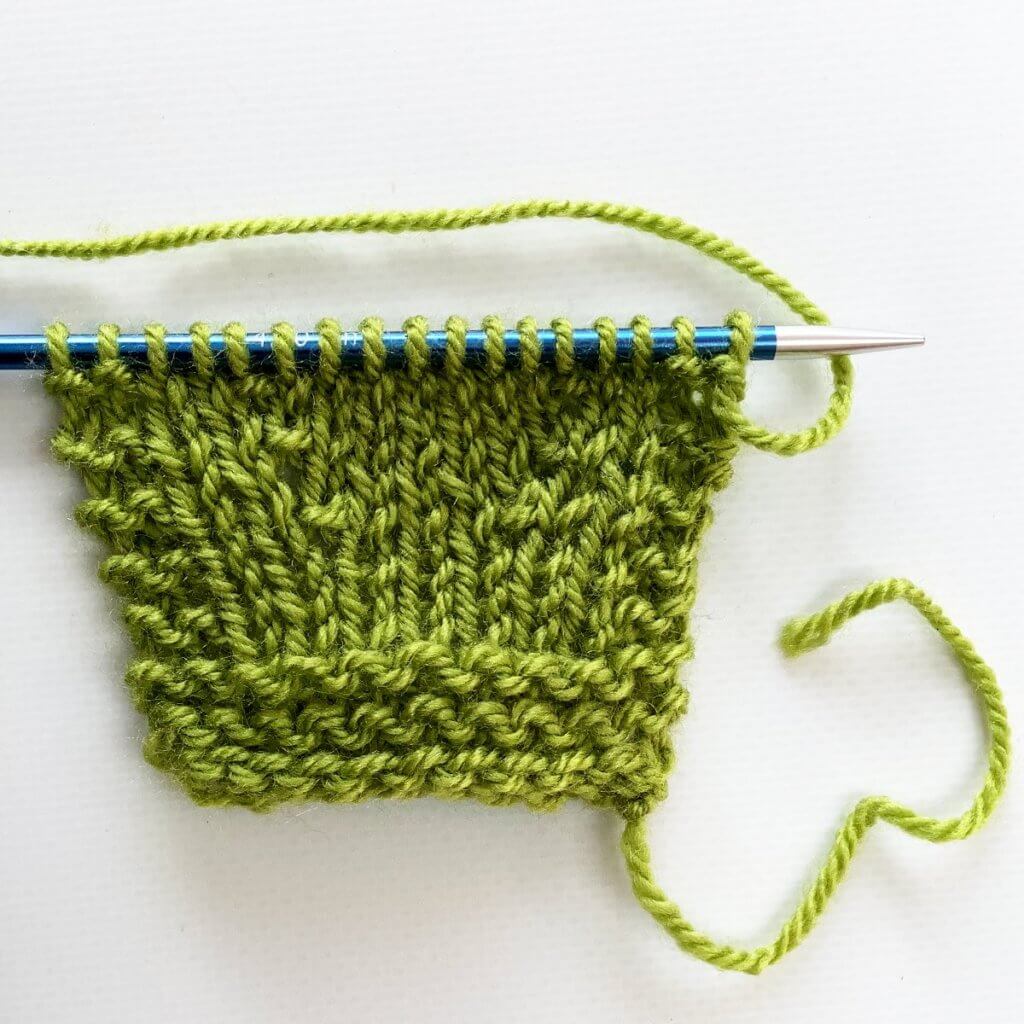
The below picture shows how it looks after 2 more decrease rows have been worked.
Thanks to my Patreon supporters for bringing you this freebie! Creating quality patterns and tutorials is a lot of work and resource-intensive. However, I find it important to give you free content like this tutorial. Thanks to the generous support of my Patreon supporters, I can make it happen. Thank you, patrons! Click here to join, or click here to read more about La Visch Designs on Patreon.
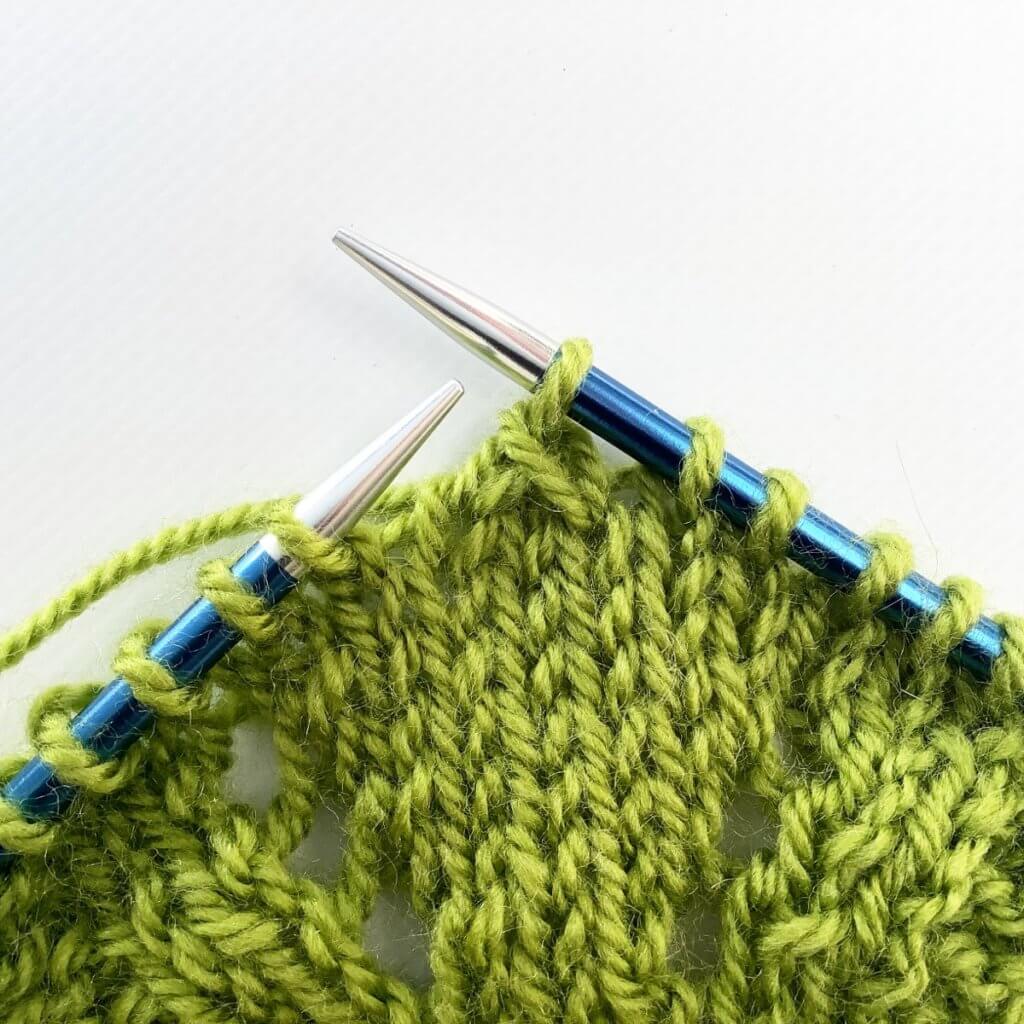
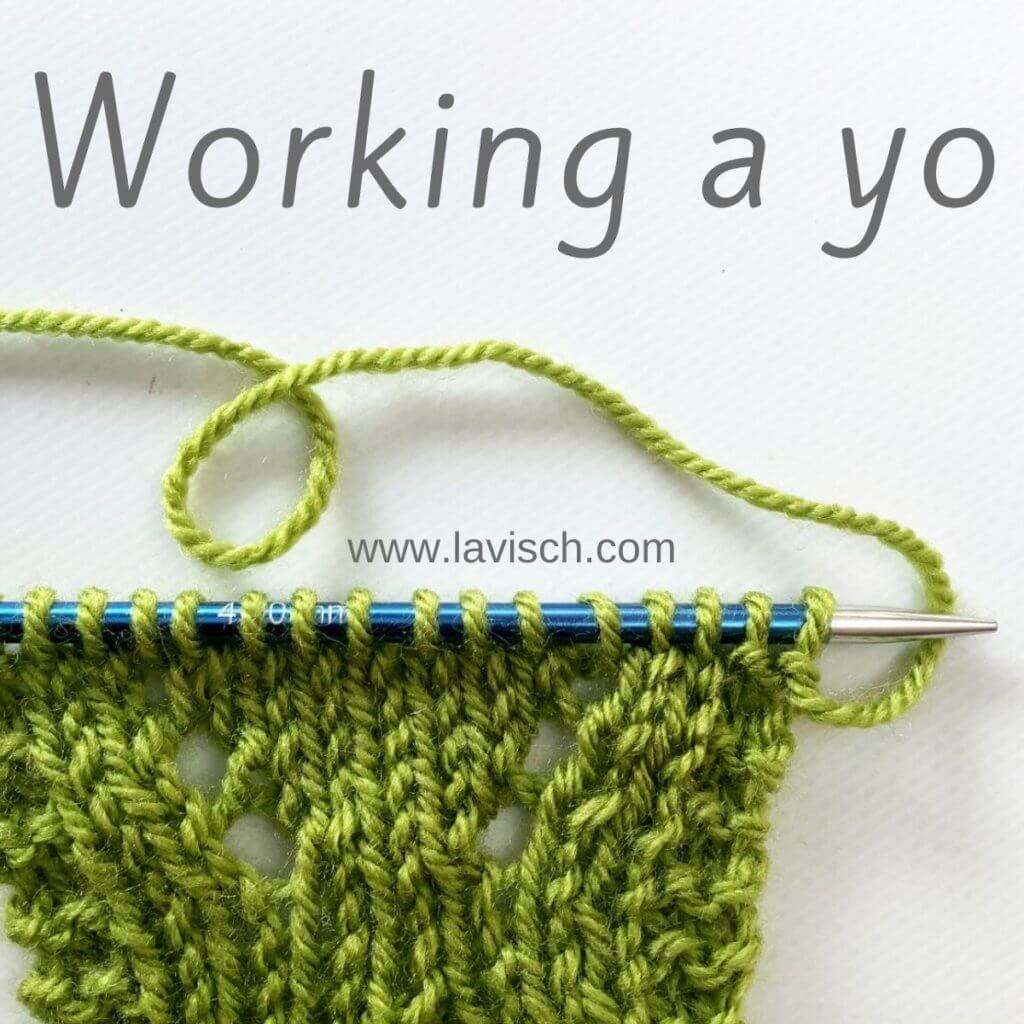
A yarn over (abbreviated as “yo”) is a simple way to increase stitches and deliberately make a little hole in your knitting. On its own, it can be used to add shaping to your knitting project. When combined with strategically placed decreases it makes lace, either as a single design element or as all-over patterning. Yarn overs also have other applications. Think for example off simple buttonholes, when paired with a k2tog decrease.
This tutorial will give you step by step instructions on how to work the “yarn over” increase.
Materials used
Yarn: * Paintbox Yarns Simply DK, a good value, good quality 100% acrylic yarn, here in the color 128 Lime Green.
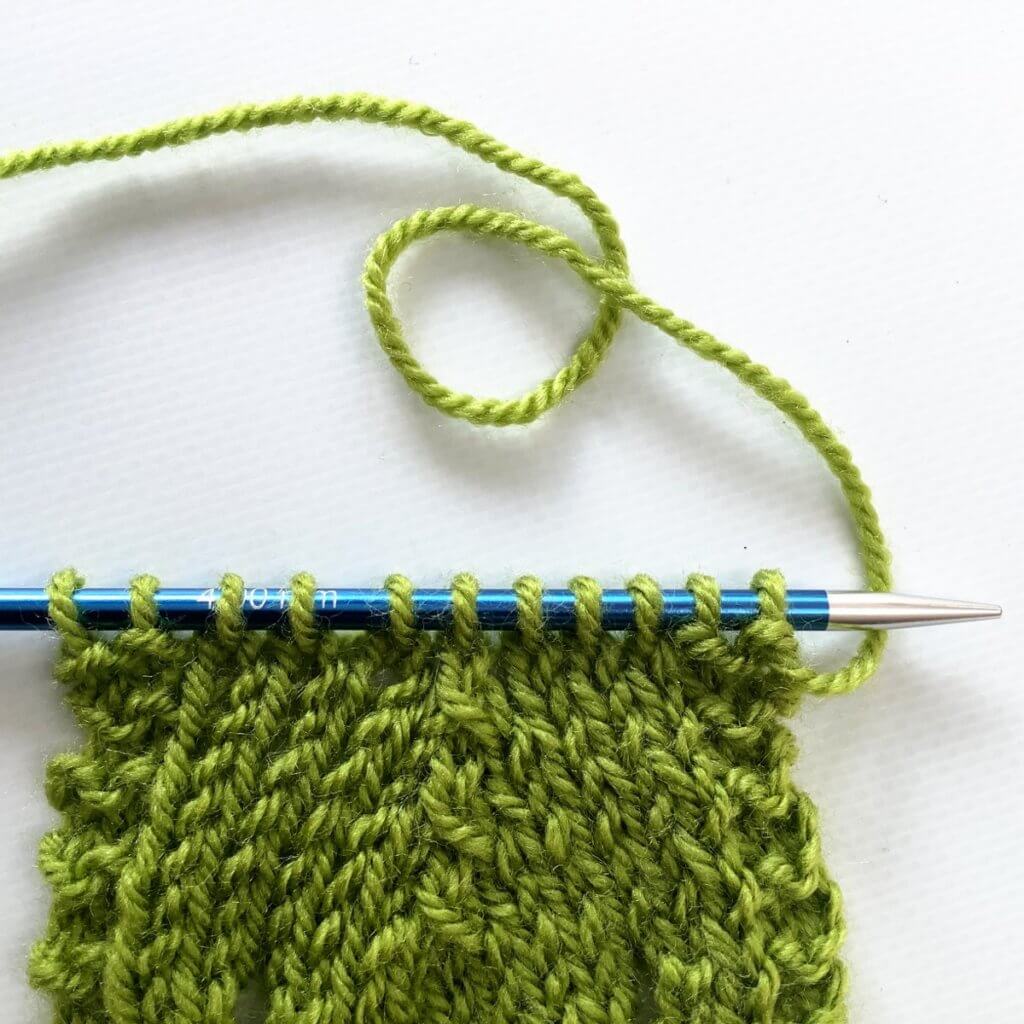
1. First, work your way across the row until you’ve reached the point where you want to make the increase. In this case, I will be making the yo increase 2 sts in from each of the garter stitch borders.
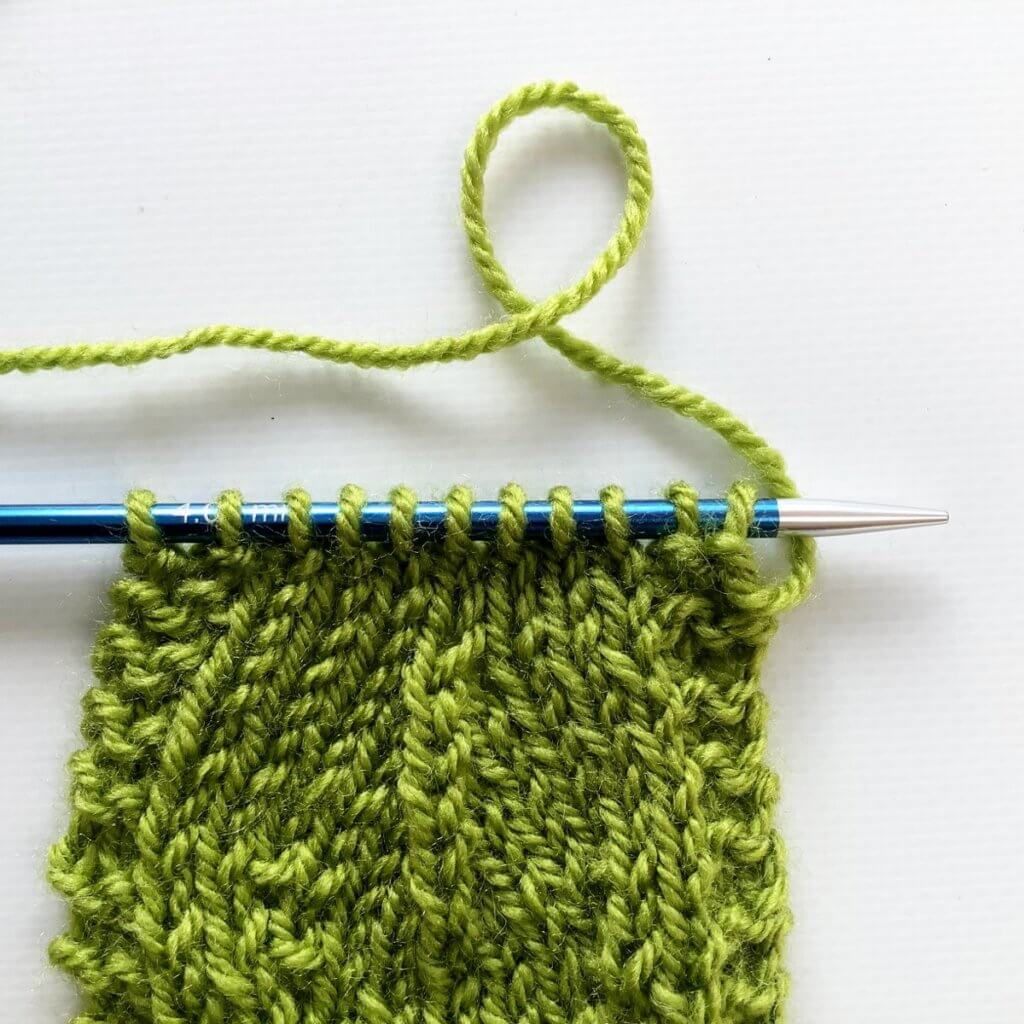
2. To make the yo, move the working yarn from the back to the front between the needles and then over the right-hand needle back to the back of the work.
If you’d be wanting to make the yo in reverse stockinette, the working yarn would already be at the front of the work, So, in that case, it would just be a matter of wrapping the yarn over and around the needle, and back to the front of the work.
When wanting to make a yarn over between a knit and a purl stitch or vice versa, you’d have to make adjustments regarding where you’re moving the yarn from and to. The main thing to remember is that you want to wrap the working yarn over and around the needle, before bringing it to the correct position for continuing your knit.
3. And below, you can see how it looks when 2 more rows with yarn over increases have been worked.
And that’s all there is to it!
Thanks to my Patreon supporters for bringing you this freebie! Creating quality patterns and tutorials is a lot of work and resource-intensive. However, I find it important to give you free content like this tutorial. Thanks to the generous support of my Patreon supporters, I can make it happen. Thank you, patrons! Click here to join, or click here to read more about La Visch Designs on Patreon.
A centered (or central) double decrease as shown in this tutorial, reduces 3 stitches down to 1 stitch in a symmetrical way. The sl2-k1-p2sso abbreviation is short for “slip two sts, k1 st, pass the 2 slipped sts over the knitted st”. You may however also encounter CDD or S2KP as abbreviations for this decrease.
It results in a strong vertical decrease line that doesn’t slant to either the left or the right. It’s a decrease that’s often used in lace patterns, and for example at the base of a v-neck opening in a sweater. A very useful decrease to have in your knitter’s toolkit!
Read on to see how it’s worked.
Materials
Yarn: * Paintbox Yarns Simply DK, a good value, good quality 100% acrylic yarn, here in the color 128 Lime Green.
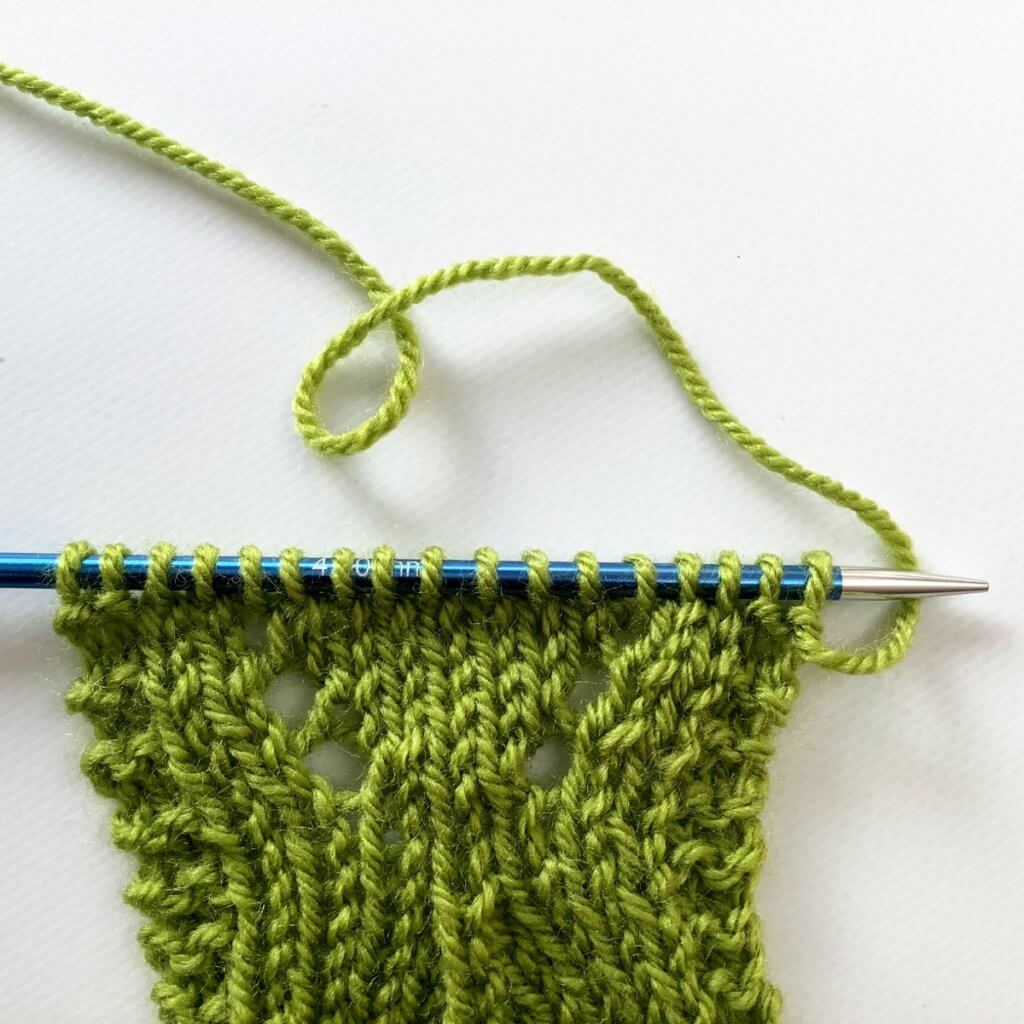
1. First, work your way across the row until you’ve reached the point where you want to make the decrease. In this case, I want to work the double decrease over the 3 stitches in the middle of the swatch.
2. To start, slip the next two stitches knitwise and together from the left knitting needle to the right knitting needle. Basically as if to knit those two stitches together.
3. The below picture shows how it looks after slipping these two stitches to the right-hand needle.
4. To knit the next stitch on the left-hand knitting needle, first, insert the right-hand needle knitwise into the front loop of the stitch.
5. Wrap the yarn around the needle…
6. … and pull it through the stitch.
7. To finish the knit stitch, slide the original stitch off the left-hand needle.
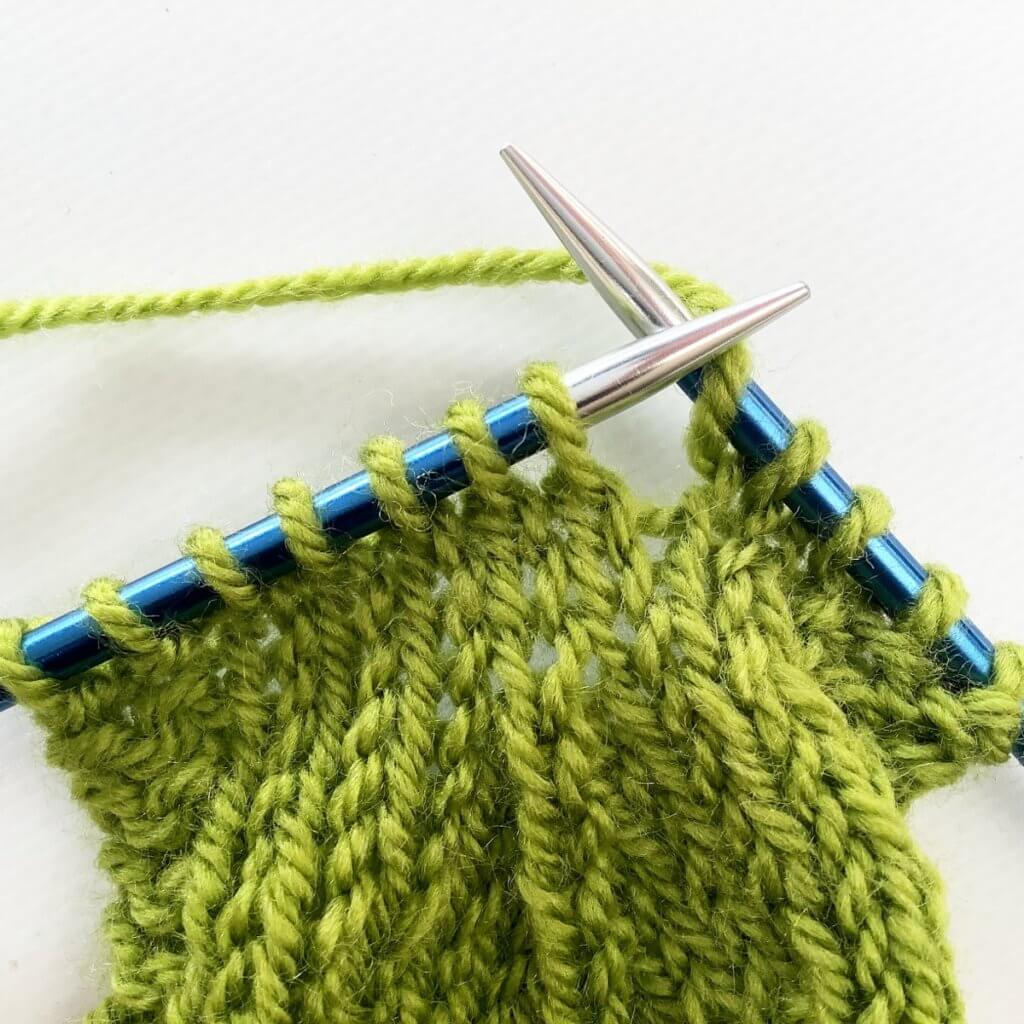
8. Now for the third and last part of this decrease, insert the left-hand needle into the two slipped stitches …
9. … and pull them over the single knitted stitch and off the right-hand needle to complete the decrease.
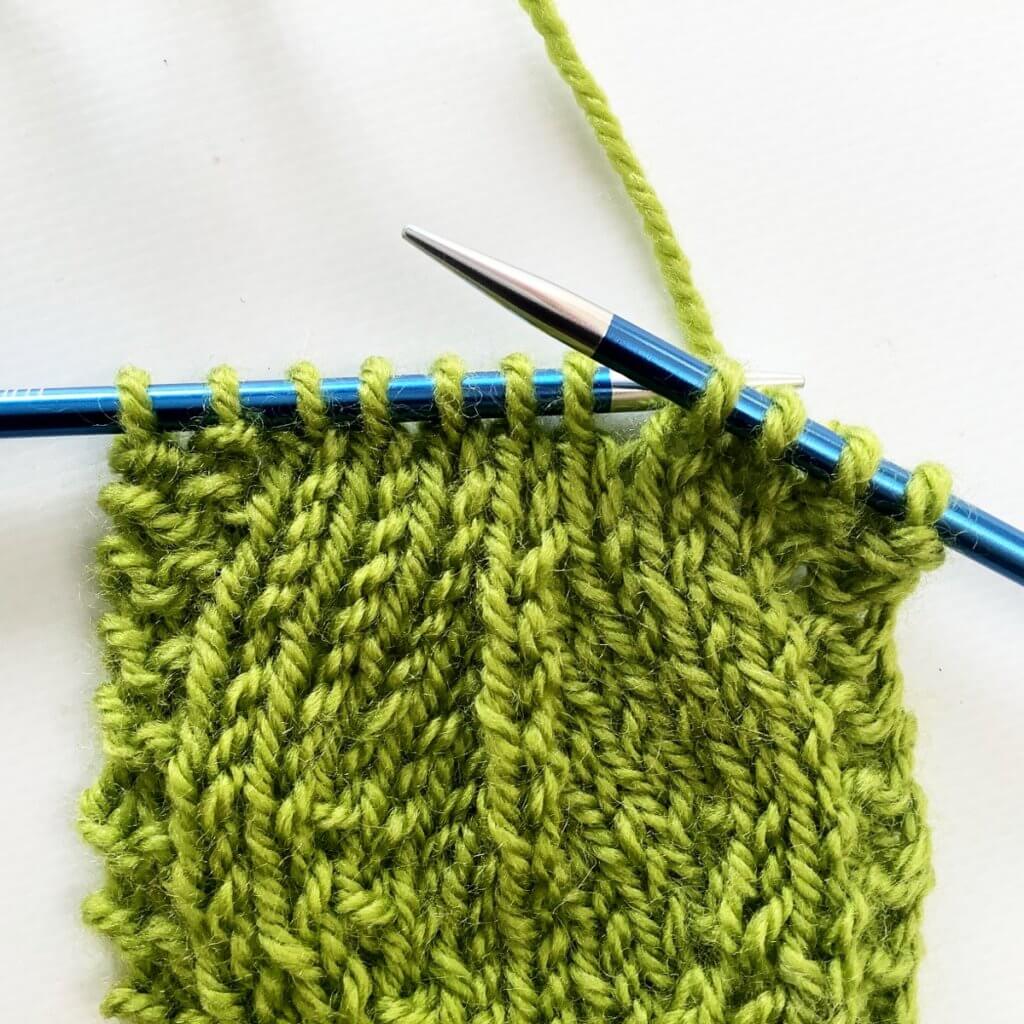
The below picture shows how it looks after 2 more decrease rows have been worked. Please note that the bottom half of the swatch pictured shows the kfb increases I showed you in a previous tutorial.
Thanks to my Patreon supporters for bringing you this freebie! Creating quality patterns and tutorials is a lot of work and resource-intensive. However, I find it important to give you free content like this tutorial. Thanks to the generous support of my Patreon supporters, I can make it happen. Thank you, patrons! Click here to join, or click here to read more about La Visch Designs on Patreon.
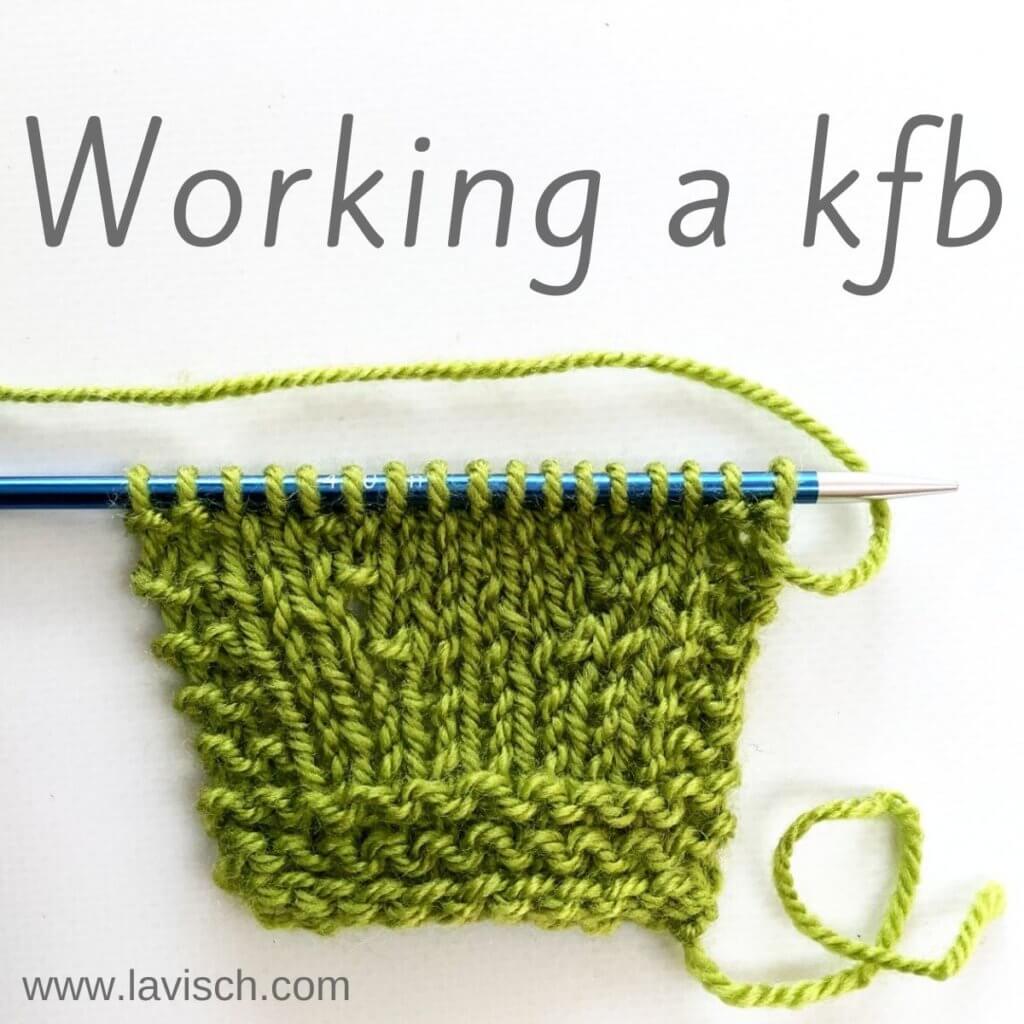
There are lots of ways to increase the number of stitches on your needle. Knitting in the front and back of the same stitch, also known as the kfb increase, is a relatively easy one. The kfb increase is also known as a “bar increase” because it forms a little horizontal bar in your work.
Due to this little bar, this increase is virtually invisible in garter stitch. When used in stockinette, as shown in this tutorial, it forms a series of decorative bars along the increase line. This how-to will give you step by step instructions on how to work the “knit front and back” increase.
Materials used
Yarn: * Paintbox Yarns Simply DK, a good value, good quality 100% acrylic yarn, here in the color 128 Lime Green.
I’ve made a little swatch and will be making the increases 2 sts in from each of the garter stitch borders.
1. First, work your way across the row until you’ve reached the point where you want to make the increase. In this case, I want the increase 2 sts in from the garter stitch border on the right. A kfb first makes a knit stitch, followed by the extra “bar” stitch on the left of it. Because of this, I start working the kfb over the second stitch.
2. To start, insert the right-hand needle knitwise into the front loop of the stitch.
3. Wrap the yarn around the needle…
4. … and pull it through the stitch. Do not let the original stitch slide of the left-hand needle yet!
5. Now we insert the right-hand needle knitwise into the back loop of the stitch.
6. Wrap the yarn around the needle…
7. … and pull it through the stitch.
8. To complete the kfb increase you can now let the original stitch slide from the needle. This is how it looks now: a knit stitch with an extra “bar stitch” to the left of it.
9. In this swatch, I’m also making an increase on the left side of the fabric. Because I want the bar stitch to be 2 sts in from the garter stitch, I now have to work the increase over the 3rd stitch from the right of the garter stitch edge stitches.
This is how it looks after the entire row with its 2 increases has been worked:
And here again, after 3 increase rows total have been worked, each with 2 kfb increases.
And that’s all there is to it!
Thanks to my Patreon supporters for bringing you this freebie! Creating quality patterns and tutorials is a lot of work and resource-intensive. However, I find it important to give you free content like this tutorial. Thanks to the generous support of my Patreon supporters, I can make it happen. Thank you, patrons! Click here to join, or click here to read more about La Visch Designs on Patreon.
If you’ve ever knit lace or eyelet-patterning you know it can happen easily: a short distraction. And when your attention is somewhere else a yarn over or yo is forgotten and all patterning and shaping is thrown off-course. It may even be that you won’t notice it until several more rows or rounds have been worked.
Personally, I have a very big aversion against ripping out my work, just because I forgot one teeny tiny stitch a couple of rows back. I mean, it certainly is an option, but I consider it to be more of a last resort type of option.
So, without further ado, here a way to fix that forgotten yo without issues and stress!
Materials used
Yarn: * Paintbox Yarns Simply DK, a good value, good quality 100% acrylic yarn, here in the color 142 Tea Rose.
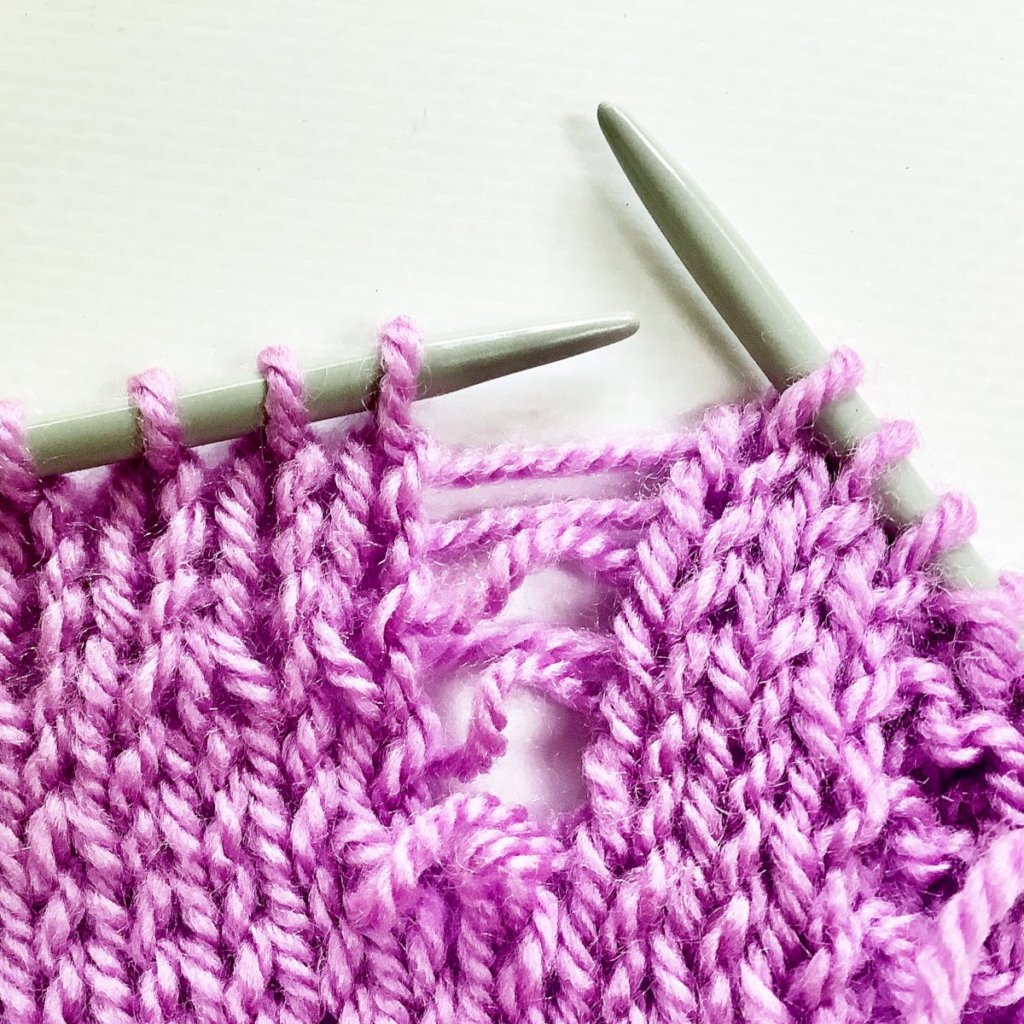
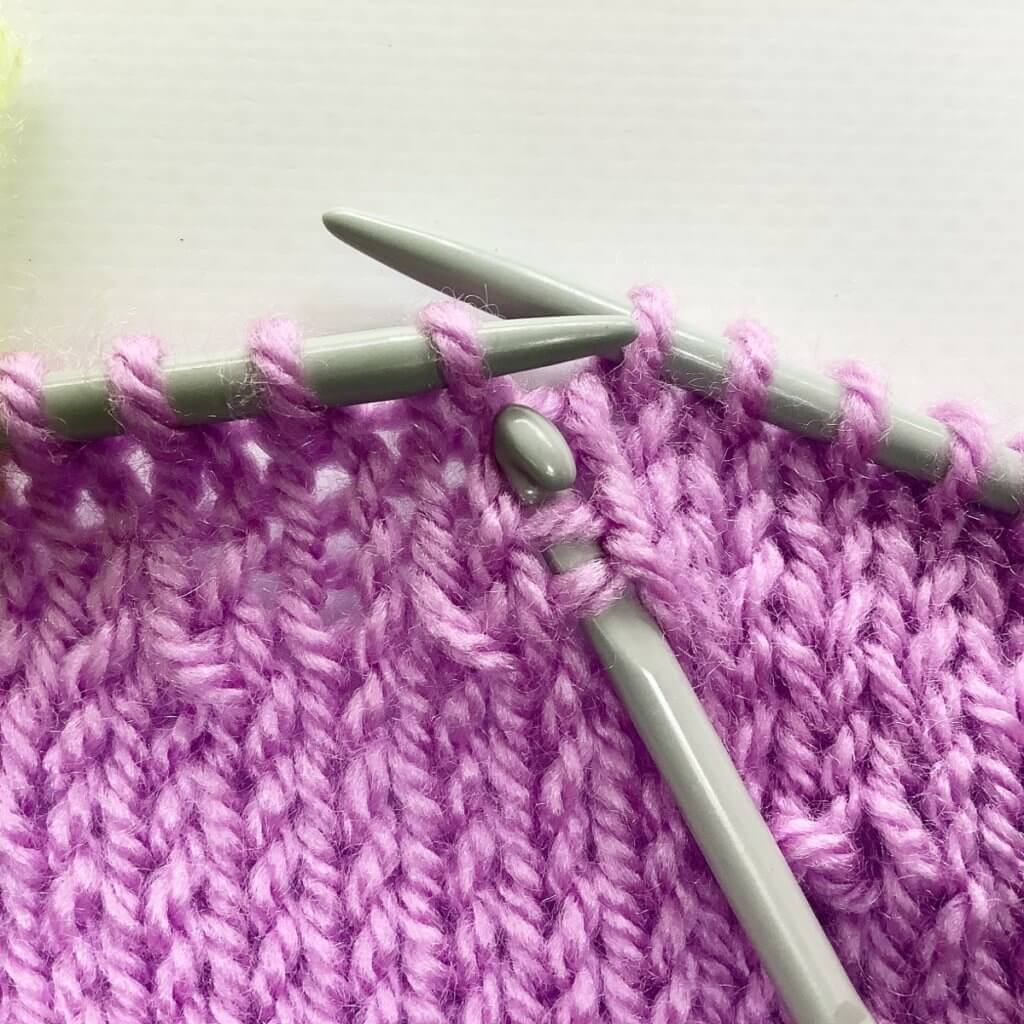
1. First, go to the spot in your knitting where the yo should have been. If you look carefully, you can see horizontal threads between the 2 columns of stitches. Do you also see the left-leaning decrease, 4 stitches down on the left-hand needle?
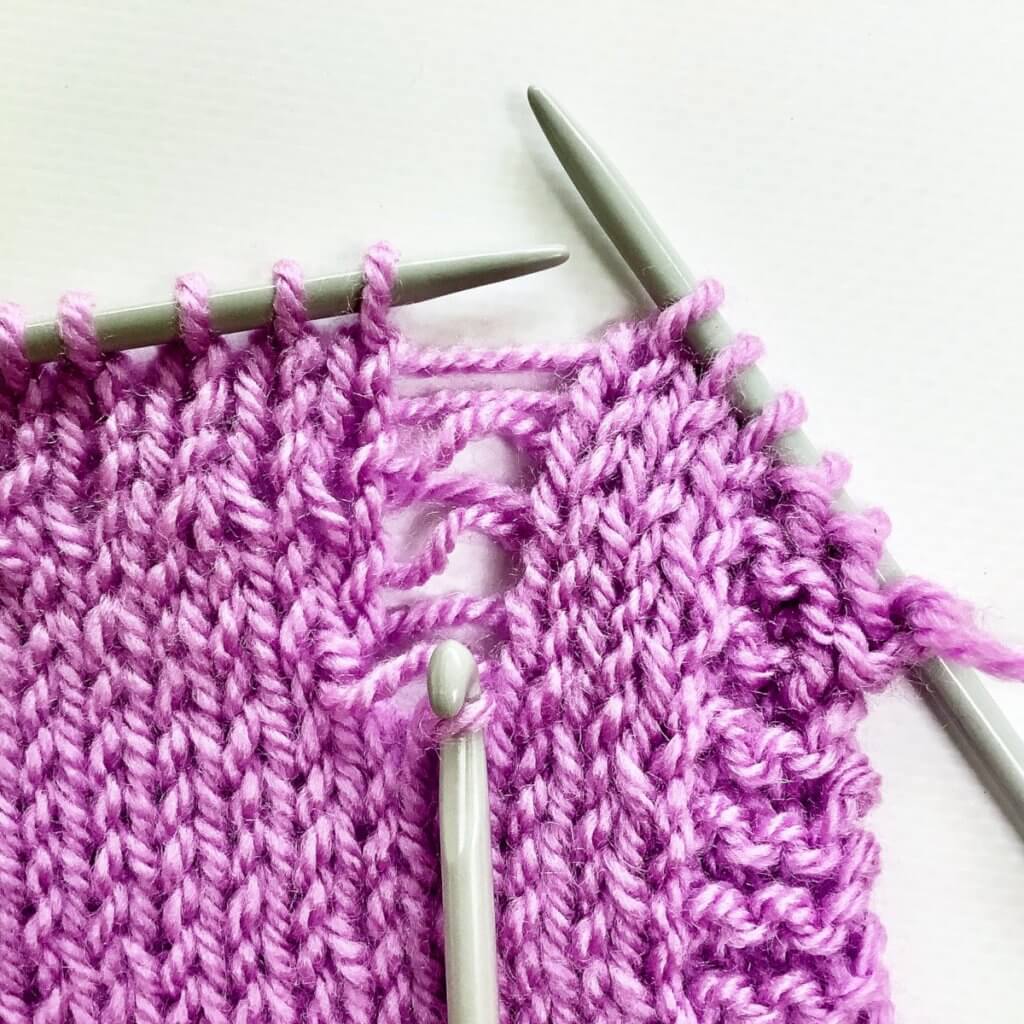
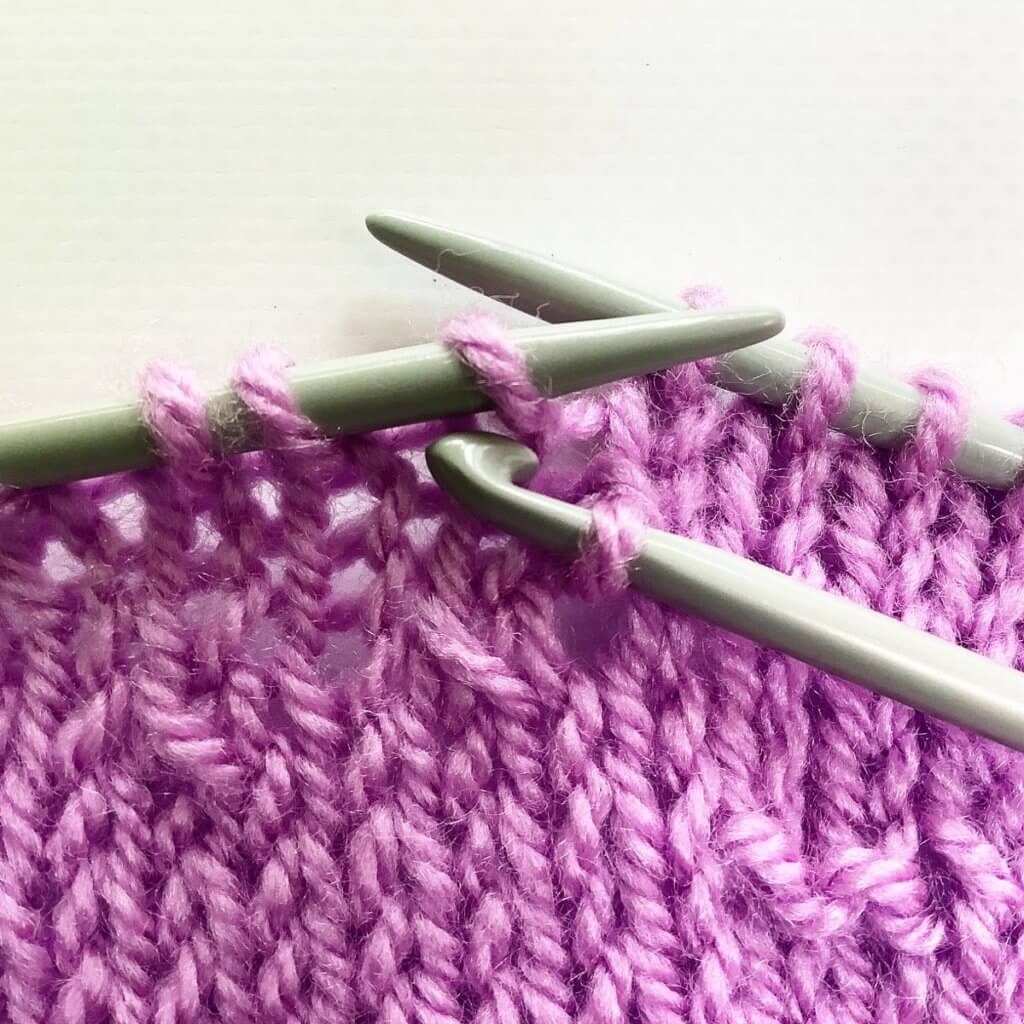
Right next to it is where the forgotten yo should have been. This means we need to insert the crochet hook from bottom to top underneath threads 3 and 4, counting from the needle down.
2. Next, pull the top thread through the other one on the hook to create the yarn over or yo.
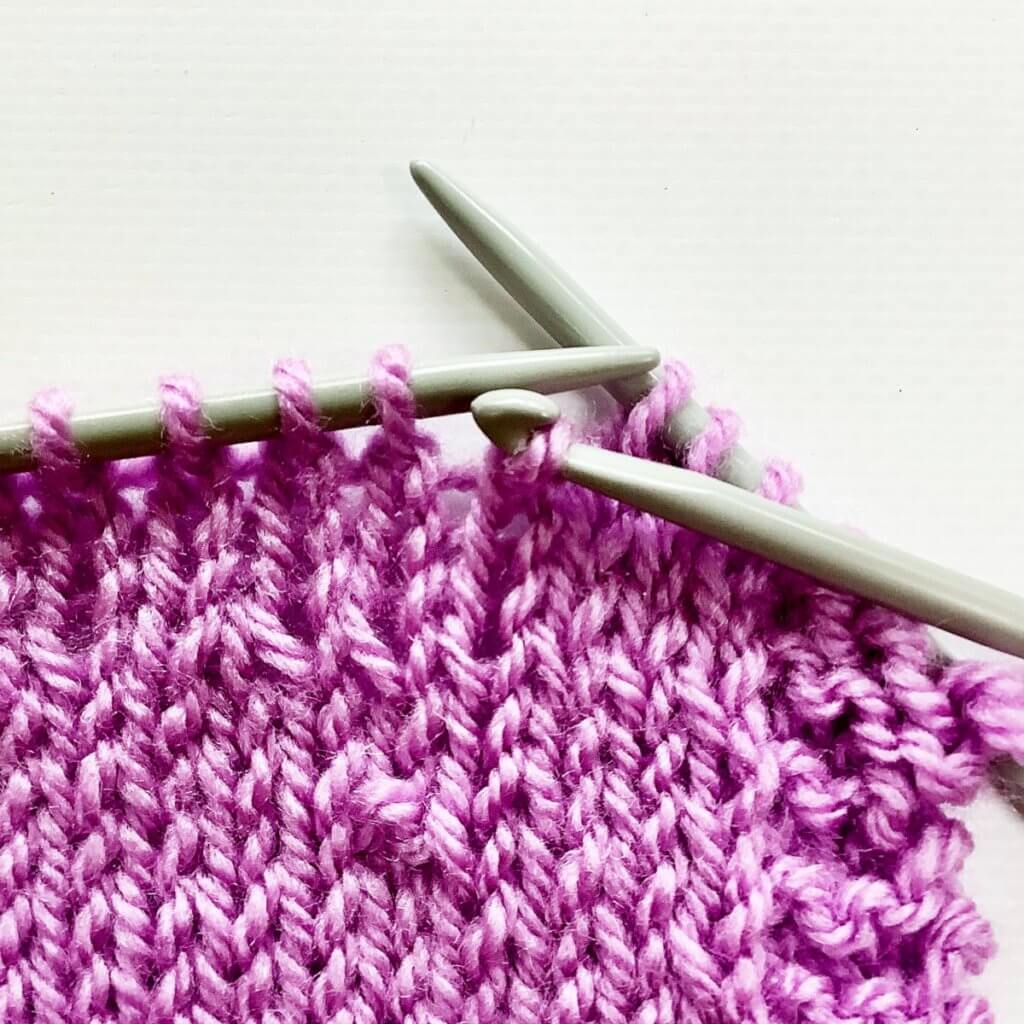
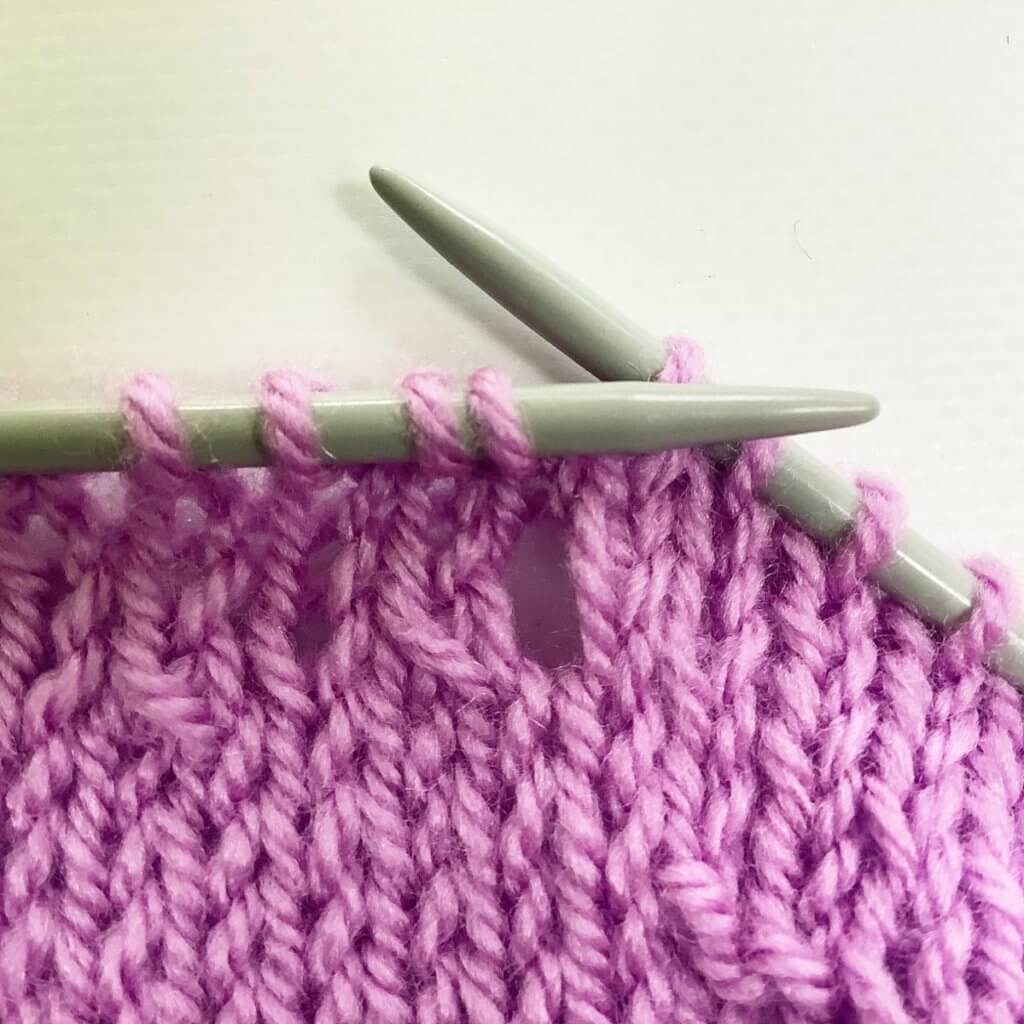
3. The next step is to insert the crochet hook underneath the horizontal thread directly above new yo and pull the thread through the loop already on the hook to make a new knit stitch. Repeat this (for stockinette) as often as needed until you’ve run out of threads to pull through and place the stitch on the left-hand needle.
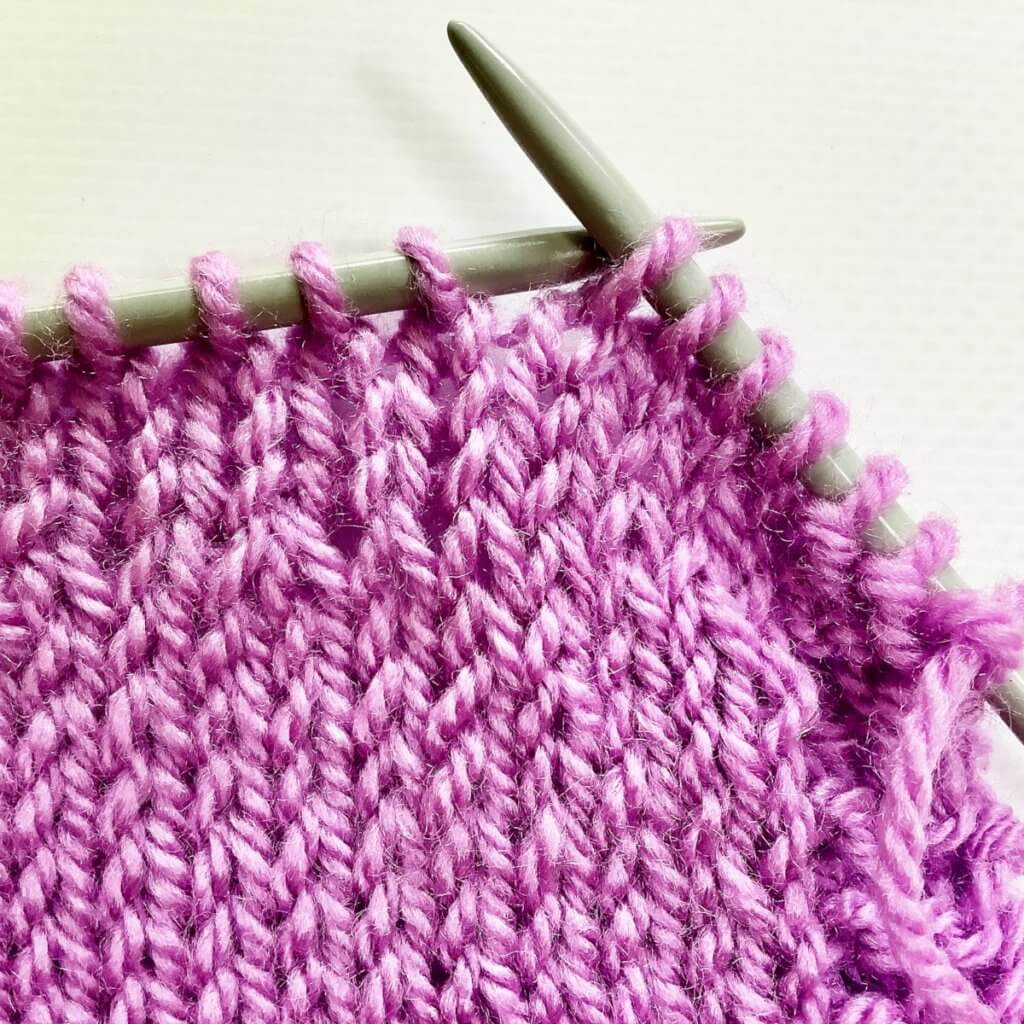
Now you’re ready to continue your knitting!
Thanks to my Patreon supporters for bringing you this freebie! Creating quality patterns and tutorials is a lot of work and resource-intensive. However, I find it important to give you free content like this tutorial. Thanks to the generous support of my Patreon supporters, I can make it happen. Thank you, patrons! Click here to join, or click here to read more about La Visch Designs on Patreon.
In this new design, I’m using mosaic slip-stitch patterning in the border. The beauty of this type of colorwork is that it is worked with a single color in a single row. In other words: An RS and a WS row are worked in the main color (MC). After working these two rows, the MC is dropped, and an RS and a WS row are worked with the contrast color (CC) yarn while slipping the sts indicated.
However, I didn’t want to use the CC yarn in the garter stitch border of 3 stitches on each side of the shawl. This caused the gaps to happen that you can see at the bottom dot:
So, of course, I had to think of a way to prevent these! I settled on a “wrap & turn” like approach, similar to w&t as in working traditional short-rows. Read on for the step by step how-to!
Materials used
Yarn: The yellow yarn is Økologisk Hverdagsuld (“organic everyday wool”) by Camarose Dk. The brown is HverdagsUld by Tusindfryd. I got these at the lovely yarn store “By Bek” in Fåborg, Denmark when I was there on vacation.
Needles: * Addi Circular Needles, pictured here in the 4 mm (US 6) size, with 80 cm (32 inches) cable.
Preventing gaps on the right step by step
1. In this row, I’m about to start the RS row using the CC yarn. The CC yarn tail is located 3 stitches in from the edge of the work, at the WS of the fabric.
2. First, we have to reach that CC yarn tail. To do so, slip the 3 MC stitches purlwise as well as the stitch marker to the right-hand needle.
3. Next, bring the CC between the needles to the front of the work.
4. Slip the stitch marker and the first of the MC stitches back the left-hand needle.
5. Now move the CC yarn between the needles back again to the WS of the work.
6. Now slip the remaining MC edge stitch and the stitch marker back to the right-hand needle and continue with the instructions in the remainder of the row.
Preventing gaps on the left step by step
1. In this row, I’m nearing the end of the RS row using the CC yarn. Stop right before the 3 MC edge stitches, the CC yarn tail as at the back of the work at WS.
2. First, we slip both the stitch marker and the first of the MC edge stitches (purlwise!) to the right-hand needle.
3. Next, we bring the CC between the needles to the front of the work. (My apologies that this picture is a tad blurry! Didn’t notice until it was too late to redo).
4. Slip the stitch marker and the first of the MC edge stitches back the left-hand needle.
5. Now move the CC yarn between the needles back again to the WS (the back) of the work.
And now you’re ready to continue with the instructions for your pattern for the remainder of the row!
Thanks to my Patreon supporters for bringing you this freebie! Creating quality patterns and tutorials is a lot of work and resource-intensive. However, I find it important to give you free content like this tutorial. Thanks to the generous support of my Patreon supporters, I can make it happen. Thank you, patrons! Click here to join, or click here to read more about La Visch Designs on Patreon.
It can happen just like that: a dropped stitch in the middle of your work! When using a somewhat “sticky” yarn, it is usually a matter of putting the stitch back on the needle and continuing to knit. With a smooth yarn, however, it may be that the stitch ladders down in your work….
Do not panic, though! A dropped stitch really isn’t that hard to fix. Especially when the project is still on the needles and you’re not dealing with patterning and shaping. So, in this tutorial, I’ll show you how to fix a dropped stitch in the middle of a piece of stockinette knitting.
Materials used
Yarn: * Paintbox Yarns Simply DK, a good value, good quality 100% acrylic yarn, here in the color 142 Tea Rose.
1. First, grab your crochet hook and catch the fallen stitch before it ladders even further down!
2. Take a look at the last stitch that sits correctly in the fabric and the stitch directly below it: Here we have stockinette stitch. This means that we, therefore, insert the crochet hook through the stitch from the front to the back.
3. Next, insert the crochet hook underneath the thread directly above the dropped stitch…
4. … and pull the thread through the loop already on the hook to make a new knit stitch.
5. Repeat steps 4 and 5 (for stockinette) until you have run out of threads to pull through.
6. Place the stitch back on the knitting needle and continue knitting as if nothing happened!
An that’s all there is to it! Really not that hard, right?
Thanks to my Patreon supporters for bringing you this freebie! Creating quality patterns and tutorials is a lot of work and resource-intensive. However, I find it important to give you free content like this tutorial. Thanks to the generous support of my Patreon supporters, I can make it happen. Thank you, patrons! Click here to join, or click here to read more about La Visch Designs on Patreon.
The purl through the back loop stitch (or ptbl for short) is a variation of the purl stitch. It creates a twisted stitch by slightly turning the stitch while you work it. I’ve used the ptbl in some of my patterns, for example in the Art Deco shawl pattern.
And while it isn’t a hard stitch to work, it can be a tad tricky if you’re not familiar with how to work into that back loop of a stitch. So, for that reason, it’s a good idea to get that straight. If you look at the picture below, you can see that the first stitch on the needle consists of a loop of yarn, straddling the needle. The “leg” facing is what we call the “front loop”. Likewise, the “leg” at the back of the work is the “back loop” one.
Materials used
Yarn: *
Paintbox Yarns Simply DK,
a good value, good quality 100% acrylic yarn, here in the color 125
Spearmint Green.
1. First, we have to make sure that the working yarn is at the front of the work since we’ll be working a purl stitch.
2. Next, insert the right-hand needle purlwise into the back leg or loop of the stitch. To do this, it is important to know the difference between knitwise and purlwise when talking about that back loop. To insert the needle knitwise you’d insert the needle away from the tip of the left-hand needle. In the same vein, to insert the needle purlwise you’d insert the needle towards the tip of the left-hand needle!
In the picture below the needles have become a bit twisted due to me holding everything with my left hand and the camera in the other. But if you take another look at the picture with the blue yarn above you can see exactly what I mean!
3. Now wrap the yarn around the needle…
4. … pull it through and slip the resulting stitch from the left-hand needle to complete your ptbl stitch.
And that’s all there is to it! Not that hard, right?
Thanks to my Patreon supporters for bringing you this freebie! Creating quality patterns and tutorials is a lot of work and resource-intensive. However, I find it important to give you free content like this tutorial. Thanks to the generous support of my Patreon supporters, I can make it happen. Thank you, patrons! Click here to join, or click here to read more about La Visch Designs on Patreon.
In one of the designs I’m working on, I’m using a lovely intricate stitch pattern from the Japanese Knitting Stitch Bible by Hitomi Shida. In this particular stitch pattern, a Left Twist stitch is used. So, in this post, I’ll go into the details on how to work this stitch.
The basic characteristic of a Left Twist is that it switches the order of 2 adjoining stitches, one “main stitch” and one “background stitch” to make it appear that the main stitch travels to the left. The background is usually reverse stockinette. The main stitch is usually worked twisted (working the stitch through the back loop) stockinette. This way it pops even more against the background.
The instruction from the Japanese Knitting Stitch Bible for this stitch consists of the following text:
With RN, go behind first st and p
second st without removing it from LN; ktbl first
st and slip both off LN.
Now, I don’t know if you’ve tried this, but following the above instruction didn’t give me anything resembling the picture of the worked left twist. It may be due to where I had my yarn or the fact that I knit weird, who knows? Anyway, I did some more research and found that this type of traveling stitch is also used quite a lot in Bavarian knitting. I also found that there are quite some ways it can be worked. Take for example this one from leethalknits.com, the one described in this Interweave article or the elaborate description of methods by Rox over on Ravelry.
Personally, I found just changing the order of the stitches before actually knitting them (as one would do for cabling without a cable needle) to be easiest. So that’s what I will show you in this tutorial.
Materials used
Yarn: Paintbox Yarns Simply DK, a good value, good quality 100% acrylic yarn, here in the color 125 Spearmint Green.
Needles: KnitPro Zing Fixed Circular Needles. In this tutorial, I used the 4 mm (US 6) size with a cable length of 80 cm (32 inches).
Some words about the swatch
In this swatch, I’ve taken part of the stitch pattern in which I encountered the Left Twist stitch. It consists of a k3, p4 rib in which the left-most knit stitch travels across the purl stitches until it joins the next column of knit stitches. As you can see, I’ve already worked one RS row with a Left twist, as well as it’s accompanying WS row.
Working a Left Twist step by step
1. The first 2 stitches on the left-hand needle in the picture
below, are the ones we’re going to work the Left Twist over. In other
words: we’re going to switch the order of the knit and the purl
stitch, to make it appear that the knit stitch travels to the left.
2. First I make sure to move the working yarn to the front of the work since the first stitch to work will be a purl stitch. Next, I grab the yarn directly below the 2 stitches to be switched and pinch down as pictured.
3. Next, I move these stitches off the left-hand needle. Keeping the fabric pinched, makes sure that the stitches won’t ladder down.
4. Then insert the left-hand needle knit wise into the loose stitch on the right to put it back on the needle. Make sure to keep pinching the fabric underneath the other stitch! Especially now we’re placing some stress on the yarn.
5. Now insert the left-hand needle knit wise into the remaining loose stitch and put it back on the needle. This can be somewhat fiddly.
6. Now it’s time to insert your right-hand needle purl wise into the first stitch from the tip of the left-hand needle.
7. Next, wrap your yarn around the needle, pull it through and let the stitch slide of the needle to complete the purl stitch.
8. Next is to work the traveling stitch itself. To make it pop against the background and tighten it up a bit, this stitch is worked through the back loop. So, insert your right-hand needle knit wise into the first stitch from the tip of the left-hand needle.
9. Next, wrap your yarn around the needle, pull it through and let the stitch slide of the needle to complete the twisted knit stitch.
Then what?
On the following wrong side row, work the stitches as they present themselves. In other words: what looks like a knit stitch is knit, what looks like a purl stitch is purled, and the “traveling stitch” itself is purled through the back loop. Below is how it looks after a couple of more rows have been worked. Please note this piece has not been blocked!
Thanks to my Patreon supporters for bringing you this freebie! Creating quality patterns and tutorials is a lot of work and resource-intensive. However, I find it important to give you free content like this tutorial. Thanks to the generous support of my Patreon supporters, I can make it happen. Thank you, patrons! Click here to join, or click here to read more about La Visch Designs on Patreon.
Russian grafting is a method of joining live knitting stitches together. It’s an alternative to the Kitchener stitch and is a quick and easy method for finishing off your knitted piece. In this tutorial, I’ll show you the in’s and outs of using the Russian grafting method to connect 2 pieces of stockinette fabric. Of course, this method has pro’s and cons when compared with the Kitchener stitch, which I’ll go into below.
Pro’s
When using Russian grafting on stockinette, a decorative seam is created on the outside of the work.
No working yarn is necessary, this makes this method, not a “true” grafting method.
When grafting with this method, the stitches of the pieces to be joined align better than with Kitchener stitch grafting. This can be desirable when using patterning.
Con’s
Since Russian grafting is worked by pulling existing stitches through other stitches, there is no way to adjust the tension of the graft.
The seam will be visible if it’s used on a piece of very open lace fabric.
Materials used
Yarn: * Paintbox Yarns Simply DK, a good value, good quality 100% acrylic yarn, here in the color 125 Spearmint Green.
I’ve made 2 little swatches of stockinette and slipped one of those to another knitting needle, making sure the yarn tail is on the left side. Position the needles as pictured. Now we’re ready to start the actual Russian graft!
Set-up
1. Back needle: Insert the crochet hook purlwise through the first stitch on the needle …
2. … and slide it off the needle.
3. Front needle: Insert the crochet hook purlwise through the first stitch on the needle ….
4. … and slide it off the needle.
5. Now pull this second stitch through the first stitch on the hook, so only 1 loop remains on the crochet hook.
Repeat
1. Back needle: Insert the crochet hook knitwise through the first stitch …
2. … and slide it off the needle.
3. Pull this last stitch through the first stitch on the hook, so only 1 loop remains on the crochet hook.
4. Front needle: Insert the crochet hook knitwise through the first stitch …
5. …and slide it off the needle.
6. Pull this last stitch through the first stitch on the hook, so only 1 loop remains on the crochet hook.
Repeat steps 1-6 until all stitches have been worked. At this point you will have 1 stitch remaining on the crochet hook:
To finish the graft, pull the yarn tail through this last stitch to secure it. This was the reason to shuffle the stitches around on one of the swatches, otherwise, we wouldn’t have a yarn tail available.
And that’s how Russian grafting on stockinette is done! The seam is very decorative on its own and could be used as a design element instead of a 3-needle bind-off. Think for example when closing the shoulder seams on a bottom-up sweater.
Thanks to my Patreon supporters for bringing you this freebie! Creating quality patterns and tutorials is a lot of work and resource-intensive. However, I find it important to give you free content like this tutorial. Thanks to the generous support of my Patreon supporters, I can make it happen. Thank you, patrons! Click here to join, or click here to read more about La Visch Designs on Patreon.