tutorial

tutorial

dyeing with natural dyes: part 3 – the dye bath

Dyeing with natural dyes - preparing the dye bath, a tutorial by La Visch Designs

This post is part 3 in a series about dyeing wool with natural dyes. This part is all about the various steps in preparing the dye bath.

The steps to go through are as follows:
a. Washing the wool
b. Mordanting
c. Preparing the dye
d. Dyeing your wool

Today we are going to make the dye bath! In this experiment I’m going to dye with madder. Below I want to tell you some more about this first.

Madder

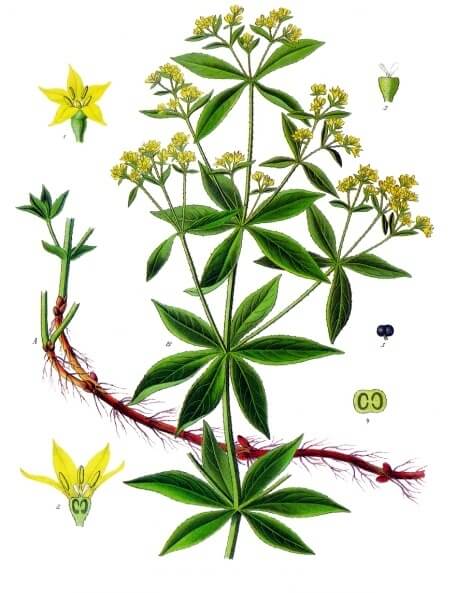
Dyeing with natural dyes - preparing the dye bath, a tutorial by La Visch DesignsMadder (Rubia tinctorum) has been used as a dye for many thousands of years. The reason? It is one of the most light-resistant red dyes of natural origin. It was and is used for the coloring of textiles and leather. In the fifteenth century, the Netherlands was the main producer of the madder. Particularly in Zeeland there were many fields of madder plants in the 19th century. At least until synthetic dyes became available.

The plant is about 60-90 cm high and has small yellow flowers. Below ground are the rhizomes, which can go as deep as  50-100 cm. The roots are the part that is of interest for dyeing. Madder is harvested about three years after planting, because only then the roots are big enough. After drying, the roots are ground to small pieces or powder.

c. Making the dye bath

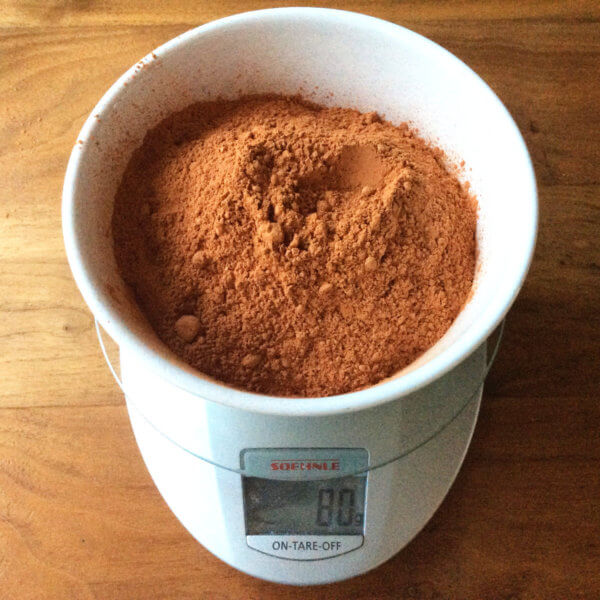
In order to dye  with madder root, you need about 25-50 g of powder per 100 g of wool. The precise amount depends upon the desired strength of the dye bath. For my wool (weighing in at 200 g dry weight) I will use a total of 80 g of madder powder. Here are the steps I followed:

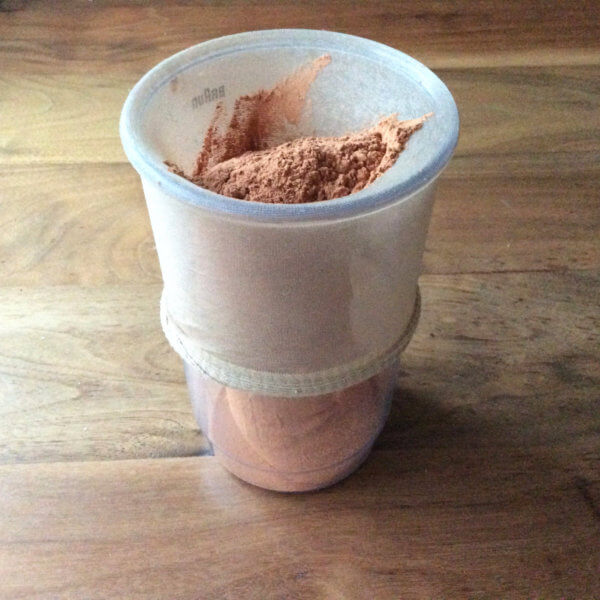
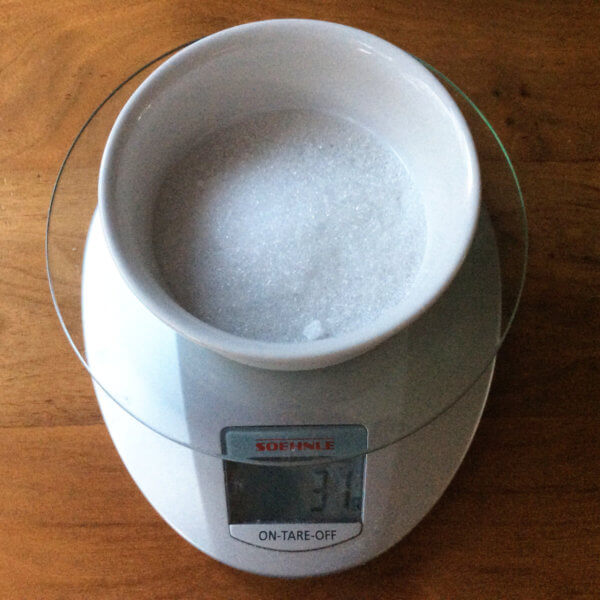
1. Weigh your dye stuff, powdered madder root in my case.

Dyeing with natural dyes - preparing the dye bath, a tutorial by La Visch Designs

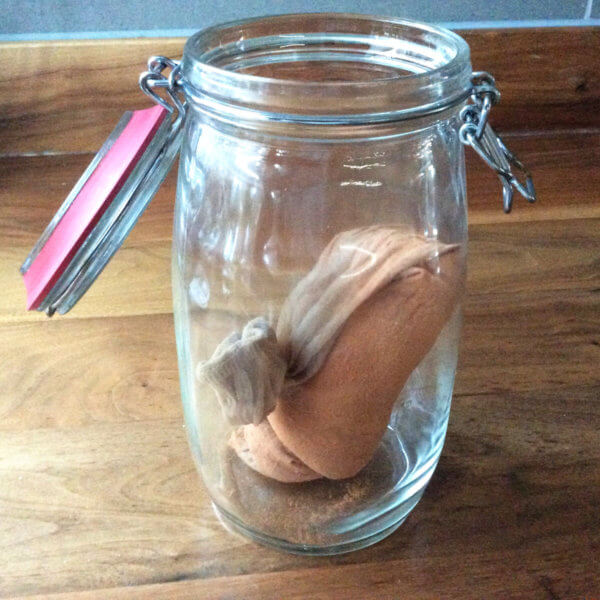
2. Put your dye stuff in an old bit of pantyhose or make a “tea bag” from it by other means. You want the dye stuff  in it to have adequate space to absorb moisture and to release its dye to the water. The dye stuff “tea bag” makes it easier later on to remove it out of your dye bath. It also has the great benefit of not having to remove any pieces or powder out of your wool.

Dyeing with natural dyes - preparing the dye bath, a tutorial by La Visch Designs

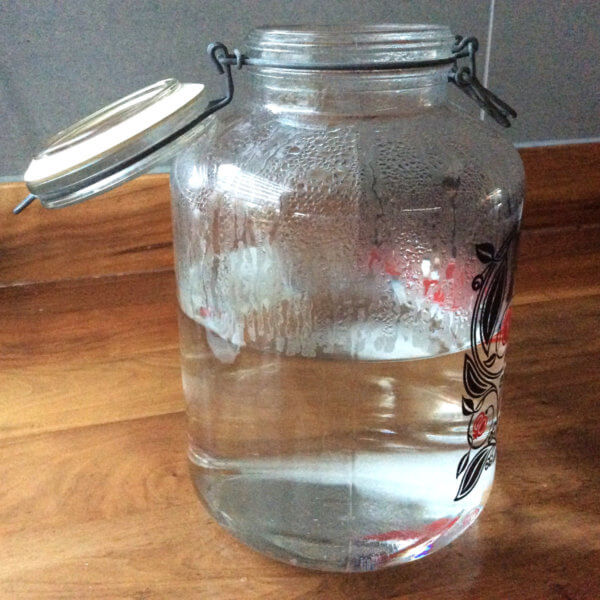
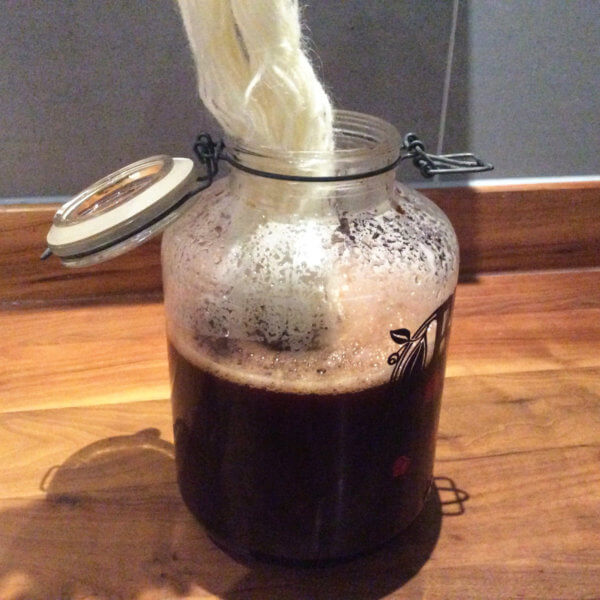
3. Put the dye bag in a glass jar and cover with boiling water. I understand that madder provides a brighter shade of red when using “hard” water. Do you have soft water? Then add some chalk in the form of calcium carbonate to your dye bath.

Dyeing with natural dyes - preparing the dye bath, a tutorial by La Visch Designs

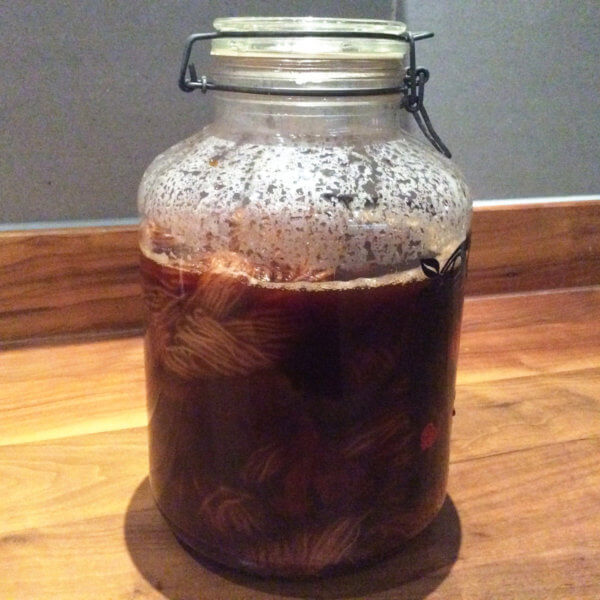
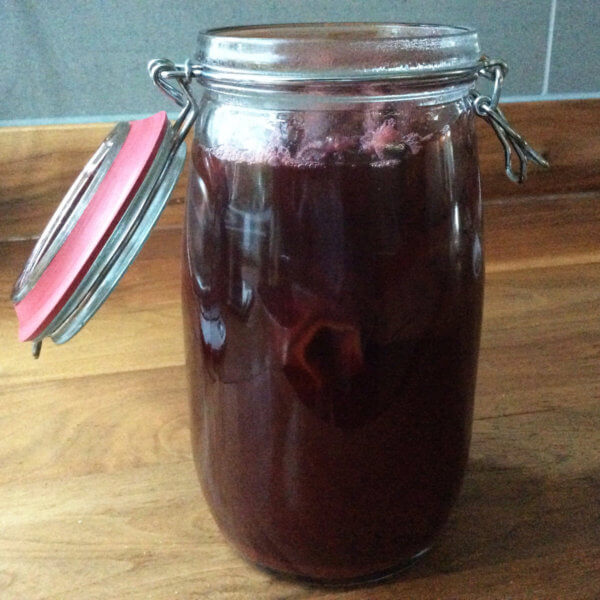
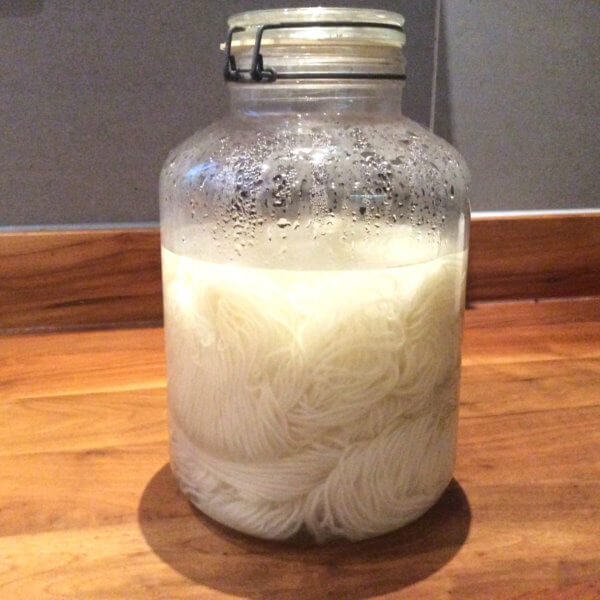
4. Allow the dye bath to soak overnight. This is how mine looks after one night of patience:

Dyeing with natural dyes - preparing the dye bath, a tutorial by La Visch Designs

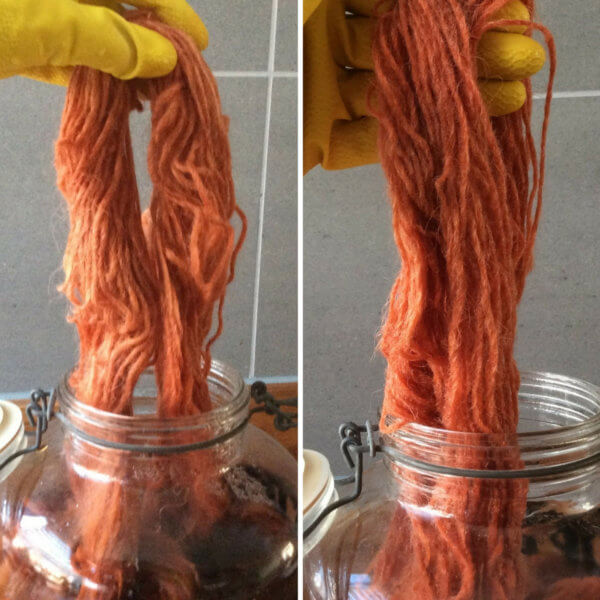
Now it’s finally time to dye! More on this in my next post.

dyeing with natural dyes: part 3 – the dye bath Read More »
dyeing with natural dyes: part 2 – mordanting

Dyeing with natural dyes - mordanting, a tutorial by La Visch Designs

This post about mordanting your fiber is part 2 in a series in which I tell you all about what is involved in dyeing wool with natural dyes. I guide you through the various steps and take you along with a natural dye experiment.

The steps to go through are as follows:

a. Washing the wool
b. Mordanting
c. Preparing the dye
d. Dyeing your wool

Today we are going to mordant the wool we washed in the previous step.

b. Mordanting

Mordanting of the wool is usually required with natural dyeing to ensure that the wool fibers are all opened up so that the dye can penetrate into the fiber. Without mordanting the dye adheres less well and the resulting color is less bright and colorfast.
There are several possible mordants: alum (potassium aluminum sulfate), chrome (potassium dichromate), copper sulfate, iron (ferrous sulfate), and tin (stannous chloride).

Each mordant has a different effect on the outcome of the dyeing process. Iron for example will “sadden” or darken colors, bringing out the green shades. Because alum is, when compared to the others, much less polluting and releases no harmful vapors during processing, I use it in this step-by-step guide.

1. The amount of mordanting agent to use depends on the quantity of wool that you want to dye. Typically, alum is used between 8% and 20% of the weight of the wool (dry weight!). I start at 15% and have 200 g of wool, therefore I use 30 g alum. (I know that the photograph shows 31 g, have corrected the weight after making the picture!)

Dyeing with natural dyes - mordanting, a tutorial by La Visch Designs

Tartaric acid (“cream of tartar”) is sometimes used as an additive when mordanting with alum. As I understand it, it can brighten the colors. Use at approx. 7% of the weight of fiber together with 8% alum. In this example, I however do not use it.

2. Dissolve the alum (and, possibly, tartaric acid) in a glass jar or stainless steel pan of boiling water. Use enough water to fully submerge your amount of wool.

Dyeing with natural dyes - mordanting, a tutorial by La Visch Designs

3. Add the wet wool to the pot. This may be immediately after washing. If your wool has dried between washing and mordanting, let it soak in water for about half an hour first. Adding dry wool to a mordanting or dye bath may cause streaks in your fiber.

Dyeing with natural dyes - mordanting, a tutorial by La Visch Designs

Many instructions for dyeing wool indicate to keep it all warm at the simmering point for more than an hour. That may indeed be the case, but you can also get good results if you let it cool completely and then allow to stand overnight. This cold mordanting takes more time, but much less energy and therefore has my preference.

4. After mordanting, the wool must be rinsed.

mordanting_4

5. Next you can directly proceed to dyeing the wool, or (if the timing is not quite right) hang your wool to dry. Once mordanted and dried, simply store the wool until you are ready to dye.

Dyeing with natural dyes - mordanting, a tutorial by La Visch Designs

Now it is time to proceed to the next step: preparing your dye bath. More on this in my next post!

dyeing with natural dyes: part 2 – mordanting Read More »
dyeing with natural dyes: part 1 – washing the wool

Dyeing with natural dyes part 1: washing the wool - a tutorial by La Visch Designs

Dyeing wool with food coloring like Easter egg dyes is of course a lot of fun and very easy to do. Lately, however, the possibilities of natural dyes intrigue me. Think of onion skins, indigo, madder, annatto and logwood.

In order to get good results with natural dyes, more steps are required, than with food coloring. In this series of posts I will guide you through the various steps and take you along with a natural dye experiment. Before I proceed I must tell you that I am by no means an expert in this area. I’m only sharing what I have learned in my own experiments!

The steps to go through are as follows:

  1. Washing the wool
  2. Mordanting
  3. Preparing the dye bath
  4. Dyeing your wool

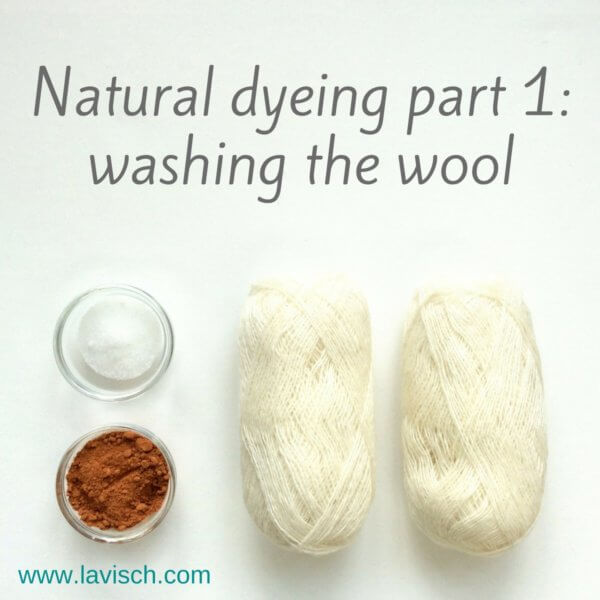
Today we are going to discuss the preparations with respect to washing the wool. Of course, it is also useful to know what materials are needed!

Materials

Collecting the required materials is obviously an important step. However, this step I haven’t included in the above overview, because what will be required depends very much on the choices made with respect to your natural dyes of choice.

Things you will however (almost) always need are:

  • Protein (animal-based) fibers, such as wool or silk or cellulose (plant-based) fibers, such as cotton, linen, or hemp. Man-made fibers like acrylics can’t be dyed this way!
  • Pieces of waste yarn to tie up your yarn into skeins.
  • Detergent (without enzymes).
  • The natural dyes or dye material.
  • A mordant like alum. This is used to help the dye adhere to the fiber and helps in achieving bright colours.
  • For warm dyeing: A stainless steel or enamelled pan which will not be used for cooking anymore.
  • For cold dyeing: Glass jars in the number or volume big enough for the amount of wool that you want to dye.
  • Old nylons or other material to make a “tea bag” for your dye material.
  • Rubber gloves, stainless steel spoons.

a. Washing the wool

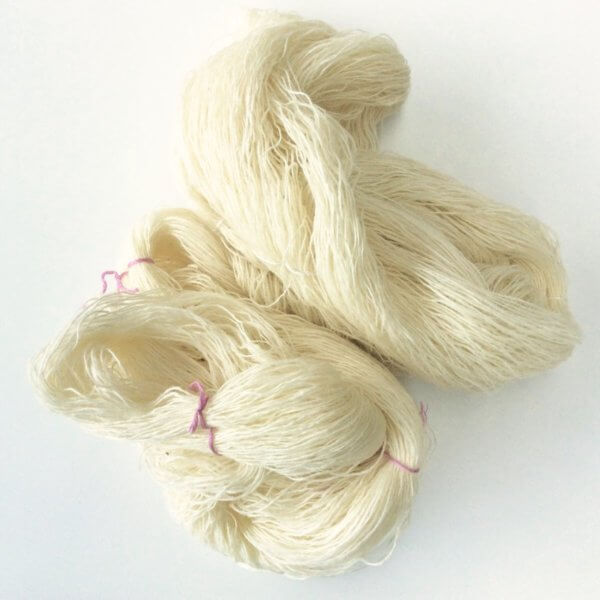
If you buy wool yarn, you may be inclined to dye without washing it. There is however a chance that there is a reasonable amount of lanolin, spin oil or other debris still present on the yarn. This makes it difficult for the dye to penetrate well into the fiber. This in turn results in your wool having less vivid colors and being a less colorfast.
For best results, wash first is the motto.

Dyeing with natural dyes part 1: washing the wool - a tutorial by La Visch Designs

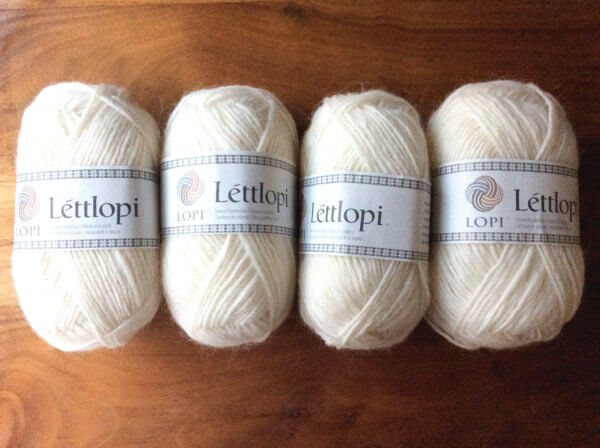
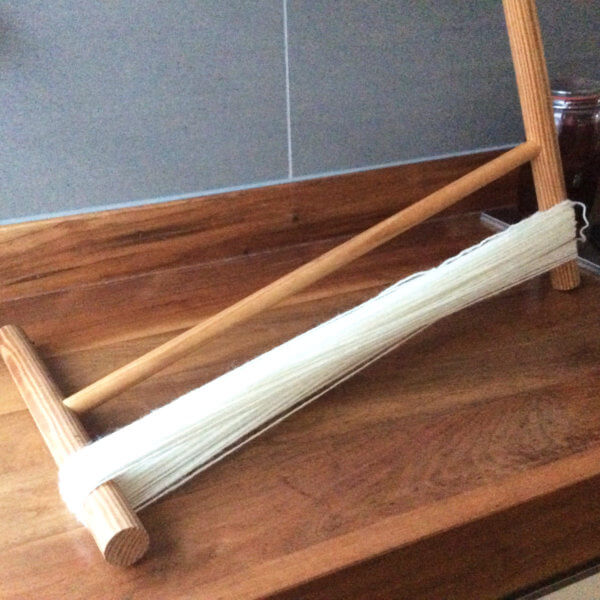
1. In this experiment I used Lettlopi, it is sold in the lovely put-up shown. However, when washing like this, the yarn will tangle beyond hope. Therefore it is wise to rewind first into skeins. I use my niddy noddy, but the yarn can of course also, for example, be wound around the back of a chair.

Dyeing with natural dyes part 1: washing the wool - a tutorial by La Visch Designs

And yes, I know that my niddy noddy isn’t used “correctly” in this picture. I prefer using it this way because I like the length of the skein it gives. Fortunately, there is no such thing as wool-police!

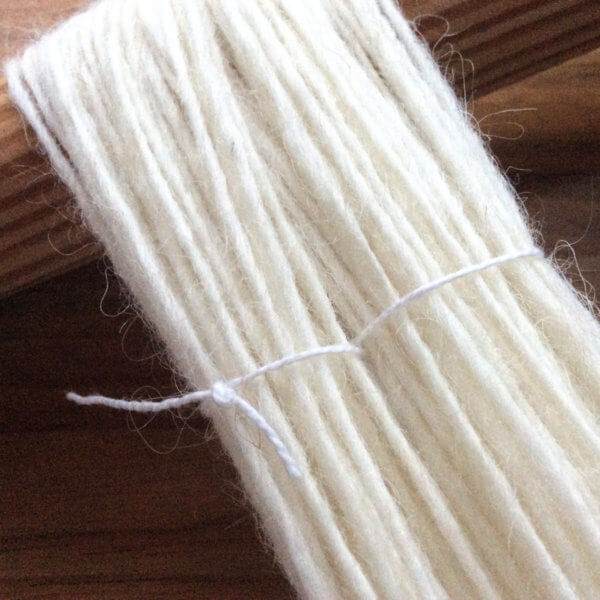
2. To ensure that the skeined yarn does not tangle, tie it together with some waste yarn in several places. Do not tie it too tight, this may prevent the dye from fully penetrating the wool in those spots. I do this as follows four places:

Dyeing with natural dyes part 1: washing the wool - a tutorial by La Visch Designs

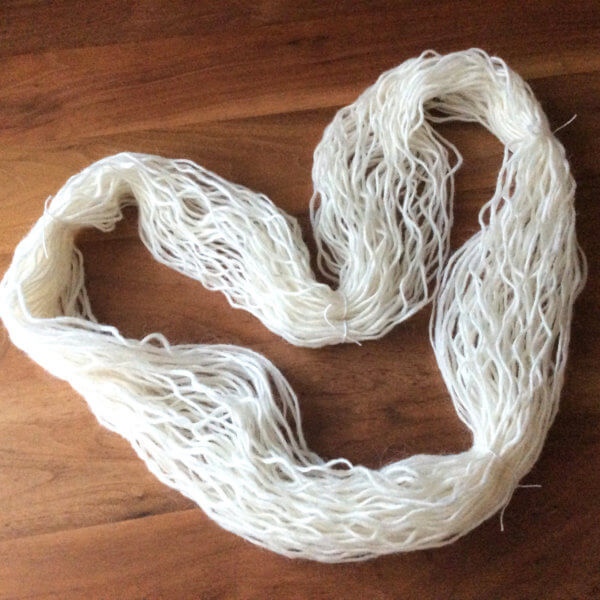
The entire skein then looks like this:

Dyeing with natural dyes part 1: washing the wool - a tutorial by La Visch Designs

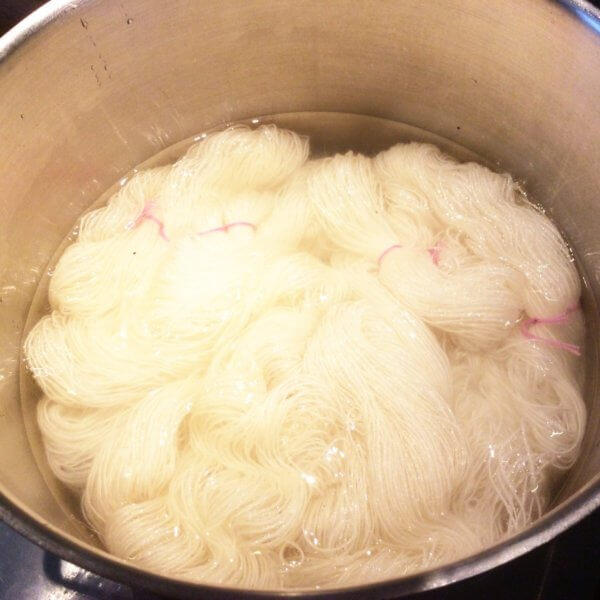
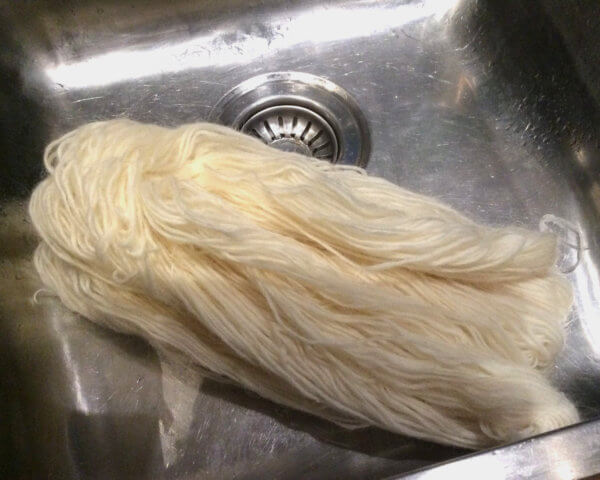
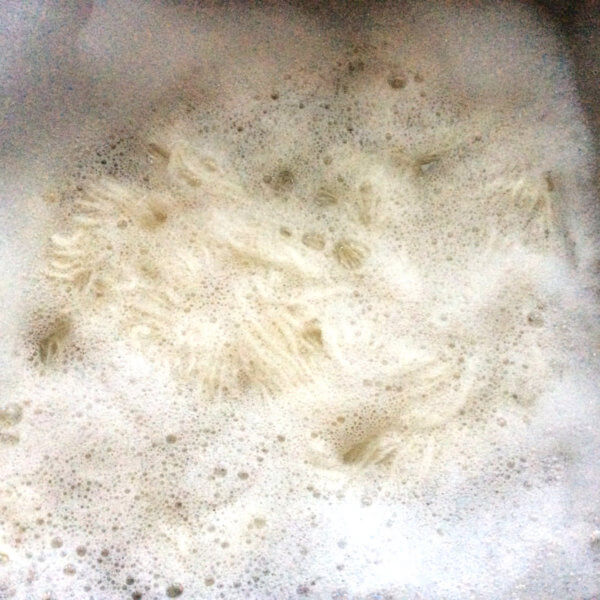
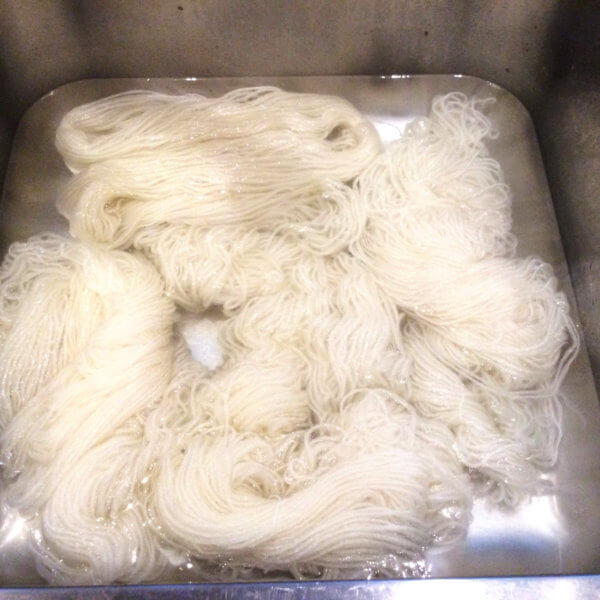
3. Now we go on to the washing! Use water of at least 60 C or 140 F for best results. I use water as hot as it comes out of the tap. If this is not very hot in your case, add a splash of boiling water from the kettle or stove. Add a dash of detergent and then the wool. Use detergent without enzymes, since these would damage the wool. Strongly agitating the wet could felt it, but gentle stirring should not be a problem.

Allow the wool to stand for about 15 to 20 minutes, but don’t let it cool down completely. Any lanolin dissolved in the water could then precipitate again on the wool.

Dyeing with natural dyes part 1: washing the wool - a tutorial by La Visch Designs

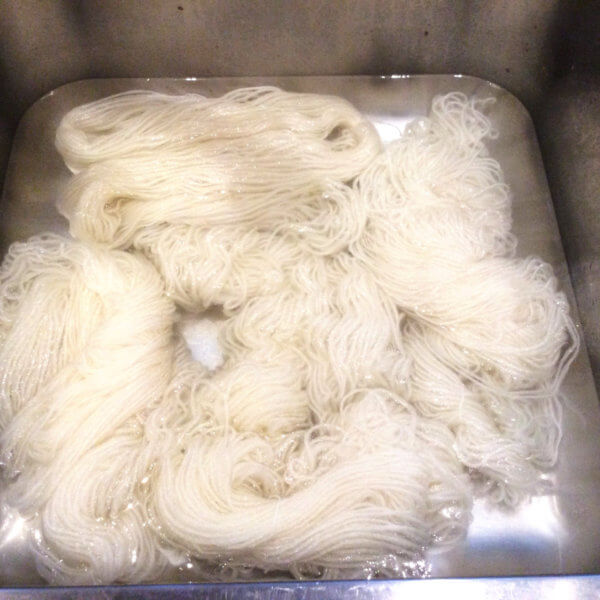
4. Now it’s time to rinse the wool with warm water. Do not rinse with cold water, a big difference in temperature from hot to cold can felt your wool!

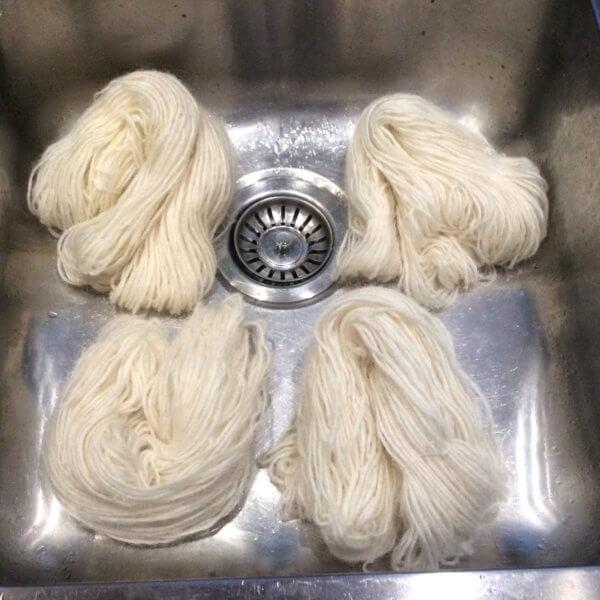
Dyeing with natural dyes part 1: washing the wool - a tutorial by La Visch Designs

After rinsing it is time to proceed to the next step: mordanting the wool. More on this in my next post!

Dyeing with natural dyes part 1: washing the wool - a tutorial by La Visch Designs

dyeing with natural dyes: part 1 – washing the wool Read More »
tutorial: knitting the loopy bind-off

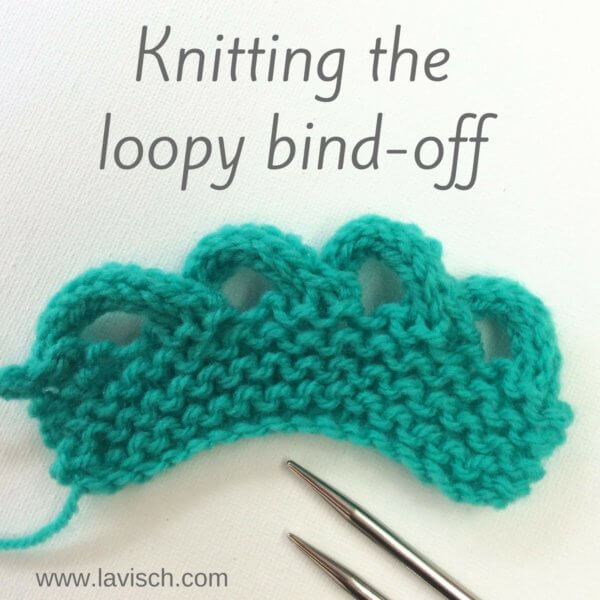
Knitting the loopy bind-off - a tutorial by La Visch Designs - www.lavisch.com

In this post I want to show you a variation of the i-cord BO: the loopy bind-off. With a regular i-cord BO you work directly over all stitches, binding them off. With the loopy bind-off loops of i-cord are made in between the stitches that are to be bound off. This does not only give a highly decorative edge, but is also a very elastic finishing. For this reason, this would be a nice BO to use on items like shawls, that have to be blocked quite aggressively for the best results.

Similar to regular i-cord (click here for the post about it!), this stitch can be knit over 3, 4 or 5 stitches. The more stitches, the fatter the resulting i-cord will be. The number of stitches also affects the loops in this bind-off: if you want to knit the i-cord for the loops over 3 stitches, you will need a multiple of 3 stitches to bind-off.

Knitting the loopy bind-off - a tutorial by La Visch Designs - www.lavisch.com

To knit the loopy bind-off, you need a set of knitting needles, plus one extra needle in the same size. It can be worked on both the good and the wrong side of the work. In this example I’m binding off a small swatch in garter stitch.

The loopy bind-off step by step

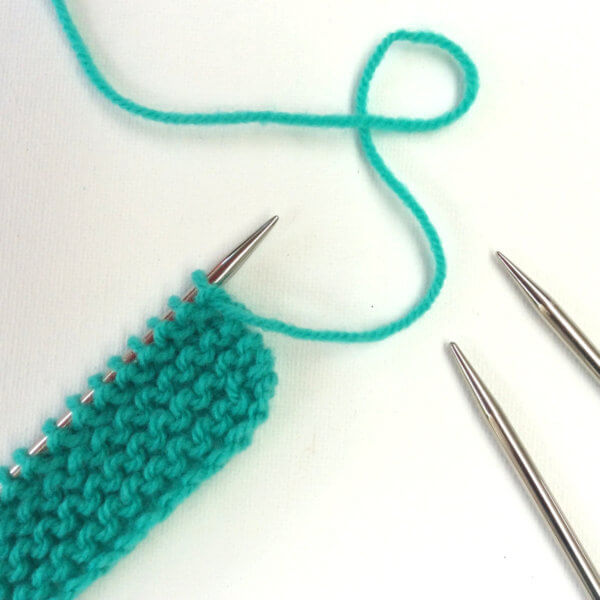
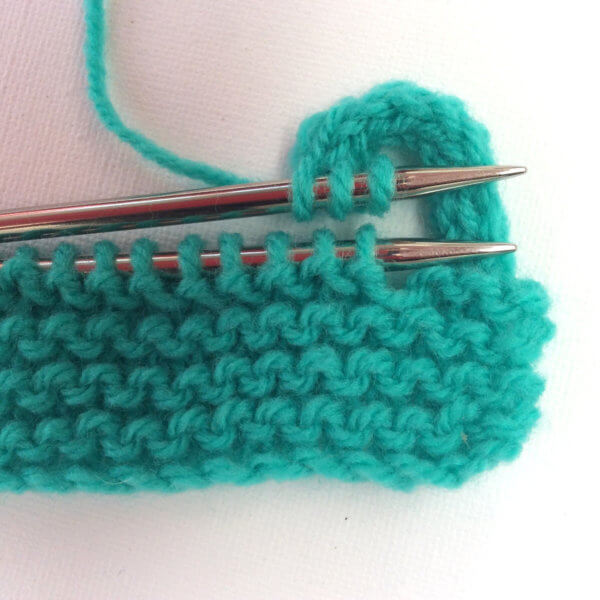
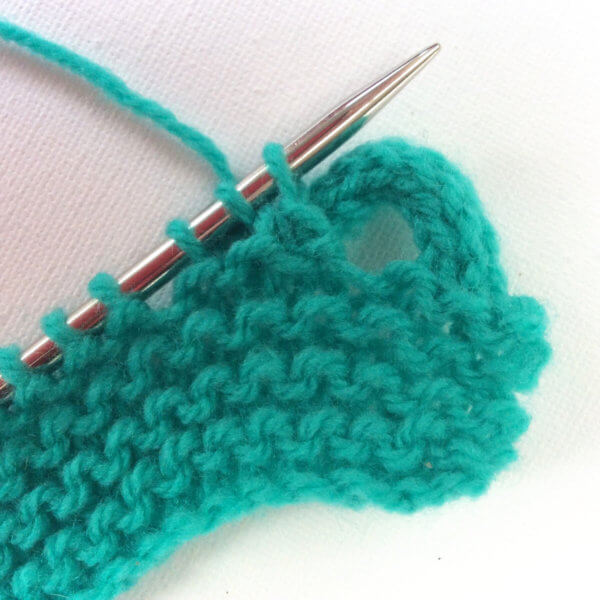
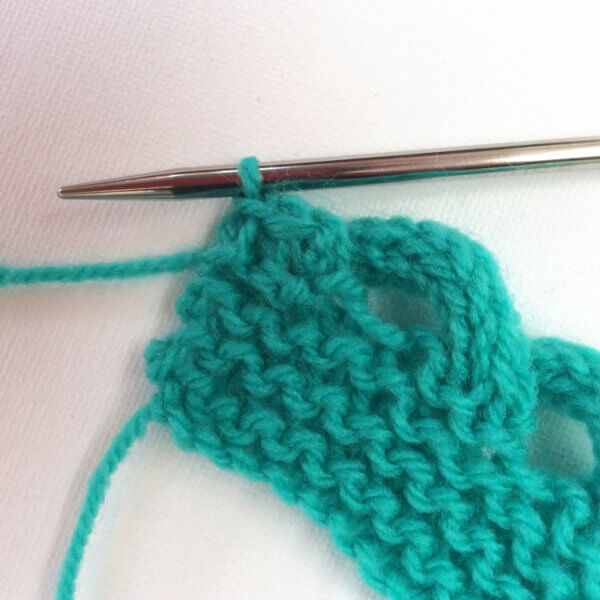
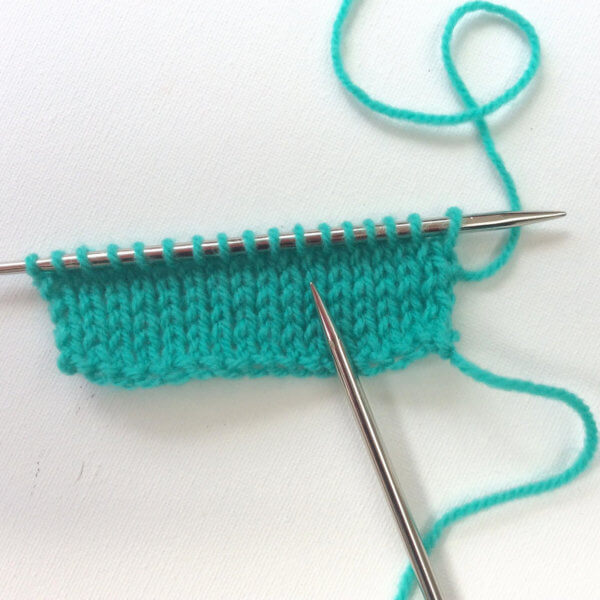
1. Use the first 3 stitches on the left needle to knit regular i-cord. You can decide how long to make the cord, as long as it is equal for all loops. In this example I made cord with a length of 3.5 cm, which was 10 rows.

Knitting the loopy bind-off - a tutorial by La Visch Designs - www.lavisch.com

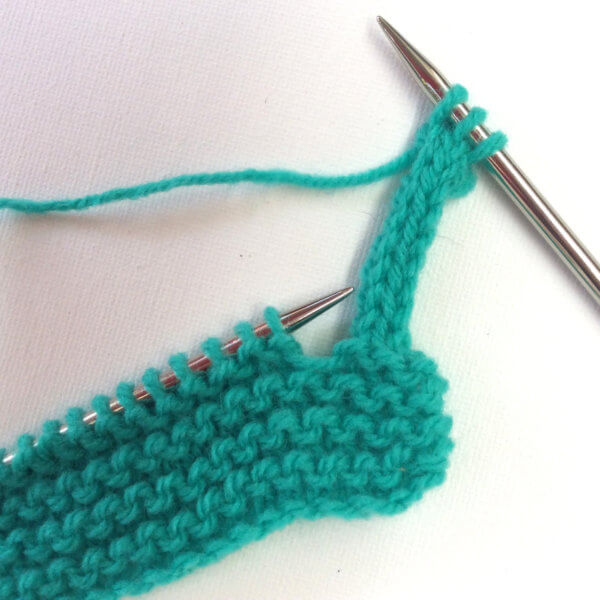
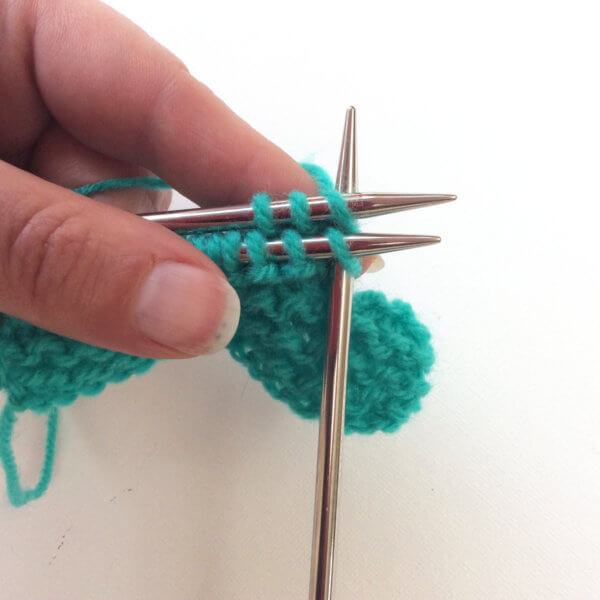
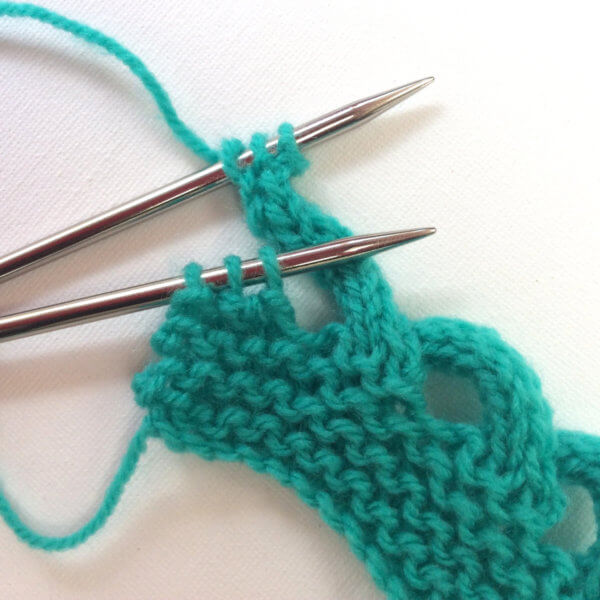
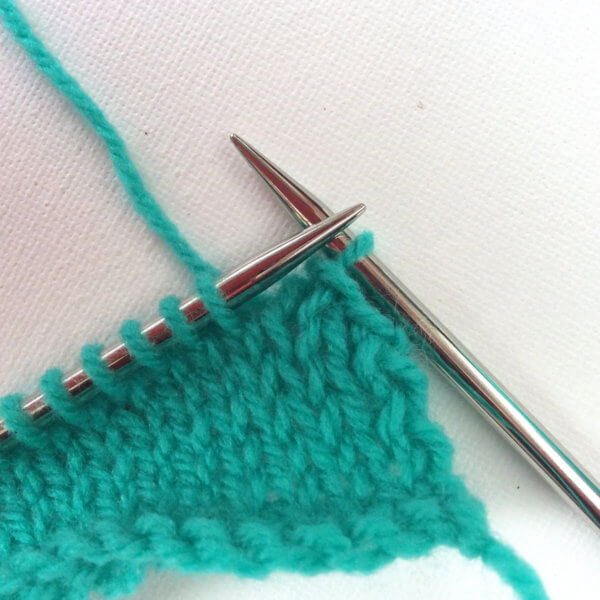
2. Next, bring the needle with the i-cord stitches parallel to the needle with the stitches to be bound off, by twisting it counterclockwise.

Knitting the loopy bind-off - a tutorial by La Visch Designs - www.lavisch.com

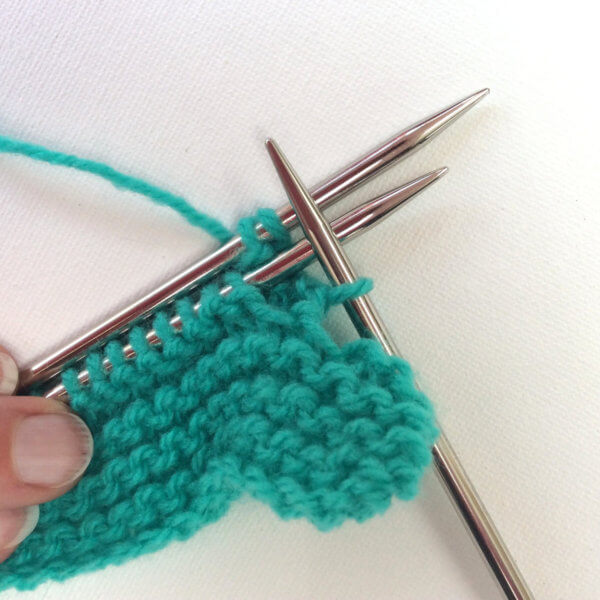
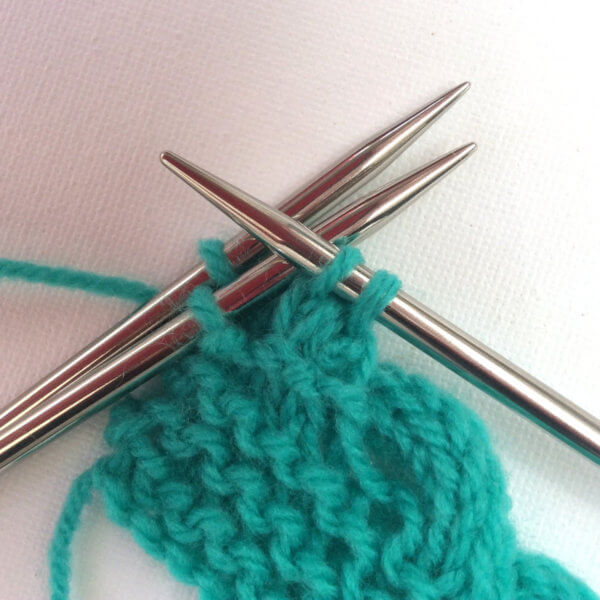
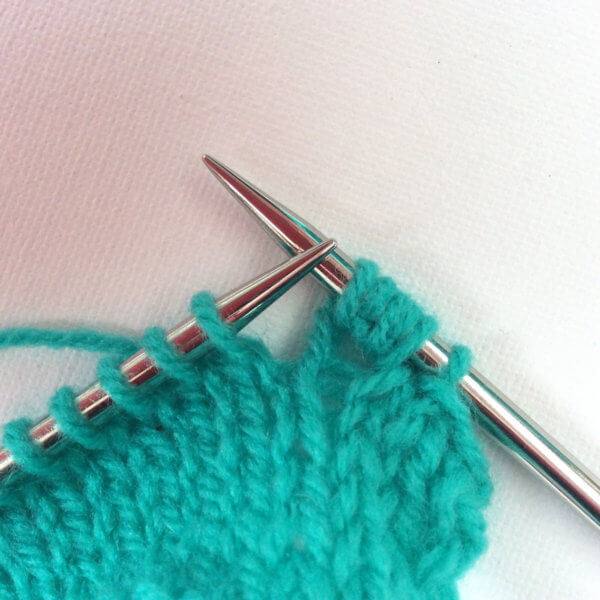
3. Insert the third needle into the first stitch on the front needle, then immediately also into the first stitch of the back needle. Wind the yarn around the needle as usual, pull the yarn through both stitches and then slip off the first stitch of both the front and back needle. This is really very similar to working a three-needle BO.

Knitting the loopy bind-off - a tutorial by La Visch Designs - www.lavisch.com

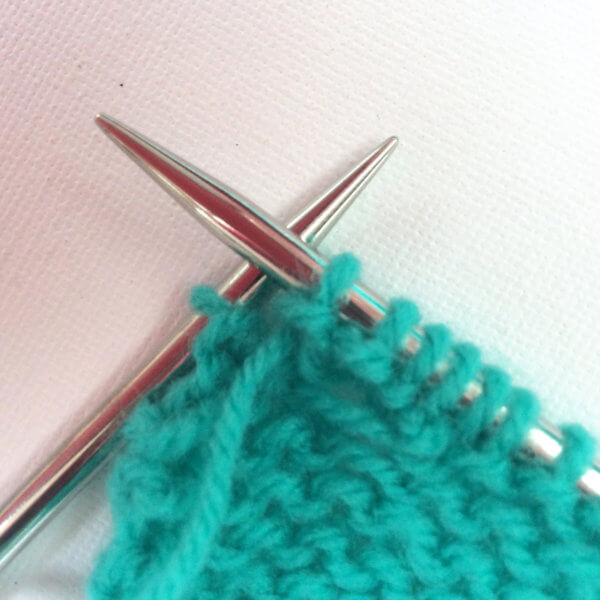
4. Repeat step 3 twice.

Knitting the loopy bind-off - a tutorial by La Visch Designs - www.lavisch.com

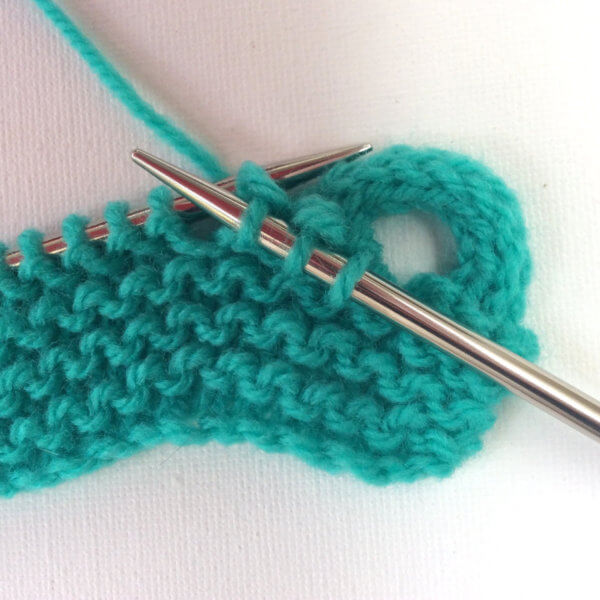
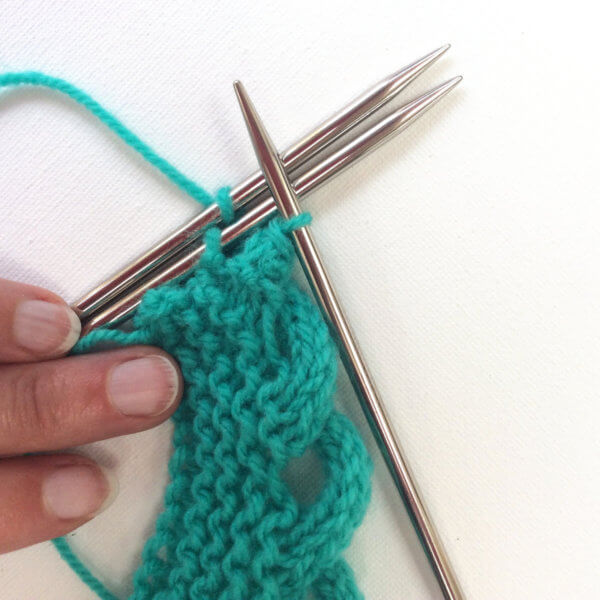
5. Next, slip the 3 newly knitted stitches back to the left-hand needle.

Knitting the loopy bind-off - a tutorial by La Visch Designs - www.lavisch.com

6. Repeat steps 1 to 5 until 3 stitches remain on the left-hand needle. Next, repeat steps 1 and 2 once more.

Knitting the loopy bind-off - a tutorial by La Visch Designs - www.lavisch.com

7. Work step 3 twice, you now have 2 stitches on the right-hand needle.

Knitting the loopy bind-off - a tutorial by La Visch Designs - www.lavisch.com

8. Pass the first stitch over the second stitch, you now have 1 stitch remaining on the right-hand needle.

Knitting the loopy bind-off - a tutorial by La Visch Designs - www.lavisch.com

9. Repeat step 3 once more, followed by 1 repetition of step 8. All stitches are now cast off, you can now cut the yarn and pull the tail through the last loop.

Knitting the loopy bind-off - a tutorial by La Visch Designs - www.lavisch.com

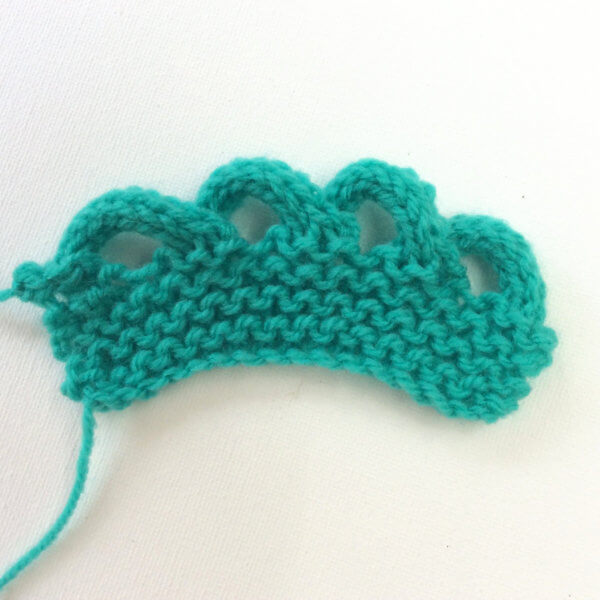
This is how the loopy bind-off edge will look like on the right side of the work:

Knitting the loopy bind-off - a tutorial by La Visch Designs - www.lavisch.com

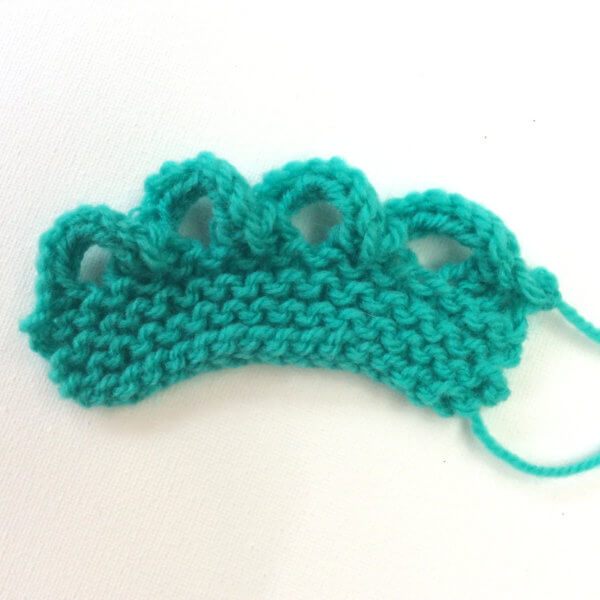
And this is how it looks on the wrong side of the work:

Knitting the loopy bind-off - a tutorial by La Visch Designs - www.lavisch.com

Depending on the desired effect you can use either the right or wrong side of this bind-off.

And that is all there is to it!

tutorial: knitting the loopy bind-off Read More »
tutorial: knitting a bobble bind-off

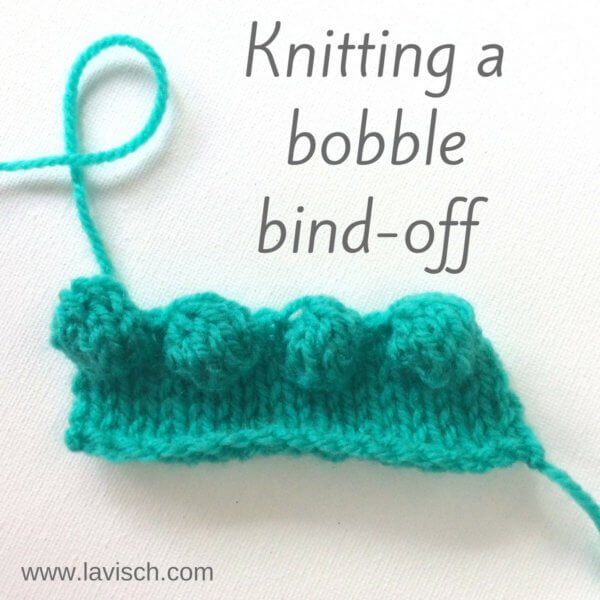
Bobble bind-off tutorial by La Visch Designs - www.lavisch.com

In a previous blog I’ve already shown you how to cast on your knitting project with decorative bobbles. Of course we also want to know how to knit the matching bobble bind-off. You never know when it comes in handy!

There are many different types of bobbles possible for this application. However, you want a reasonably “fat” bobble for the best result, because these makes the bobble “pop” better.

In short an instruction for such a bobble would will be as follows:

Bobble of 5 stitches: Work [k1, yo, k1 , yo, k1] all in the same st. Turn work, p1, p1 tbl, p1, p1 tbl, p1. Turn and k5. Turn work, and p5. Turn work, k5, * pass second st on the right hand needle over the first stitch; rep from * until 1 st remains – 1 bobble made.

Below I’ll show you step by step how this looks when used at the bind-off edge of your knitting.

Knitting a bobble bind-off step by step

1. Your project is ready and you want to bind-off. First of all, make sure you’re using a multiple of 4+1 stitches plus any edge stitches. In this example I’m using a multiple of 4 + 1 + 2×2 edge stitches for both sides of the work. The 4 stitches consist of 1 stitch for every bobble and 3 stitches distance between each bobble.

Bobble bind-off tutorial by La Visch Designs - www.lavisch.com

2. Make sure you are on the right side of the work and knit 2 stitches. Next pass the second stitch on the right-hand needle over the first stitch to cast it off.

Bobble bind-off tutorial by La Visch Designs - www.lavisch.com

3.In the next stitch we will be making a bobble as follows: Work [k1, yo, k1 , yo, k1] all in the next stitch, without sliding it off prematurely. You now have 6 stitches on the right hand needle, we will knit the bobble over 5 of them.

Bobble bind-off tutorial by La Visch Designs - www.lavisch.com

4. Turn work, p1, p1 tbl, p1, p1 tbl, p1. The “p tbl” stitches are worked that way to close up the yo’s of the previous row. This will make the resulting bobble smoother, this may require some practice!

Bobble bind-off tutorial by La Visch Designs - www.lavisch.com

5. Turn work and knit 5 stitches.

Bobble bind-off tutorial by La Visch Designs - www.lavisch.com

6. Turn work and purl 5 stitches.

Bobble bind-off tutorial by La Visch Designs - www.lavisch.com

7. Turn work again and knit 5 stitches.

Bobble bind-off tutorial by La Visch Designs - www.lavisch.com

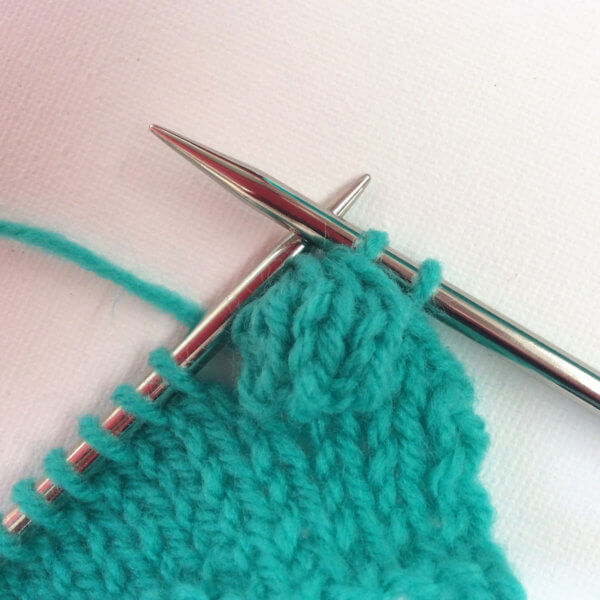
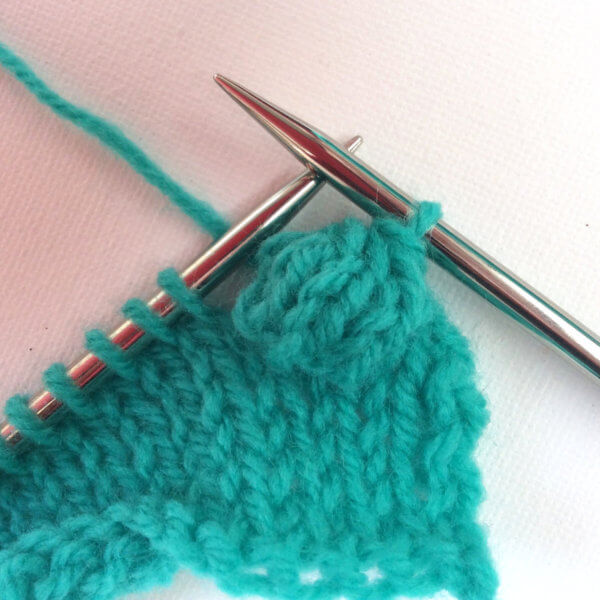
8. Now pass the second stitch on the right hand needle over the first stitch, repeat this until only 1 of the 5 bobble stitches remains. You have now created one bobble! You can push it out a bit to the right side of the work to show it to its best advantage. There are now only 2 stitches left on your right hand needle.

Bobble bind-off tutorial by La Visch Designs - www.lavisch.com

9. Next pass the second stitch on the right-hand needle over the first stitch to cast it off.

Bobble bind-off tutorial by La Visch Designs - www.lavisch.com

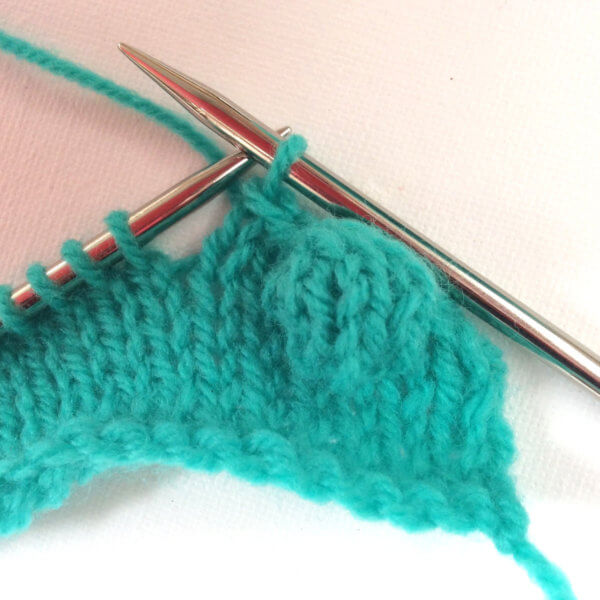
10. Knit one stitch and again pass the second stitch on the right-hand needle over the first stitch to cast it off. Repeat two more times to bind off 3 stitches in total.

Bobble bind-off tutorial by La Visch Designs - www.lavisch.com

11. Repeat steps 3 to 10 until 3 stitches on the left-hand needle remain.

Bobble bind-off tutorial by La Visch Designs - www.lavisch.com

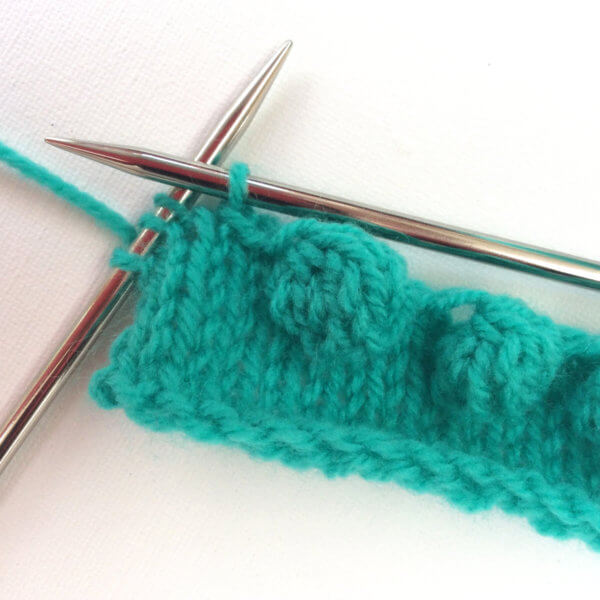
12. Repeat steps 3 to 9 once more to knit the last bobble and end with binding off the 2 edge stitches.

Bobble bind-off tutorial by La Visch Designs - www.lavisch.com

And this is how the bobble bind-off is done!

tutorial: knitting a bobble bind-off Read More »
tutorial: knitting a bobble cast-on

Bobble cast-on tutorial by La Visch Designs - www.lavisch.com

In the series of decorative ways to cast-on a knitting project, I present here the bobble cast-on method. You’re probably already familiar with bobbles as a way to give an interesting 3D texture to your knitting. I used it myself for that purpose in my Moerbei shawl design. It is also possible to make bobbles right on the cast-on edge. Officially, the bobble cast-on is not a “real” cast-on method, because you already cast-on and knit a row before you start the actual bobbles. However, this should not spoil the fun!

To be honest, the only difference between regular bobbles and the bobbles with a bobble cast-on, is that they are knit on the edge of the work. There are many different types of bobbles possible for this application, however, you want a reasonably “fat” bobble for the best result.

In short an instruction for such a bobble would be as follows:

Bobble of 5 stitches: Work [k1, yo, k1 , yo, k1] all in the same st. Turn work, p1, p1 tbl, p1, p1 tbl, p1. Turn and k5. Turn work, and p5. Turn work, k5, * pass second st on the right hand needle over the first stitch; rep from * until 1 st remains – 1 bobble made.

Below I’ll show you step by step how this looks when used at the cast-on edge of your knitting.

Knitting a bobble cast-on step by step

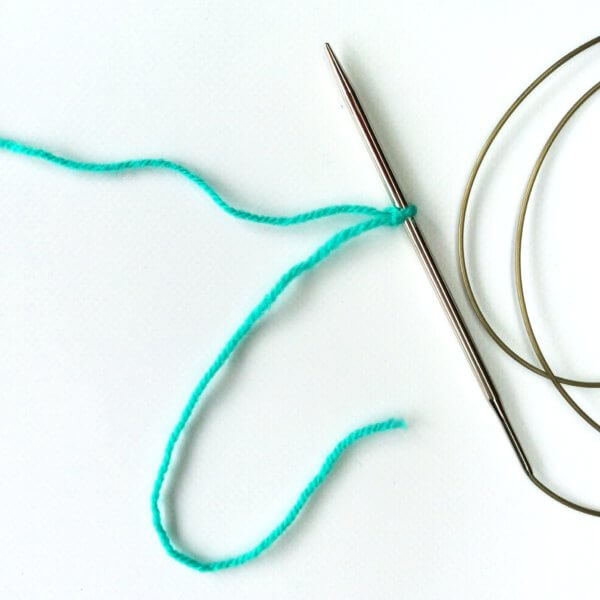
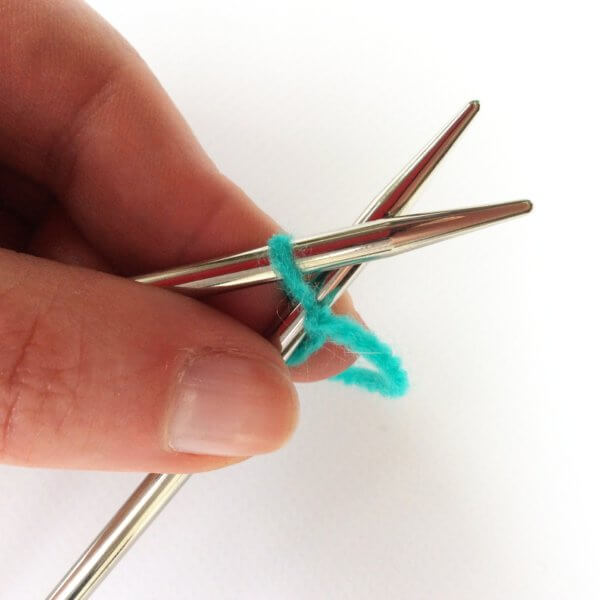
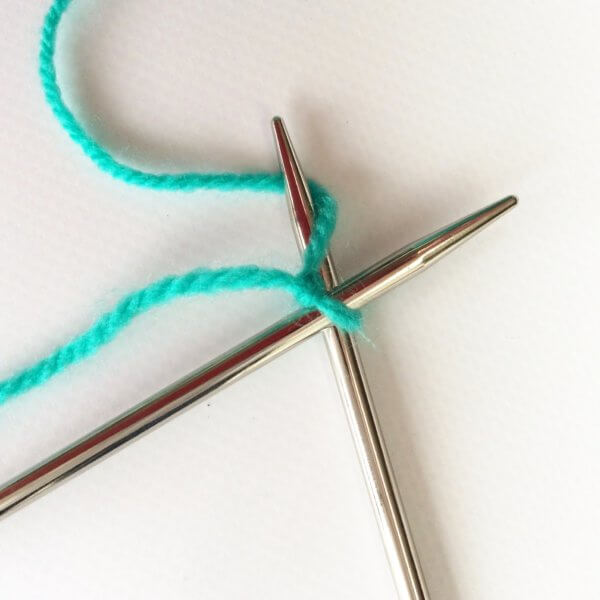
1. Cast-on the required number of stitches, here I used a multiple of 4 + 1 + 2×2 edge stitches for both sides of the work. The 4 stitches consist of 1 stitch for every bobble and 3 stitches distance between each bobble. To cast-on I used the knitted-on method, but any other method would work.

Bobble cast-on tutorial by La Visch Designs - www.lavisch.com

2. Purl 1 row and turn the work.

Bobble cast-on tutorial by La Visch Designs - www.lavisch.com

3. Knit 2 stitches for the edge to the side.

Bobble cast-on tutorial by La Visch Designs - www.lavisch.com

4. Work [k1, yo, k1 , yo, k1] all in the next stitch, without sliding it off prematurely. You now have 7 stitches on the right hand needle, we will knit the bobble over 5 of them.

Bobble cast-on tutorial by La Visch Designs - www.lavisch.com

5. Turn work, p1, p1 tbl, p1, p1 tbl, p1. The “p tbl” stitches are worked to close up the yo’s of the previous row. This will make the outside surface of the resulting bobble smoother, this may require some practice!

Bobble cast-on tutorial by La Visch Designs - www.lavisch.com

6. Again turn your work and knit 5 stitches.

Bobble cast-on tutorial by La Visch Designs - www.lavisch.com

7. Next, turn work and purl 5 stitches.

Bobble cast-on tutorial by La Visch Designs - www.lavisch.com

8. Turn work again and knit 5 stitches.

Bobble cast-on tutorial by La Visch Designs - www.lavisch.com

9. Now pass the second stitch on the right hand needle over the first stitch, repeat this until only 1 of the 5 bobble stitches remains. There are now only 3 stitches left on your right hand needle. You have now created one bobble! You can push it out a bit to the right side of the work to show it to its best advantage.

Bobble cast-on tutorial by La Visch Designs - www.lavisch.com

10. Next knit the 3 stitches which I had chosen as the distance between the bobbles.

Bobble cast-on tutorial by La Visch Designs - www.lavisch.com

11. Repeat steps 4 to 10 until only 3 stitches remain on the left hand needle.

Bobble cast-on tutorial by La Visch Designs - www.lavisch.com

12. Repeat steps 4 to 9 once more for the last bobble and finish with knit 2 for the second set of edge stitches.

Bobble cast-on tutorial by La Visch Designs - www.lavisch.com

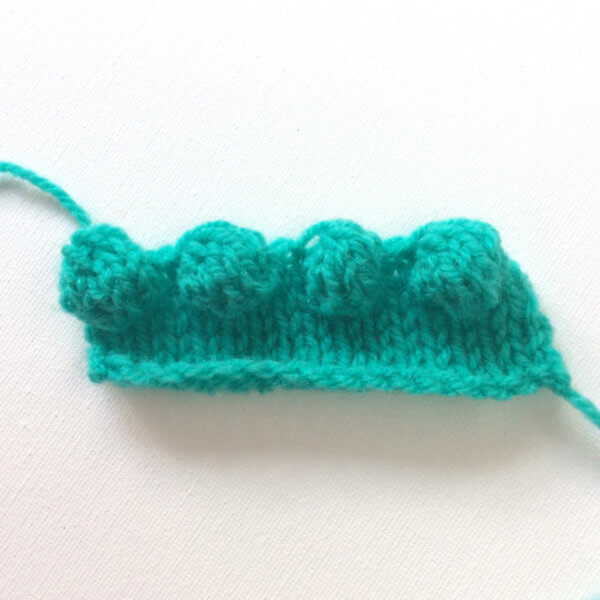
With this your bobble cast-on is finished!

This is how it looks after a few more rows in stockinette have been knit.

Bobble cast-on tutorial by La Visch Designs - www.lavisch.com

Pretty, isn’t it?

Stay tuned for the tutorial on the matching bobble bind-off!

tutorial: knitting a bobble cast-on Read More »
tutorial: knitting the i-cord bind-off

Knitting the i-cord bind-off - a tutorial by La Visch Designs - www.lavisch.com

In a previous post I’ve already shown you how to cast-on your knitting project with an i-cord cast-on. And of course it would be nice to be able to bind-off with a matching i-cord bind-off finishing. Fortunately, we can!

The i-cord bind-off is usually knit over 3 to 5 stitches. In this example I’m going to show the version made over 3 stitches. In short, instructions would look something like this:

I-cord bind off: Cast-on 3 sts, *k2, k2tog tbl, sl 3 sts just worked back to LH needle, pull yarn tight across back of sts; rep from * until 3 sts remain.
Next: K2tog tbl, k1, sl 2 sts to LH needle, k2tog tbl and fasten off.

The i-cord bind-off step by step

You can start casting off as soon as the last row of your work has been knit, and after your work has been turned when working flat back and forth.

1. With the right side facing, cast-on 3 stitches. I used the knitted-on method.

Knitting the i-cord bind-off - a tutorial by La Visch Designs - www.lavisch.com

2. Knit 2 stitches.

Knitting the i-cord bind-off - a tutorial by La Visch Designs - www.lavisch.com

3. Knit 2 stitches together through the back loop.

Knitting the i-cord bind-off - a tutorial by La Visch Designs - www.lavisch.com

4. Move the 3 stitches on the right needle back to the left hand needle one by one.

Knitting the i-cord bind-off - a tutorial by La Visch Designs - www.lavisch.com

5. Pull the yarn tight and make sure that it is behind your work.

Knitting the i-cord bind-off - a tutorial by La Visch Designs - www.lavisch.com

6. Repeat steps 2 to 5 until 3 stitches to bind-off remain.

Knitting the i-cord bind-off - a tutorial by La Visch Designs - www.lavisch.com

7. Knit 2 stitches together through the back loop.

Knitting the i-cord bind-off - a tutorial by La Visch Designs - www.lavisch.com

8. Knit 1 stitch.

Knitting the i-cord bind-off - a tutorial by La Visch Designs - www.lavisch.com

9. Move the 2 stitches on the right needle back to the left hand needle one by one.

Knitting the i-cord bind-off - a tutorial by La Visch Designs - www.lavisch.com

10 Knit 2 remaining stitches together through the back loop and fasten off.

Knitting the i-cord bind-off - a tutorial by La Visch Designs - www.lavisch.com
The “ear” where the yarn was fastened off, can be reduced by using a tapestry needle to pull it into the i-cord tube. Front and back of the work then look as follows:

Knitting the i-cord bind-off - a tutorial by La Visch Designs - www.lavisch.com

Knitting the i-cord bind-off - a tutorial by La Visch Designs - www.lavisch.com

Tip 1

It can be very nice to knit the i-cord bind-off in a contrasting color to the rest of your project. It may however happen, that the main color shines through in the i-cord BO. To avoid that, I would recommend to first knit a row in the contrast color, before starting the i-cord bind-off.

Tip 2

An i-cord bind-off edge on a piece worked in stockinette stitch is very pretty. As you know however, stockinette tends to curl…. A lot. An i-cord bind-off is usually not sufficient to prevent curling. For this you will have to look at other methods, such as garter stitch or rib. So if you purely want the effect of a stockinette stitch edge to your work, you better have a look at a folded hem.

tutorial: knitting the i-cord bind-off Read More »
tutorial: knitting an i-cord cast-on

Knitting the i-cord cast-on - a tutorial by La Visch Designs

Lately, I have all sorts of methods to cast on my knitting projects on my mind. Some I have already shared with you, think for example of the folded hem, the two-color cast-on, the picot cast-on, the provisional crochet cast-on and of course the Latvian twist. In this post, I want to show you how to knit an i-cord cast-on.

I-cord is usually knit over 3 to 5 stitches. In this example, I’m going to make an i-cord cast-on based on 3 stitches. In short, the instruction would be as follows:

I-cord CO: Cast-on 4 sts. k4, sl 4 sts just worked back to the LH needle, * kfb in next st, k3, sl 4 sts just worked back to the LH needle; rep from * until the desired number of sts has been achieved, plus 3 sts. Next: (k2tog) twice, sl 2 st back to LH needle, k2tog.

Knitting the i-cord cast-on step by step

1. Cast on 4 stitches, in this example I used the knitting-on method.

Knitting the i-cord cast-on - a tutorial by La Visch Designs

2. Knit 4 stitches.

Knitting the i-cord cast-on - a tutorial by La Visch Designs

3. Slip the 4 newly knitted stitches back to the left-hand needle one by one.

Knitting the i-cord cast-on - a tutorial by La Visch Designs

4. Knit the next stitch in front loop and then in the back loop before sliding the off the stitch just worked. Tighten your yarn a bit.

Knitting the i-cord cast-on - a tutorial by La Visch Designs

5. Knit 3 stitches.

Knitting the i-cord cast-on - a tutorial by La Visch Designs

6. Slip 4 stitches back to the left-hand needle one by one.

Knitting the i-cord cast-on - a tutorial by La Visch Designs

7. Repeat steps 4 to 6 until you have the desired number of stitches plus 3.

Knitting the i-cord cast-on - a tutorial by La Visch Designs

8. Knit 2 stitches together, twice.

Knitting the i-cord cast-on - a tutorial by La Visch Designs

9. Slip 2 stitches back to the left needle.

Knitting the i-cord cast-on - a tutorial by La Visch Designs

10. Knit these 2 stitches together.

Knitting the i-cord cast-on - a tutorial by La Visch Designs

Now your cast-on is ready and you can start the rest of your project!
This is how it looks at the front and back of the piece:

Knitting the i-cord cast-on - a tutorial by La Visch Designs

Notes

For a less “rounded” corner, you can also choose to omit steps 8 to 10. In the last repeat of step 6, slip only 3 stitches back to the left-hand needle and bind these off.

To use this cast-on method for a project knitted in the round, you can also choose to omit steps 8 to 10. In the last repeat of step 6, slip only 3 stitches back to the left-hand needle instead of 4 stitches and place those on a bit of waste yarn. Afterward you can then graft these stitches together with the starting stitches for a seamless connection of the i-cord edge.

This cast-on method also has a matching bind-off!

Patreon logo

Thanks to my Patreon supporters for bringing you this freebie! Creating quality patterns and tutorials is a lot of work and resource-intensive. However, I find it important to give you free content like this tutorial. Thanks to the generous support of my Patreon supporters, I can make it happen. Thank you, patrons! Click here to join, or click here to read more about La Visch Designs on Patreon.

tutorial: knitting an i-cord cast-on Read More »
tutorial: knitting the small flower stitch

Knitting the small flower stitch - A tutorial by La Visch Designs - www.lavisch.com

Lately I have found myself attracted to stitches that give the fabric a lovely texture. A prime example is the small flower stitch. This stitch is unusual in the sense that it combines decreases with smartly placed elongated knit stitches. It can of course be worked both flat and in the round.
In this post I’ll show you how to work the small flower stitch as a flat piece working back and forth.

The small flower stitch step by step

1. The small flower stitch looks best on a background of stockinette stitch, therefore I have prepared a small stockinette swatch for this example. When planning your project it is good to realise that the flower stitch itself uses 4 stitches and looks best if there are at least 2 normal stitches in between the flowers.

Knitting the small flower stitch - A tutorial by La Visch Designs - www.lavisch.com

2. Start by knitting to the place where you want the first flower to be.

Knitting the small flower stitch - A tutorial by La Visch Designs - www.lavisch.com

3. Next, knit the following 2 stitches together to decrease 1 stitch with a right leaning decrease.

Knitting the small flower stitch - A tutorial by La Visch Designs - www.lavisch.com

4. Next, work a left leaning decrease over the following 2 stitches. I like to use skp, but ssk can of course also be used if preferred.

Knitting the small flower stitch - A tutorial by La Visch Designs - www.lavisch.com

5. Knit the stitches separating the flowers (in my case 2 stitches), work another k2tog and skp and knit to end.

Knitting the small flower stitch - A tutorial by La Visch Designs - www.lavisch.com

6. Work 1 row plain in stockinette, in my flat worked swatch this means purling a row. When working in the round, this would of course be a knit round.

Knitting the small flower stitch - A tutorial by La Visch Designs - www.lavisch.com

7. Again work to the spot where you want to place the flower, in my case 4 stitches into the row.

Knitting the small flower stitch - A tutorial by La Visch Designs - www.lavisch.com

8. Now make an elongated knit stitch by inserting the right-hand needle into the space between the next 2 stitches (the k2tog and skp) under the second thread down. This is the thread that runs between the 2 stitches. Next knit 1 stitch into that space. Because this stitch is 2 rows down, you have to pull up quite a loop when making this stitch.

Knitting the small flower stitch - A tutorial by La Visch Designs - www.lavisch.com

9. This looks something like this:

Knitting the small flower stitch - A tutorial by La Visch Designs - www.lavisch.com

10. Next, knit 2 stitches. These are the stitches directly above the k2tog and skp knit earlier.

Knitting the small flower stitch - A tutorial by La Visch Designs - www.lavisch.com

11. This step can be a bit tricky, because it is a bit hard to see. But is really not that bad when you get the hang of it. Do you see the spot in the fabric where the elongated stitch from step 9 is coming from? Insert your right hand needle into that very same space and knit another elongated stitch.

Knitting the small flower stitch - A tutorial by La Visch Designs - www.lavisch.com

12. Again knit the stitches in between flowers, than repeat steps 8 to 11 to make more flowers. Next knit to end.

Knitting the small flower stitch - A tutorial by La Visch Designs - www.lavisch.com

13. Finish your first row of flowers by working a couple of rows in stockinette stitch.

Knitting the small flower stitch - A tutorial by La Visch Designs - www.lavisch.com

And this is how the small flower stitch looks in a larger project (this is a snapshot of my Stellaria cowl, worked in Moeke Yarns Elena):

A tutorial by La Visch Designs - www.lavisch.com

In this example I have offset the second row of flowers. However, you can of course also put the flowers directly above previous flowers.

tutorial: knitting the small flower stitch Read More »
knitting i-cord

Knitting i-cord - a tutorial by La Visch Designs - www.lavisch.com

You’re probably familiar with those cute French knitting dolls. With the doll I had as a child, I probably made dozens and dozens meters of cord. At that time the making of just the cord itself was enough, nowadays I really only use cord when needed in addition to another project. Think of straps or closures for wrap cardigans.

Nowadays I don’t use French knitting dolls anymore for my cord needs: I make cord with just my knitting needles. This type of cord is also know as “I-cord”, with the “I” standing for “idiot” because it is indeed idiotically easy to knit.

Most tutorials for i-cord indicate that double pointed needles or circular needles are needed. This is because after the setting up the stitches and the working the first row, the work is not turned. Instead the stitches are pushed to the other side (point) of the needle. However, this approach does not work if you want to attach the cord to an existing piece of knitting.
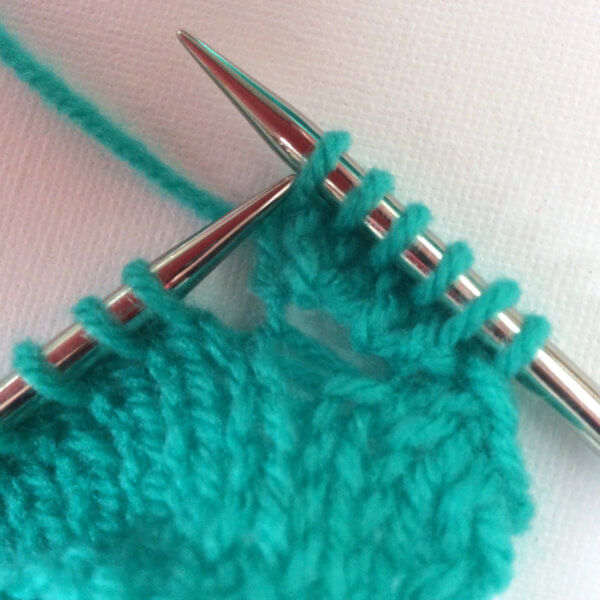
That’s why I’ll show you in this post how to knit an i-cord without the pushing around of stitches. With this method, you can also just use regular straight needles if you wish. I don’t, but that is just because I like knitting with circs better.

I-cord is usually knit over 3 to 5 stitches. In this example I’m going to make i-cord on 3 stitches. In short instruction would be as follows:

I-cord: Cast on 3 sts. *k 3, sl 3 sts just worked back on the LH needle, pull yarn tight across back of sts; rep from * to desired length.

Knitting i-cord step by step

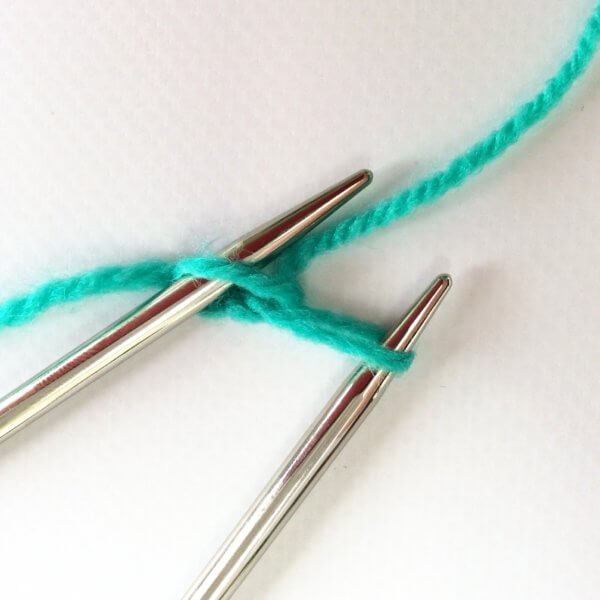
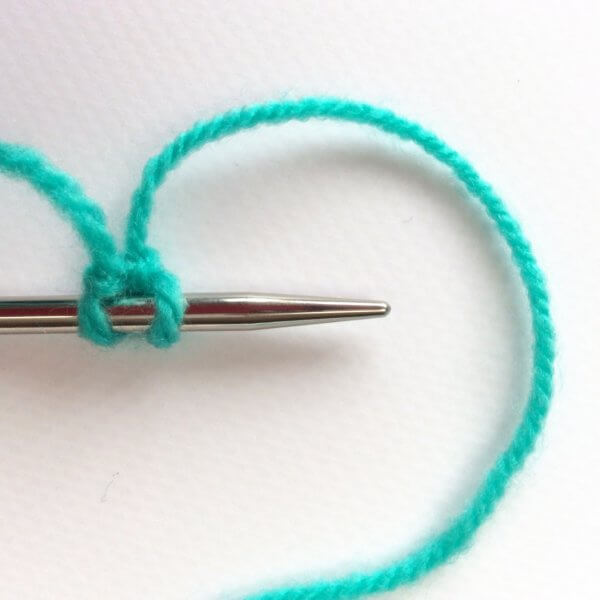
1. Cast on 3 stitches, in this example I used the knitting-on method.

Knitting i-cord - a tutorial by La Visch Designs - www.lavisch.com

2. Knit 1 row.

Knitting i-cord - a tutorial by La Visch Designs - www.lavisch.com

3. Slip the three newly knitted stitches back to the left hand needle one by one.
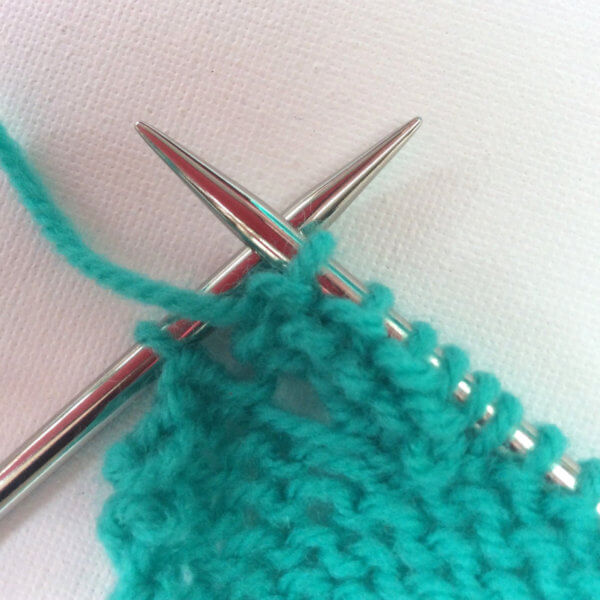
Knitting i-cord - a tutorial by La Visch Designs - www.lavisch.com

4. Pull the yarn tight and make sure it is behind the work.
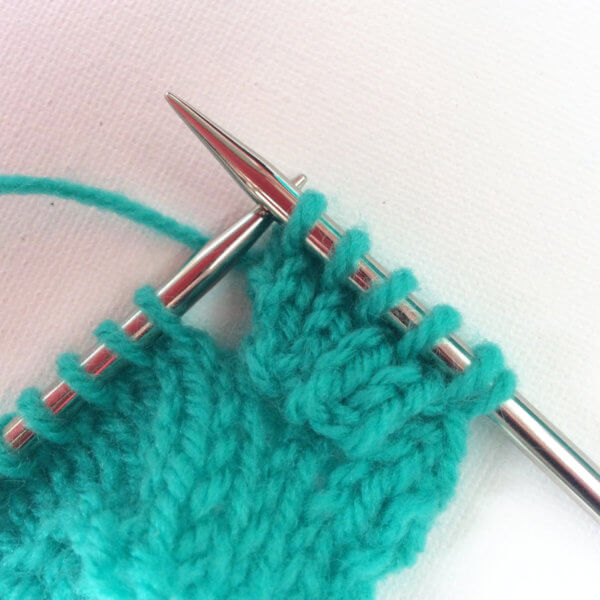
Knitting i-cord - a tutorial by La Visch Designs - www.lavisch.com

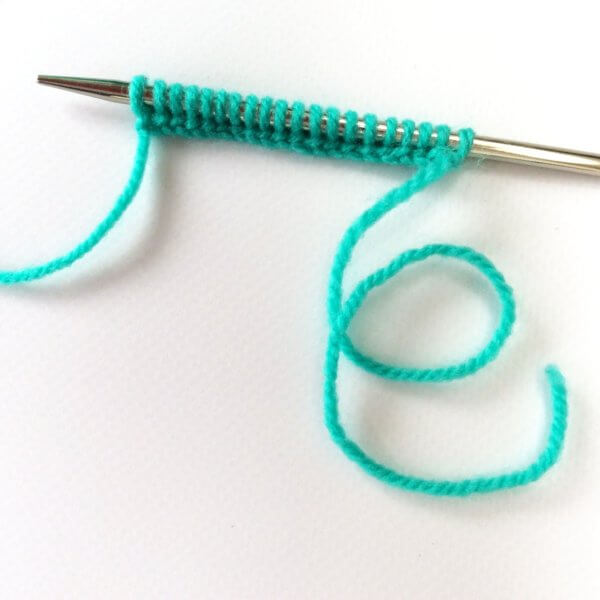
5. Repeat steps 2 to 4 until the cord has the desired length. In the picture below, I repeated these steps about 10 times.

Knitting i-cord - a tutorial by La Visch Designs - www.lavisch.com

Knitting i-cord is indeed, not too difficult, right?

knitting i-cord Read More »